Chicago Personal Injury Lawyer
Award-Winning Chicago Personal Injury Lawyer - Securing Justice
for Illinois Injury Victims - Over $450 Million Recovered



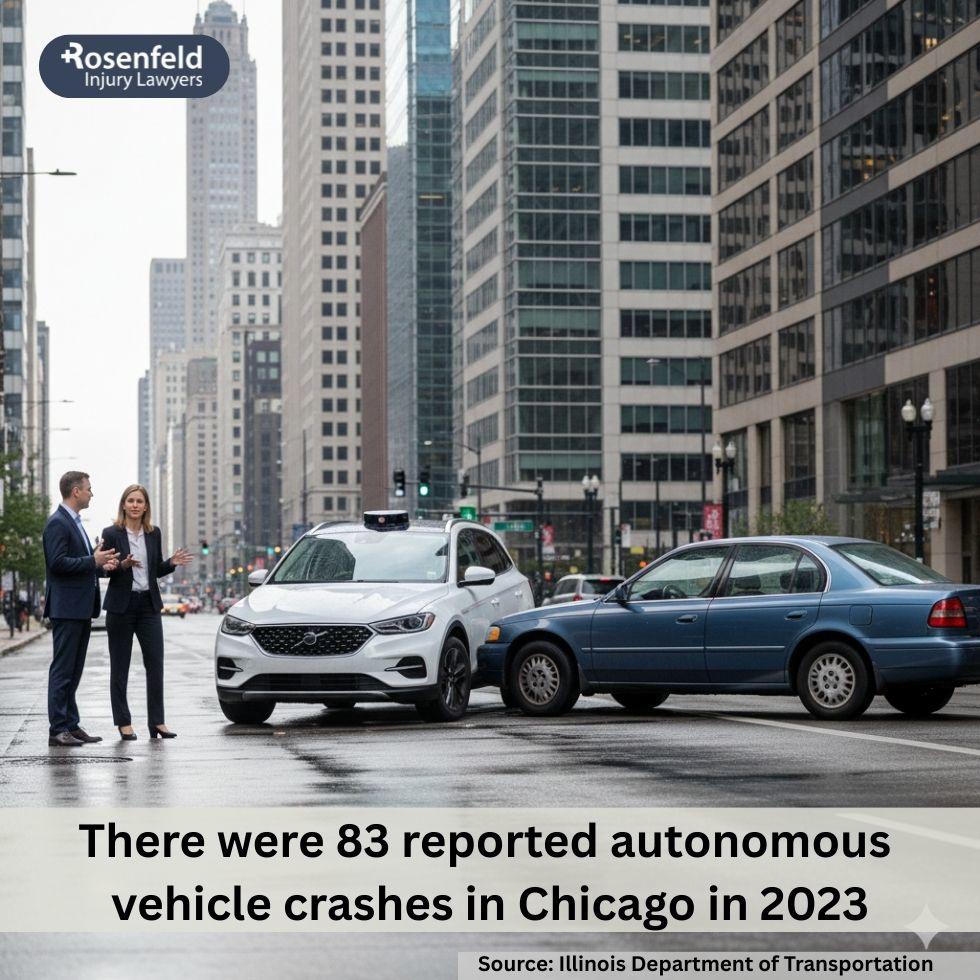
Autonomous vehicles are growingly common, as artificial intelligence makes it possible to deliver packages or transport passengers without human intervention. However, this poses legal challenges that are not present in traditional vehicle accidents. A Chicago self-driving car accident attorney from Rosenfeld Injury Lawyers can guide you through the process of determining liability and securing fair compensation after these unique accidents.
Contact us today for a free consultation about collisions involving self-driving technology.
$5,250,000: Sam was riding his motorcycle along 79th Street when he was hit by an autonomous vehicle making a turn. He suffered from a leg amputation. A thorough investigation revealed that the human operator did not take control of the vehicle when automatic braking failed.
$1,600,000: Susan was stopped at the Cicero Avenue and I-55 interchange when she was rear-ended, resulting in a spinal injury. Our attorneys showed that the driver had not turned off cruise control after exiting I-55. Rear-end collisions caused by excessive speed or failure to adjust speed for traffic conditions may require assistance from a Chicago Speeding Car Accident Lawyer to establish liability and pursue full compensation.
$1,100,000: Julio, a toddler living in Lincoln Park, wandered into the street and was struck by a self-driving car. We demonstrated that the autonomous system did not identify him due to his height and that the human driver had failed to maintain control of his vehicle. Accidents involving children or young pedestrians often raise additional liability concerns, and families may seek guidance from a Chicago Teen Driver Accident Lawyer when inexperience or failure to react plays a role.
The average payout for a self-driving car accident is $1,415,083. Factors that determine a fair settlement include your medical expenses, lost wages, available evidence, and liable parties.
Zuhey Cobos, 37, a courier, was involved in a multi-vehicle collision when a driverless flatbed tow truck rolled down an incline, pushing her into the opposite lane of traffic. She was then hit by a pickup truck going around 25 mph. Cobos tore both rotator cuffs and required several surgeries to manage her pain. Cobos sued the auto manufacturer, as it was determined that the emergency brake failed, and several other responsible parties. She recovered $3,382,000.00.
Erika Thomas, a young mother of four, was struck by Tesla driver Brian Lee Shechtman, causing her to spin out and suffer severe spinal cord injuries. Shechtman argued that he did not have legal responsibility, as a “phantom driver” caused the accident. The victim’s legal representation found witnesses who disputed this and gathered evidence demonstrating that Shechtman had been eating at the time of the accident. While Teslas do have autonomous features, they require human input and are not entirely autonomous. A jury awarded Thomas $2,856,231.15.
Though vehicle manufacturers began exploring autonomous vehicles in the 1980s, the first commercial self-driving car entered the market in 2014. Waymo started offering self-driving car services in 2015, and by 2020, it operated cars with fully autonomous features and no backup drivers.
During this period, the State of Illinois issued an executive order to support driverless car technology, acknowledging that human error is one of the largest contributors to car accidents (Executive Order Number 13-18). IDOT now has an autonomous vehicle testing initiative to better study and implement regulations for these technologies.
The state also amended the Illinois Vehicle Code to prohibit local governments from enacting legislation that would prohibit self-driving cars on their motorways (625 ILCS 5/11-208).
According to the Illinois Department of Transportation, fully autonomous vehicles require human supervision, as they are only legal if there is a licensed human driver available to take control if necessary (625 ILCS 5/6-101).
Self-driving cars must still follow all the rules of the road, including Chicago’s 30 mph speed limit on terrestrial roads (9-12-070) and indicating turns with turn signals (9-16-020).
Illinois uses modified comparative negligence to assign liability (735 ILCS 5/2-1116). This means that every party to the suit is assigned a percentage of blame. You can sue for damages if you are less than 50% responsible, but your compensation will be reduced in proportion to your assigned blame. For example, if you were considered 25% responsible, you would receive 25% less than if you were entirely blameless.
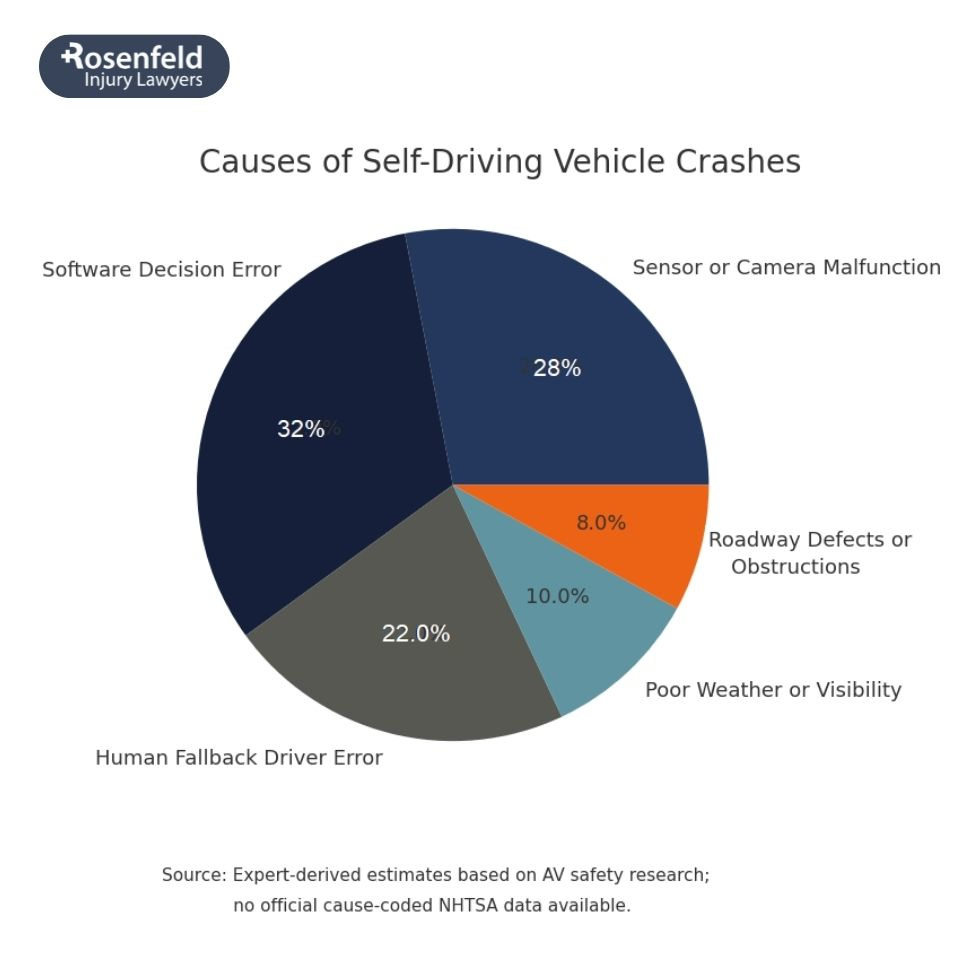
Assigning liability requires a thorough evaluation of the accident. Witness statements, police officer interpretations, surveillance footage, and vehicle data can help to uncover potential causes and types of negligence. With a self-driving car accident, potentially liable parties can include the following.
Driver: While self-driving cars may have helpful features, they require frequent human intervention. Drivers can be held liable for failing to supervise their cars, distracted driving, and overreliance on automation.
Car Manufacturer: Autonomous vehicle manufacturers like Tesla have been hit with numerous lawsuits regarding false representations of their autopilot features, which have contributed to multiple accidents. A skilled lawyer from our team can hold these companies accountable for defective designs, insufficient warnings, and LIDAR/radar malfunctions.
Software Developers: Proving liability of software developers involves reviewing sensor development, software malfunctions, and defective design.
Parts Manufacturers and Repair Shops: These vehicles often require aftermarket parts, replacement sensors, or specialized repairs. If parts defects contributed to the crash, then these organizations can be held liable.
Fleet Operators: Operators of delivery robots and self-driving test vehicles can be liable parties if inadequate training, poor vehicle maintenance, or failure to comply with state testing agreements (Executive Order Number 13-18) contributed to the car accident. In these cases, victims often benefit from working with experienced Chicago car accident lawyers who can evaluate all potential sources of liability.
Municipalities: Self-driving cars struggle with faded lane markings, unmapped construction zones, and temporary traffic patterns. An experienced attorney can prove fault in accordance with the Illinois Tort Immunity Act (745 ILCS 10/). In some self-driving car accidents, the responsible party may leave the scene before liability is fully established. This can occur when a human operator disengages from the vehicle, a test driver panics, or responsibility between the driver and the autonomous system is unclear. In these situations, victims may need assistance from a Chicago Hit And Run Lawyer to investigate the crash, identify all liable parties, and preserve critical evidence.
Per the Illinois Supreme Court case Laue v. Leifheit, the Illinois Joint Tortfeasor Contribution Act means that multiple parties can be held responsible for a personal injury claim (740 ILCS 100/2).
The Illinois statute of limitations for personal injury claims is two years (735 ILCS 5/13-202). For fatal self-driving car accident cases, you have two years from the date of death to file a lawsuit (740 ILCS 180/). Prompt action is essential for securing compensation, so contact us as soon as possible for a free case review.
Our Chicago personal injury lawyers are renowned for thorough case reviews and aggressive negotiation. We start by collecting information about your claim and determining what type of case you may have. Our team will calculate your potential damages and identify potentially liable parties.
The investigation process involves analyzing a variety of resources, including surveillance footage, police reports, and medical records. We’ll consult with accident reconstructionists to recreate the accident scene, which can help determine liability.
Autonomous vehicle experts can provide an unbiased perspective on how self-driving technology, such as LIDAR or sensors, may have contributed to the crash. Once this is complete, we will file a claim with the Circuit Court of Cook County.
We’ll then negotiate with insurance companies to recover compensation for lost income, medical bills, and physical pain and suffering.
While many cases settle out of court, it is sometimes necessary to take your claim to trial. With a 98% success rate and a Super Lawyers® distinction, you can be assured the best possible chances of fair compensation.
We work on a contingency fee basis: no fees unless we win. Contact Rosenfeld Injury Lawyers for a free, no-obligation consultation by calling (888) 424-5757 or using our online contact form.
Sources: Law.com