
Chicago Personal Injury Lawyer
Award-Winning Chicago Personal Injury Lawyer - Securing Justice
for Illinois Injury Victims - Over $450 Million Recovered



After an Amazon delivery accident, many people hear the same message from an insurance company or claims adjuster: “That driver does not work for Amazon.” It sounds like a dead end, especially when the crash involved a blue Amazon-branded van or a contracted white van delivering Amazon packages on a tight route.
The problem is structural. Amazon relies on delivery service partners and small LLCs to run local deliveries while trying to avoid direct responsibility when an accident happens. The goal is to point to independent contractors, say the company is separate, and argue Amazon should not be held liable.
But the reality of Amazon delivery looks very different on the street. Amazon sets the rules of the route, sets the pace, and measures performance in real time.
In many cases, Amazon has complete control over how the delivery driver works, how fast the Amazon driver moves, and what the day must look like to meet quotas. That control is exactly what we use when determining liability and identifying the responsible parties.
If you were injured in an accident involving an Amazon delivery driver, do not accept the “not us” defense at face value. Your legal options may be stronger than they are making it sound.
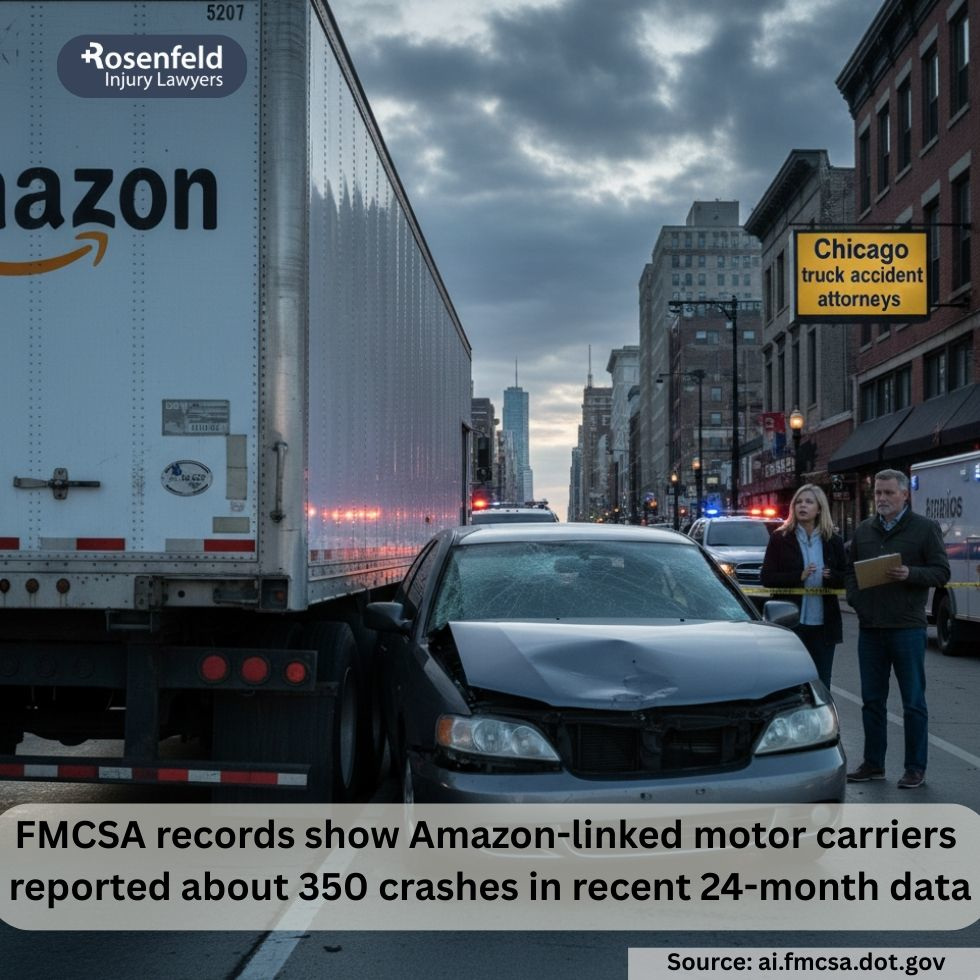
Amazon’s legal model depends on one thing: keeping corporate defendants at arm’s length. When a person is hit by a delivery driver, Amazon often leans on independent contractor status and argues the driver works for a separate business. That argument is designed to avoid liability.
Our job is to test the facts. In many situations, the key question is not what the contract calls the relationship. The key question is control.
To challenge the “independent” label, our Chicago truck accident attorneys focus on how Amazon delivery operates day to day. We look at whether Amazon or its systems controlled the route, the expectations, and the performance metrics that shaped the driver’s behavior.
This is where we show that Amazon has control over DSP drivers and that the supposed independence is more marketing than reality. When a driver is monitored for speed, braking, and route adherence, and when the work is structured around constant tracking and compliance, the relationship can look far less like true independence.
This is also where concepts like employment status and joint employer analysis can matter in certain circumstances. If the evidence shows Amazon exercised significant control over the operation, that becomes leverage in establishing liability and pushing back against efforts to avoid liability.
Another strategy is demonstrating that the driver functioned as an agent of the corporate system. If Amazon’s structure directs the route, dictates quotas, and oversees performance, we can argue that Amazon should be held responsible for the conduct of the drivers running its routes. The purpose is direct liability and direct responsibility, not finger-pointing between layers of companies.
The bottom line is simple. If Amazon wants the benefits of controlling the work, it cannot deny responsibility when accidents involving its delivery vehicles cause harm.
The “last mile” is where Amazon delivery becomes a safety problem. Local deliveries are timed, tracked, and measured, and that pressure shows up in predictable crash patterns.
Unrealistic delivery windows can push drivers to speed, park illegally, and rush through residential streets and commercial corridors. We see accidents involving hurried turns, sudden stops, unsafe backing, and risky maneuvers in tight spaces. We also see issues like distracted driving when drivers are navigating app prompts, scanning, and trying to stay on pace.
It is not about one bad person. It is about a system that rewards speed and makes it easy to cut corners.
Amazon DSP operations often rely on high-volume hiring and rapid turnover. The training and screening can look very different from traditional commercial carrier standards. Many drivers are not CDL drivers, yet they operate large delivery vehicles in dense neighborhoods with constant time pressure. When the required training is rushed or inconsistent, the risk increases, and liability questions grow sharper.
In an Amazon delivery crash, the evidence is not limited to the police report. The most important proof is often digital, time-stamped, and controlled by the company. That is why early legal action matters.
Amazon’s handheld device and app activity can create a detailed record. We demand data showing whether the driver was active on the route at the moment of impact, where the vehicle was located, and how the route progressed leading up to the crash.
GPS logs can help establish the timeline, speed trends, and route compliance. In many accident cases, that data supports fault analysis and strengthens the claim.
Many Amazon delivery vehicles have in-cab cameras or outward-facing systems that capture events before and during the crash. Video can reveal whether the driver was following too closely, rolled through a red light, failed to yield, or was distracted. It can also rebut defenses that blame the injured person. When a crash happens, this footage can be one of the fastest paths to clarity.
We also examine Amazon contracts and the relationship between delivery service partners DSPs, the parent company, and any third-party vendors involved. The insurance story is often layered, and the first explanation you hear is not always the full picture. We track the insurance coverage, identify the correct insurance parties, and prevent the responsible entities from shifting blame sideways.
This is part of determining liability in a way that supports fair compensation and a complete accounting of injuries, medical care, and future needs.
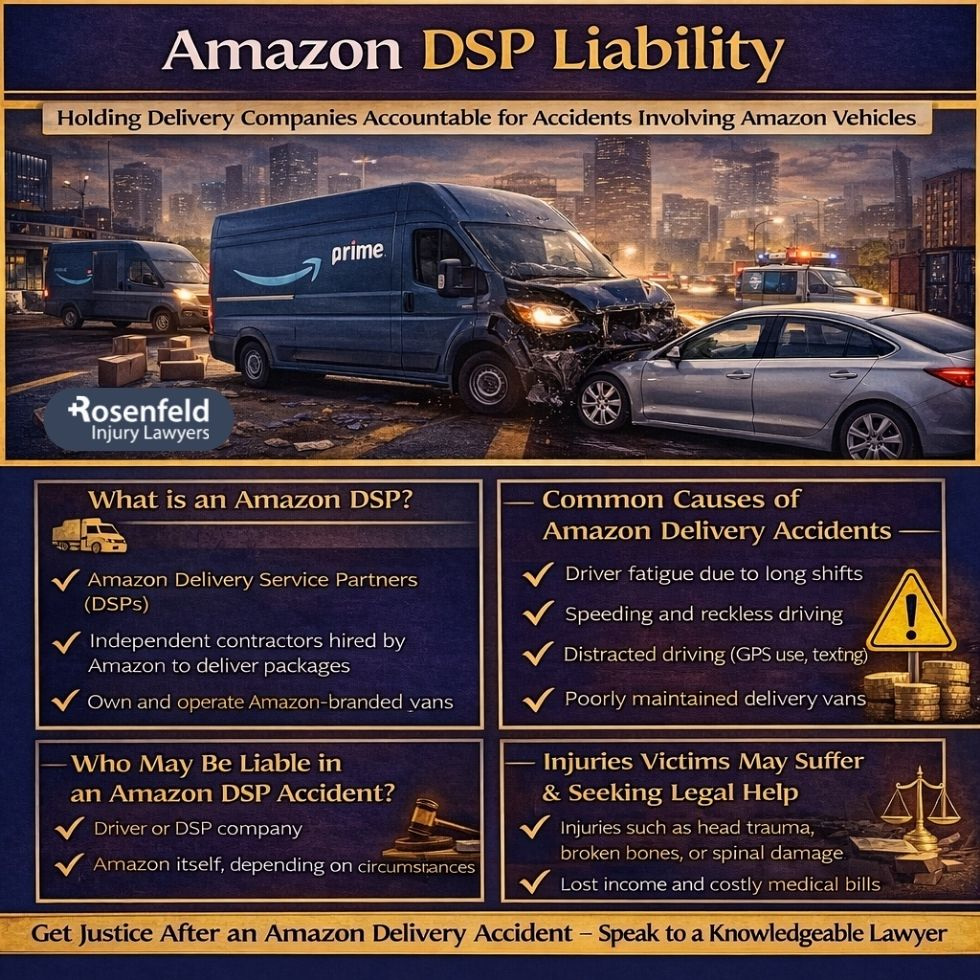
Truck and delivery crashes can cause more than visible injuries. Many accident victims are injured in ways that take time to show, including concussions, back injuries, and joint damage. A strong claim should reflect the real consequences.
Depending on the facts, compensation can include medical care costs, future treatment, lost earnings, and the broader impact of injuries on daily life. The goal is maximum compensation that matches what the accident caused, not what the insurance adjuster is trying to close the file for.
Do not let Amazon hide behind a small LLC. We fight to hold Amazon responsible when an accident was caused by failing to meet safety standards, rushing routes, or a system that pushes DSP drivers and employees past safe limits.
If you were injured by an Amazon delivery driver in Chicago, contact our legal team for legal help and a free consultation. We move quickly to preserve the evidence, demand the data Amazon controls, identify the corporate defendants, and pursue the responsible parties.
Contact us today to consult a Chicago personal injury lawyer.
All content undergoes thorough legal review by experienced attorneys, including Jonathan Rosenfeld. With 25 years of experience in personal injury law and over 100 years of combined legal expertise within our team, we ensure that every article is legally accurate, compliant, and reflects current legal standards.