

Chicago Personal Injury Lawyer
Award-Winning Chicago Personal Injury Lawyer - Securing Justice
for Illinois Injury Victims - Over $450 Million Recovered



A crash with an ABF Freight truck in Chicago often happens in the places where freight work gets complicated: dock approaches, tight industrial turns, and stop-and-go lanes where a tractor-trailer has no margin for a sudden brake check.
ABF operates as an LTL carrier, so its exposure is shaped by repeated terminal runs and city deliveries, not a single uninterrupted highway trip.
When you’re hurt, the case usually turns on identifying the correct tractor and trailer, preserving the stop-by-stop timeline, and securing the equipment history that shows whether the truck was safe to be on the road.
If you need a Chicago ABF Freight System truck accident lawyer who knows how to build an LTL collision case around records and logistics realities, Rosenfeld Injury Lawyers is ready to help.
ABF Freight System is a long-established less-than-truckload carrier associated with a terminal-based network that moves palletized freight through scheduled pickups, transfers, and local delivery routes.
That business model produces a distinct evidentiary footprint: dispatch routing, terminal activity records, trailer assignment logs, and freight documentation that can confirm what the truck was doing before the crash.
In a serious injury claim, the questions are concrete: which unit was assigned, how the run was sequenced, whether the trailer configuration or load placement affected handling, and what the inspection and maintenance history shows for tires, brakes, and other safety-critical components.
| ABF FREIGHT SYSTEM INC – Safety Snapshot | |
|---|---|
| USDOT Number | 82866 |
| Mailing Address | 3801 Old Greenwood Road, Fort Smith, AR 72903 |
| Telephone | (800) 755-6486 |
| Website | https://arcb.com/shippers/solutions/less-than-truckload/abf-freight |
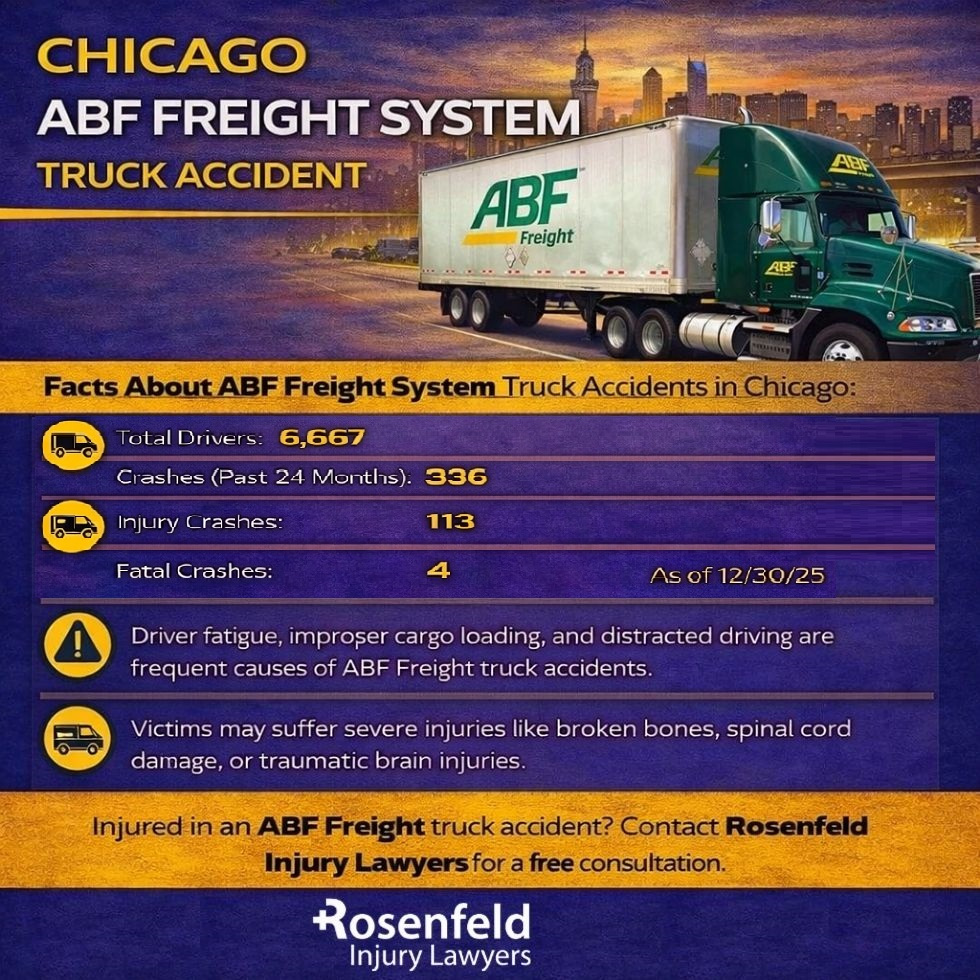
| Total Power Units | 4,604 |
| Total Drivers | 6,667 |
| Crashes (Past 24 Months) | 336 |
| Injury Crashes | 113 |
| Fatal Crashes | 4 |
| Date | 12/30/25 |
Crash litigation against a national LTL carrier often comes down to accountability in real-world conditions: lane positioning, following distance, and how a commercial driver responds when traffic compresses. The cases below involve ABF Freight System truck accident settlements and lawsuits.
In Breeden v. ABF Freight System, a jury concluded ABF was negligent in a crash sequence that began when an ABF tractor-trailer struck the victims’ vehicle from behind as it was attempting a left turn.
The jury set total damages at $561,906.00 and apportioned fault at 10% to ABF Freight and 90% to the other driver. The plaintiffs previously settled with the other driver for approximately $17,000.
After the victim was found 35% at fault, a verdict arose from a collision caused by an improper lane change involving a tractor-trailer owned by ABF Freight System, Inc. The reporting frames the case as a serious injury matter centered on how the lane change was executed and the impact that followed.
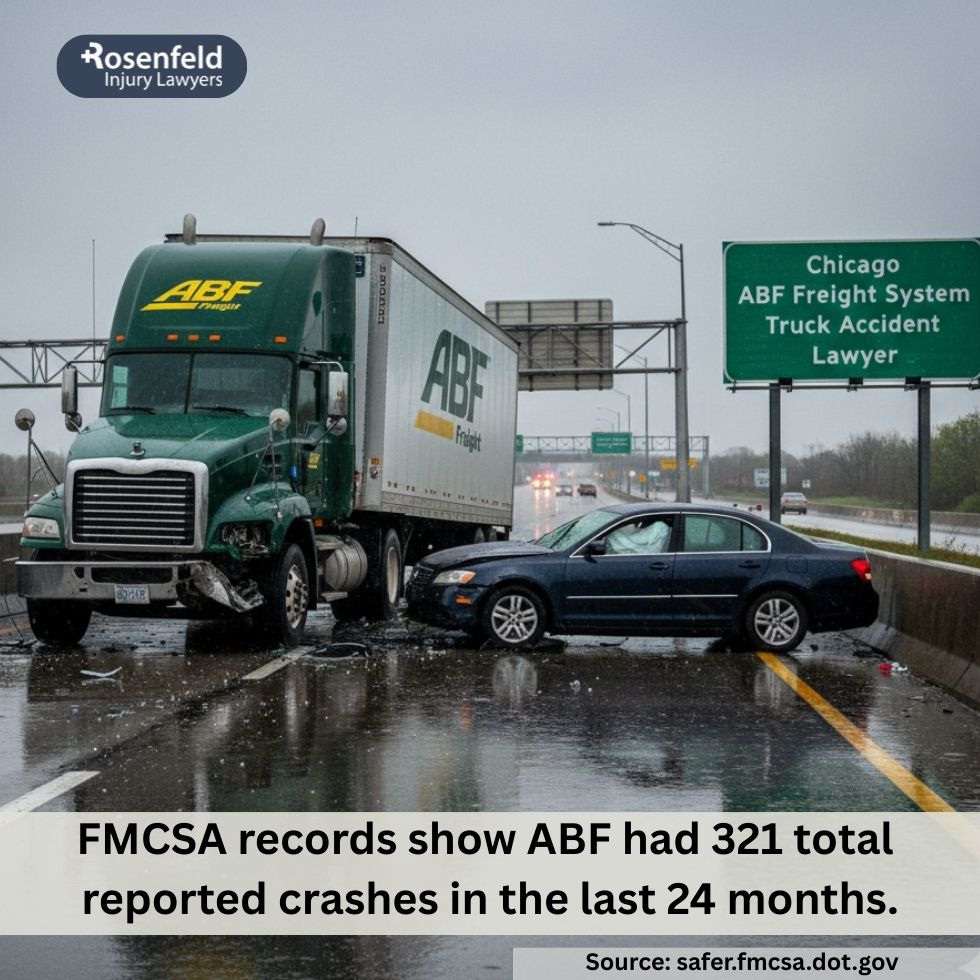
ABF Freight System runs a terminal-driven LTL model, which means its trucks are constantly moving between freight facilities and customer docks rather than staying on one continuous highway leg.
In a city like Chicago, that operational rhythm puts ABF equipment into the same constrained places over and over: industrial entrances with tight geometry, short staging lanes, and the last half-mile before an exit where a tractor-trailer has to be positioned correctly well in advance.
Because these runs are built around multiple handoffs and timed pickups, ABF-related crashes often reflect the practical tension between schedule expectations and the physical limits of a loaded truck in dense freight traffic.
ABF Freight operations typically generate an LTL-specific record set that can clarify what happened even when the driver’s account is incomplete. Freight paperwork and terminal routing can establish why the truck was in that corridor, what stops were on the run, and how the equipment was assigned across the shift.
On the equipment side, ABF cases often turn on whether the tractor and trailer were fit for service at the time they entered Chicago traffic.
The most probative materials are unit-specific: daily inspection reports, defect write-ups, repair tickets tied to the same tractor or trailer number, and service histories that show whether recurring issues were actually corrected or simply cycled through.
Chicago expressways punish late decisions by heavy vehicles.
ABF Freight trucks moving between terminals and industrial customers frequently have to set up early for interchanges, and the collision patterns reflect that reality: abrupt lateral moves near exit lanes, sideswipes when a trailer’s path drifts into an adjacent lane, and chain reactions triggered by hard braking when a truck tries to “make” a lane at the last second.
With LTL freight, injury risk is not confined to a roadway collision. The work requires repeated docking, backing, coupling, and threshold transitions where people are close to the equipment and the margin for error is thin.
In these incidents, the key issues are often basic and provable:
Some of the most violent trucking accidents begin with a mechanical problem rather than a driving maneuver. Tire failures and debris events are a prime example: a blowout can destabilize a truck, and debris entering a live lane can force sudden evasive moves that cause secondary collisions.
When the initiating event is an equipment failure, the case usually hinges on traceable proof: the condition of the specific tire position involved, the casing and retread history, service intervals, prior pressure or tread-separation notes, and whether the truck’s inspection entries match what the post-incident evidence shows.
ABF Freight truck accident cases often involve overlapping control of the equipment and the worksite. A trailer lessor may be responsible when unsafe equipment was supplied or when maintenance obligations were not met. A repair vendor can be implicated when a defect was missed or a fix did not address the underlying hazard.
Facilities and receivers can also contribute when their yard design, dock layout, or staging practices require unsafe backing movements or force trucks to enter and exit in ways that put the danger onto public roadways. In the right case, responsibility follows control, not branding.
Under 735 ILCS 5/13-202, Illinois generally gives truck accident victims two years to take legal action.
If an ABF Freight truck caused your injuries in Chicago, we can move quickly to secure vehicle identifiers, preserve carrier and terminal records, and build a clean timeline that supports liability and damages. Consult a Chicago personal injury lawyer from Rosenfeld Injury Lawyers before key documentation and video are recycled or lost.
All content undergoes thorough legal review by experienced attorneys, including Jonathan Rosenfeld. With 25 years of experience in personal injury law and over 100 years of combined legal expertise within our team, we ensure that every article is legally accurate, compliant, and reflects current legal standards.