

Chicago Personal Injury Lawyer
Award-Winning Chicago Personal Injury Lawyer - Securing Justice
for Illinois Injury Victims - Over $450 Million Recovered



An Amazon delivery crash in Chicago rarely looks like a “big-rig case” at first glance. It’s more often a step van cutting across a bike lane, a box truck double-parked near an intersection, or a delivery vehicle backing into a tight loading area with limited sightlines.
What makes these claims different is the delivery ecosystem behind the wheel: rapid route density, stop-by-stop timing pressure, and a patchwork of operators that can include Amazon-branded providers and independent contractors.
To build a real case, the first job is locking down identity and data. Vehicle markings, DSP affiliation, route and scan timestamps, telematics, and nearby camera footage can determine liability before an adjuster ever talks numbers.
If you need a Chicago Amazon truck accident lawyer who knows how to trace control and preserve the delivery record, Rosenfeld Injury Lawyers is ready to help.
Amazon’s delivery network in the Chicago area includes last-mile operations using branded vans and step vans, box trucks for larger routes, and linehaul transportation moving freight into and out of regional facilities.
Many local routes are operated through Delivery Service Partners, which means the company name on the side of the vehicle and the company responsible on paper are not always the same.
For injury claims, the operational details matter more than the logo: who employed the driver, who set the route expectations, what device data exists for the trip, and what policies governed driving, parking, and delivery practices on Chicago streets.
| AMAZON LOGISTICS INC – Safety Snapshot | |
|---|---|
| USDOT Number | 2881058 |
| Mailing Address | 207 Boren Ave, Seattle, WA 98109 |
| Telephone | (206) 529-5817 |
| Website | https://www.amazon.com/ |
| Total Power Units | 15,482 |
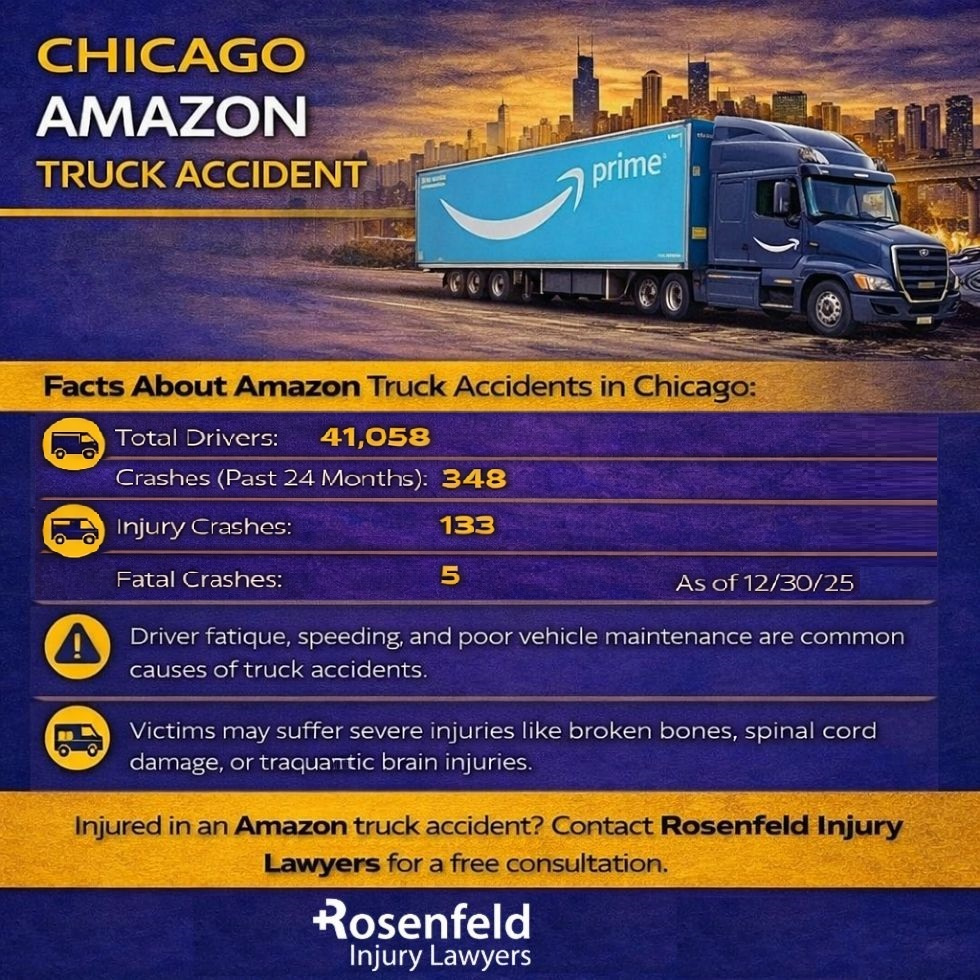
| Total Drivers | 41,058 |
| Crashes (Past 24 Months) | 348 |
| Injury Crashes | 133 |
| Fatal Crashes | 5 |
| Date | 12/30/25 |
Amazon delivery crashes that end in seven- and eight-figure verdicts tend to share the same theme: preventability becomes clear when the record shows what the driver did, what safety steps were missed, and what lasting harm followed. The cases below involve Amazon-branded delivery operations and reported verdict outcomes.
A jury returned a $16.2 million verdict against Amazon Logistics and a delivery service partner after a child was struck and run over by a delivery van.
The child was crossing a neighborhood street on an electric bike when the van pulled away from a stop, hit him, and ran over him. The injuries included a fractured pelvis and a degloving injury that required multiple skin grafts, leaving permanent scarring.
The largest share of fault was placed on Amazon, with additional fault attributed to the driver and a smaller share to a non-party neighbor, reducing the award. The verdict included $16 million for pain and suffering and roughly $200,000 for past medical expenses.
A jury returned a $105 million verdict for the family of a man killed when a commercial truck hauling Amazon freight rear-ended his vehicle. The truck was an 18-wheeler owned by All Points 360, LLC, described as operating within Amazon’s Middle Mile Delivery Service Partner structure.
The driver was not licensed, trained, or background checked, and the jury awarded $42 million in compensatory damages and $63 million in punitive damages. Other defendants in the same case resolved their exposure before the verdict for undisclosed amounts.
A jury awarded $5 million to a woman who was run over in a parking lot by an Amazon delivery vehicle. The case involved severe leg crush injury, neck and back injuries, and Complex Regional Pain Syndrome claimed as part of the damages.
Amazon did not dispute that she suffered a serious ankle and leg injury, but contested the Complex Regional Pain Syndrome claim and disputed the severity of the neck and back injuries.
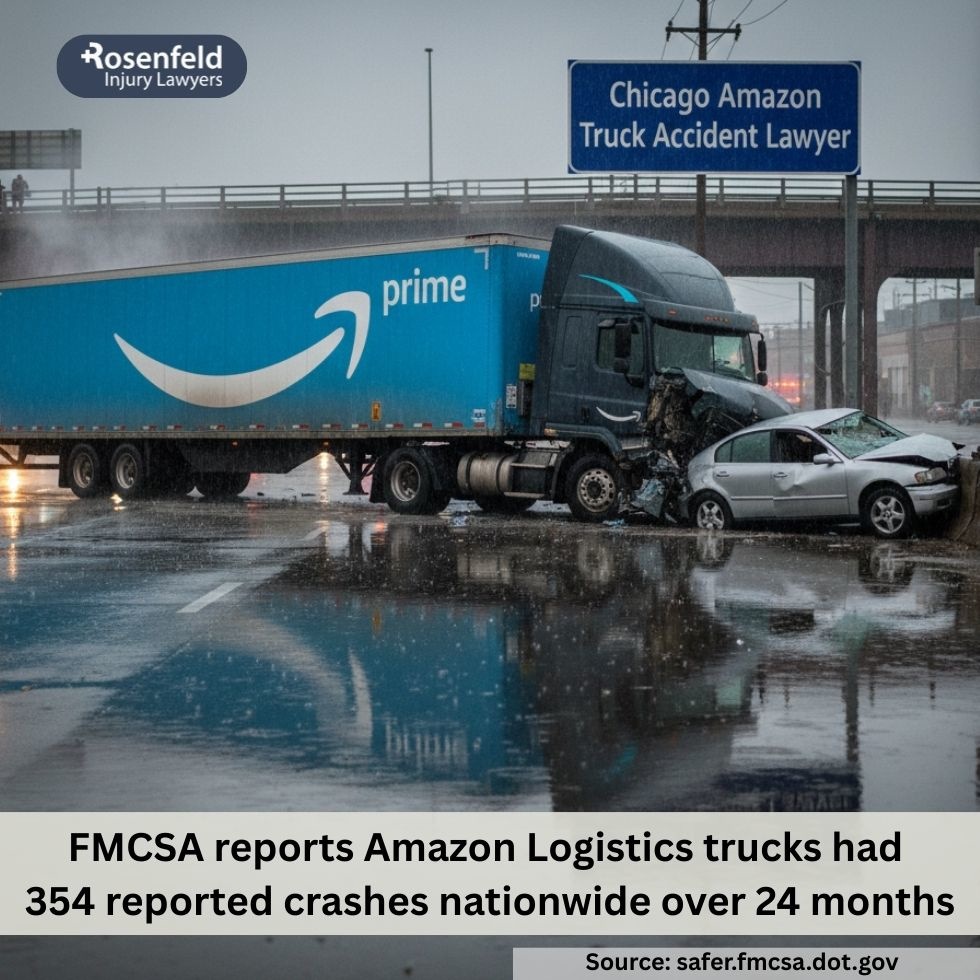
An “Amazon truck” in Chicago can mean very different things. Some crashes involve a last-mile van on a neighborhood route, while others involve middle-mile freight moving between facilities and handoffs. That distinction affects who controlled the driver, which company holds the trip records, and what policies governed the work on the day of the crash.
A Chicago truck accident lawyer has to identify the correct operating entity early because the name on the side of a vehicle is not always the company that hired, supervised, insured, or dispatched the driver.
Amazon delivery operations generate time-stamped data that can clarify liability when stories conflict. Route sequencing, scan timestamps, delivery event logs, and device location records can help establish where the vehicle was, how long it was stopped, and what it did immediately before impact.
In the right case, that record fills in the gaps that a crash report cannot, especially when a collision involves a curb pull-out, a backing maneuver, or a right turn where a pedestrian or cyclist had no room to escape.
Last-mile deliveries are often handled through Delivery Service Partners running Amazon-branded vans and step vans, with supervision and safety expectations tied to the delivery program.
Middle-mile moves can involve larger trucks hauling freight between facilities or to handoff points, sometimes through separate contracted carriers connected to Amazon’s freight structure.
These paths should not be blended. The evidence, the responsible entities, and the insurance structure often change depending on whether the crash happened during neighborhood delivery or freight transport.
Chicago’s street design creates predictable delivery hazards: narrow lanes, frequent curbside stops, tight right turns, and alleys that force drivers to reverse with limited visibility. Those conditions are most dangerous where foot traffic and bike traffic are dense and where vehicles are forced to stop mid-block to complete deliveries.
For freight movement, Chicago expressways concentrate exposure differently. The Dan Ryan Expressway (I-90/94), I-290, and the Stevenson Expressway (I-55) are common routes for trucks moving into and through the city, and the most severe crashes often follow sudden slowdowns, short merge zones, and lane compression near exits.
Many Amazon injury cases do not start with high speed. They start with a delivery maneuver. Double-parking can block sightlines. A quick curb departure can force a chain reaction. A right turn can squeeze a cyclist or pedestrian when the truck’s blind spots and swing path overlap a crosswalk or bike lane.
Backing incidents are another repeat pattern, especially in alleys, loading areas, and tight residential streets. These claims often depend on whether the driver had a clear view, whether a safe procedure was used, and whether the route forced unsafe stopping and reversing decisions.
Amazon-related cases often involve early efforts to narrow responsibility. Defenses may focus on separating the delivery operator from Amazon’s role, disputing control of the driver, or shifting blame to the injured person’s positioning at the moment of impact.
Damage disputes are also common. The defense may argue that symptoms are unrelated or exaggerated, particularly with head injuries, spinal injuries, and pain syndromes that evolve over time. The strongest claims are the ones built around medical documentation and a clear record of the delivery timeline.
Illinois generally gives injured people two years to file a personal injury lawsuit under 735 ILCS 5/13-202, but delivery cases can become harder to prove long before that deadline if route data and video are lost.
If an Amazon delivery vehicle caused your injuries in Chicago, we move quickly to identify the correct entities, preserve route and timing evidence, and build a clear account of how the crash happened. Contact a personal injury attorney before the delivery record fades and the defense controls the narrative.
All content undergoes thorough legal review by experienced attorneys, including Jonathan Rosenfeld. With 25 years of experience in personal injury law and over 100 years of combined legal expertise within our team, we ensure that every article is legally accurate, compliant, and reflects current legal standards.