

Chicago Personal Injury Lawyer
Award-Winning Chicago Personal Injury Lawyer - Securing Justice
for Illinois Injury Victims - Over $450 Million Recovered



After a serious collision with a Cardinal Logistics tractor-trailer in Chicago, the hardest part is often that the trucking operation behind the vehicle is not obvious from the logo. Cardinal frequently runs dedicated contract lanes for specific shippers, which can mean fixed routes, repeat facility movements, and schedule expectations tied to a customer’s supply chain.
When someone is injured, the claim depends on quickly identifying who directed the run and what the underlying operational record shows about how that trip was planned and carried out.
We focus on preserving the identifiers and documentation that can disappear early, including tractor and trailer numbers, shipping paperwork, dispatch or lane instructions, and any electronic tracking tied to the run.
If you need a Chicago Cardinal Logistics truck accident lawyer who understands how dedicated fleet crashes are investigated, Rosenfeld Injury Lawyers is ready to help.
Cardinal Logistics Management Corporation is a transportation provider known for dedicated contract carriage and managed transportation services. Many of its trucks operate in shipper-specific lanes that function like an extension of a customer’s private fleet, which can shape driver supervision, yard procedures, and delivery window expectations.
For an injury case, the profile details that matter are concrete: the correct Cardinal entity and driver, the equipment assigned to the route, the shipper relationship governing the lane, and the unit-specific inspection and service history for the tractor and trailer involved.
| CARDINAL LOGISTICS MANAGEMENT CORPORATION – Safety Snapshot | |
|---|---|
| USDOT Number | 191496 |
| Mailing Address | 5333 Davidson Highway, Concord, NC 28027 |
| Telephone | (786) 247-1987 |
| Website | https://cardinalgl.com/ |
| Total Power Units | 2,954 |
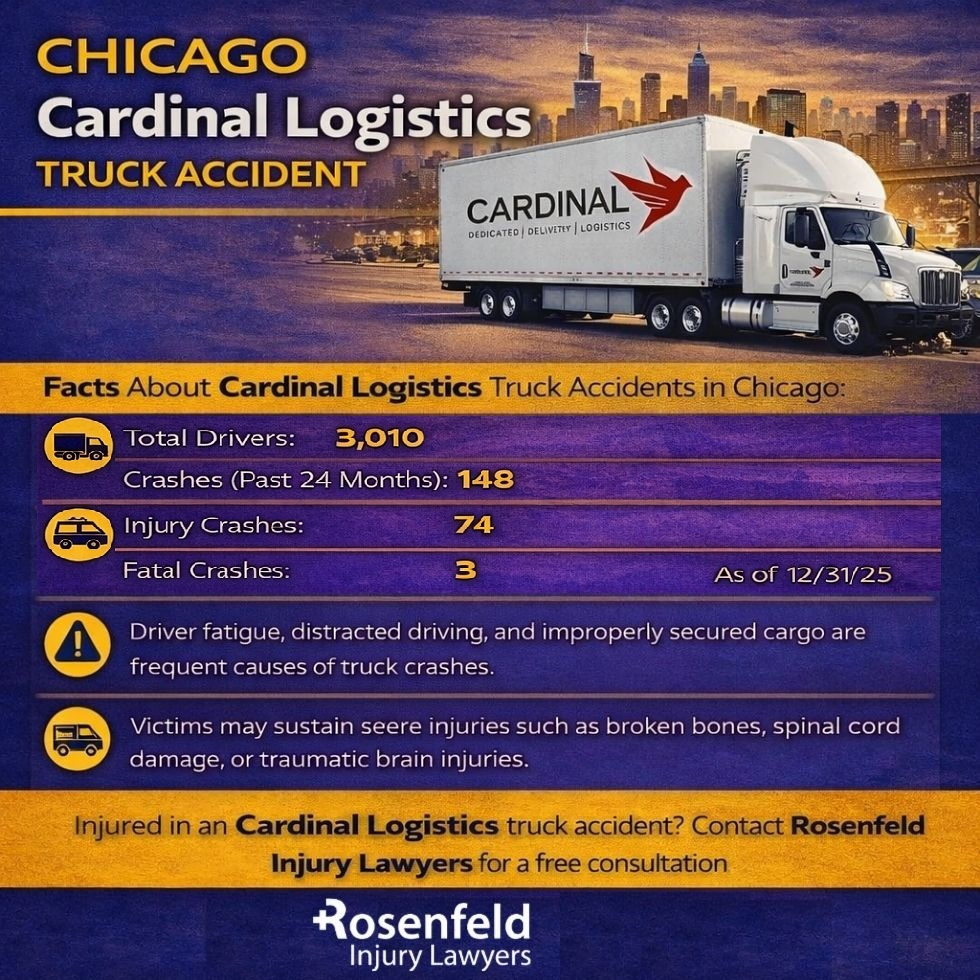
| Total Drivers | 3,010 |
| Crashes (Past 24 Months) | 148 |
| Injury Crashes | 74 |
| Fatal Crashes | 3 |
| Date | 12/31/25 |
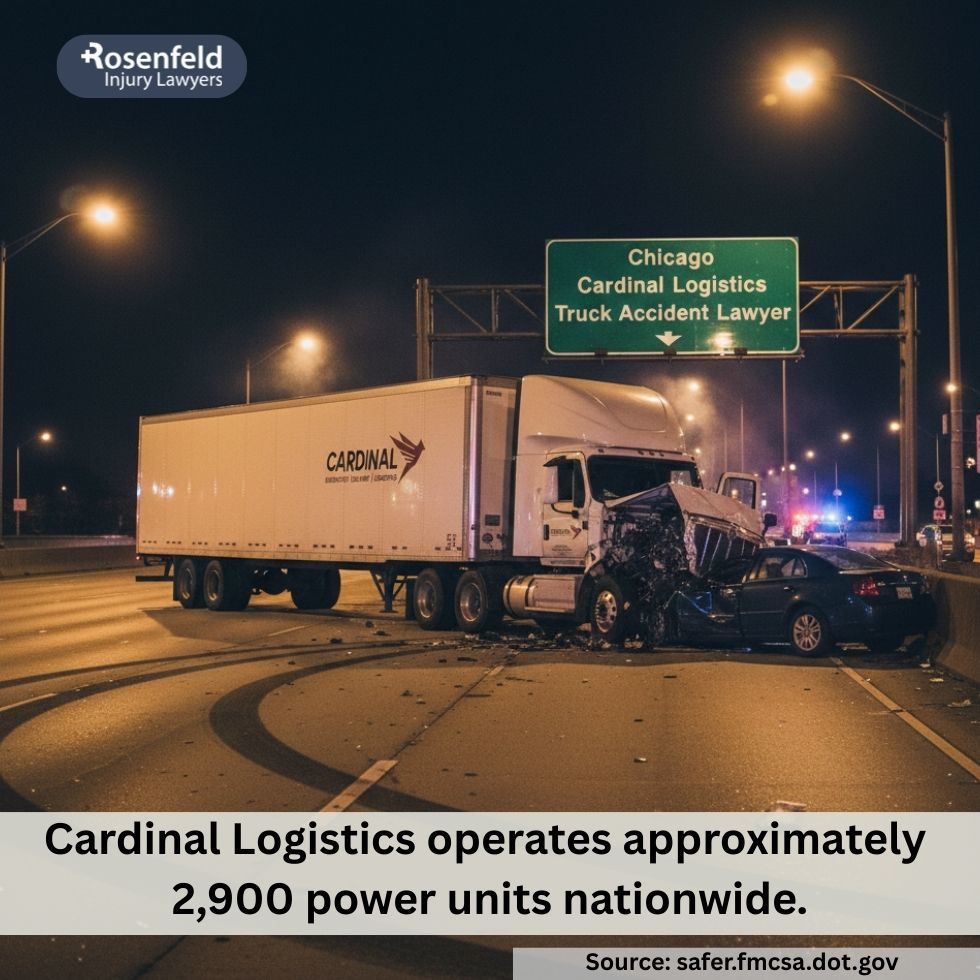
Cardinal Logistics trucks have been involved in incidents that show how quickly a routine run can turn into a major emergency.
In one case, a Cardinal Logistics tractor-trailer was involved in a crash where the truck left the roadway and struck another vehicle while a 43-year-old driver was asleep in the top bunk of the sleeper cab. The passenger died at the scene.
In another case, a tractor-trailer registered to Cardinal Logistics Management Corporation rolled over after the driver failed to maintain lane control. The wreck tied up the roadway for hours while towing crews and responders cleared the scene and recovered the trailer.
Cardinal Logistics operates a dedicated contract carriage model, so its trucks often run the same shipper-assigned lanes on repeat.
In Chicago, that consistency concentrates truck accident risk in familiar places: the approach to a distribution gate, the last half-mile between an industrial corridor and a dock door, and the lane setup a tractor-trailer must commit to well before an exit.
After a Cardinal Logistics truck crash, we treat the trip like a trackable work sequence, not a one-off drive. The goal is to tie the tractor-trailer’s movement to a fixed lane, an appointment window, and the operational choices that can make a collision more likely in Chicago congestion.
Dedicated fleets typically operate under written route guides and site procedures that control how a driver enters, stages, backs, and moves equipment. Those rules matter because they can force unsafe maneuvers or set up an unrealistic timing expectation that shows up later as hurried driving in the evidence.
In Cardinal Logistics truck accident cases, we look for the records that explain the job’s ground truth: gate check-in and check-out times, dock-door assignments, trailer pool instructions, on-site speed limits, designated internal truck routes, and any written requirements for backing, staging, and drop-lot moves.
Cardinal Logistics trucks running facility-to-facility work in the Chicago area commonly rely on the freight ring and the industrial feeders that connect warehouses to interstates. The collision patterns here tend to revolve around lane commitment, braking in compressed flow, and trailer tracking when a tractor-trailer is forced to adjust position late.
I-294 functions as the freight loop where truck traffic is constantly sorting for interchanges.
I-55 Stevenson funnels heavy commercial volume into the Clearing and Bedford Park industrial belt, where short access distances and frequent exit setups create repeat conditions for sideswipes and rear-end sequences.
I-290 becomes a squeeze point when a driver is repositioning a large vehicle through tight merge geometry and stacked lanes.
When container volume surges in the Joliet–Elwood corridor, the effect is often a long stop-start freight queue that raises the risk of tractor-trailer rear-end crashes and chain reactions.
Even when a Cardinal Logistics lane is not an intermodal move, its trucks can be pulled into that flow simply because dedicated routes still share the same approach roads and expressway segments.
These truck crash investigations often come down to pacing and planning: how long the rig sat in slow traffic, whether the driver was trying to recover lost time, and how speed and following distance changed as the roadway flipped from open movement to sudden stoppage.
Dedicated operations create constant low-speed exposure that can still produce life-changing injuries. Drop-lot swaps, bobtail repositioning, coupling and uncoupling, and backing to doors are routine around Chicago’s industrial properties, but each step has a clear failure mode that can trigger a truck accident.
The proof usually lives in the layout and the routine: whether the yard traffic plan required blind-side backing, whether staging lanes forced conflict between moving trucks and smaller vehicles, whether sightlines were blocked by parked trailers, and whether the dock approach demanded tight turns that pushed a trailer’s path into adjacent space.
With shipper-dedicated trucking, the carrier operates the vehicle, but the job can still be shaped by a customer’s timing demands and facility procedures. If a yard design or gate process forces unsafe movements, operational control can matter when responsibility is evaluated after a truck crash.
Our Chicago truck accident attorneys’ investigation tests each link without assuming the logo tells the whole story: who set the route and appointment window, who controlled yard procedures, who supplied or maintained the trailer, and whether third-party repairs or equipment conditions played a role in the truck accident.
If you can, capture the identifiers that connect the tractor-trailer to a specific lane and equipment history. Photograph the tractor number, trailer number, USDOT information, and any pool markings or unit labels on the trailer.
If the crash occurred near a facility, document the gate entrance, posted truck-route signage, yard speed notices, and the staging or dock approach area from a public vantage point.
Also preserve anything that locks down timing, such as delivery communications, appointment confirmations, or check-in documentation. In many trucking disputes, the ability to reconstruct the run minute-by-minute is what separates a guess from a provable narrative.
Most Chicago personal injury claims arising from Cardinal Logistics truck accidents must be filed within two years under 735 ILCS 5/13-202.
If a Cardinal Logistics truck caused your injuries in Chicago, we can secure shipper-lane documentation, dispatch instructions, equipment records, and available video while they are still obtainable. Contact Rosenfeld Injury Lawyers to speak with a Chicago personal injury lawyer and take control of the evidence before it slips out of reach.
All content undergoes thorough legal review by experienced attorneys, including Jonathan Rosenfeld. With 25 years of experience in personal injury law and over 100 years of combined legal expertise within our team, we ensure that every article is legally accurate, compliant, and reflects current legal standards.