

Chicago Personal Injury Lawyer
Award-Winning Chicago Personal Injury Lawyer - Securing Justice
for Illinois Injury Victims - Over $450 Million Recovered



A CR England tractor-trailer crash in Chicago can leave you dealing with serious injuries while the carrier’s insurance side moves quickly to frame the story around the driver’s version of events.
In commercial truck accident cases, the most important proof is usually not public. It sits in driver logs, dispatch instructions, trip timing, onboard data, and maintenance records tied to the specific tractor and trailer involved.
We focus on securing that evidence early and building the claim around what the records show, not what the insurer wants to be assumed. If you need a Chicago CR England truck accident lawyer who understands how national carriers defend these cases, Rosenfeld Injury Lawyers is ready to help.
CR England is a long-established refrigerated trucking carrier known for temperature-controlled freight operations. That business model often involves strict appointment windows and load scheduling that can create pressure points visible in dispatch messages, route changes, and log data when a crash occurs.
For an injury claim, the profile details that matter are verifiable and unit-specific: the correct CR England entity tied to the truck, the tractor and trailer identifiers, the route and delivery schedule, and the inspection and service history for the equipment involved.
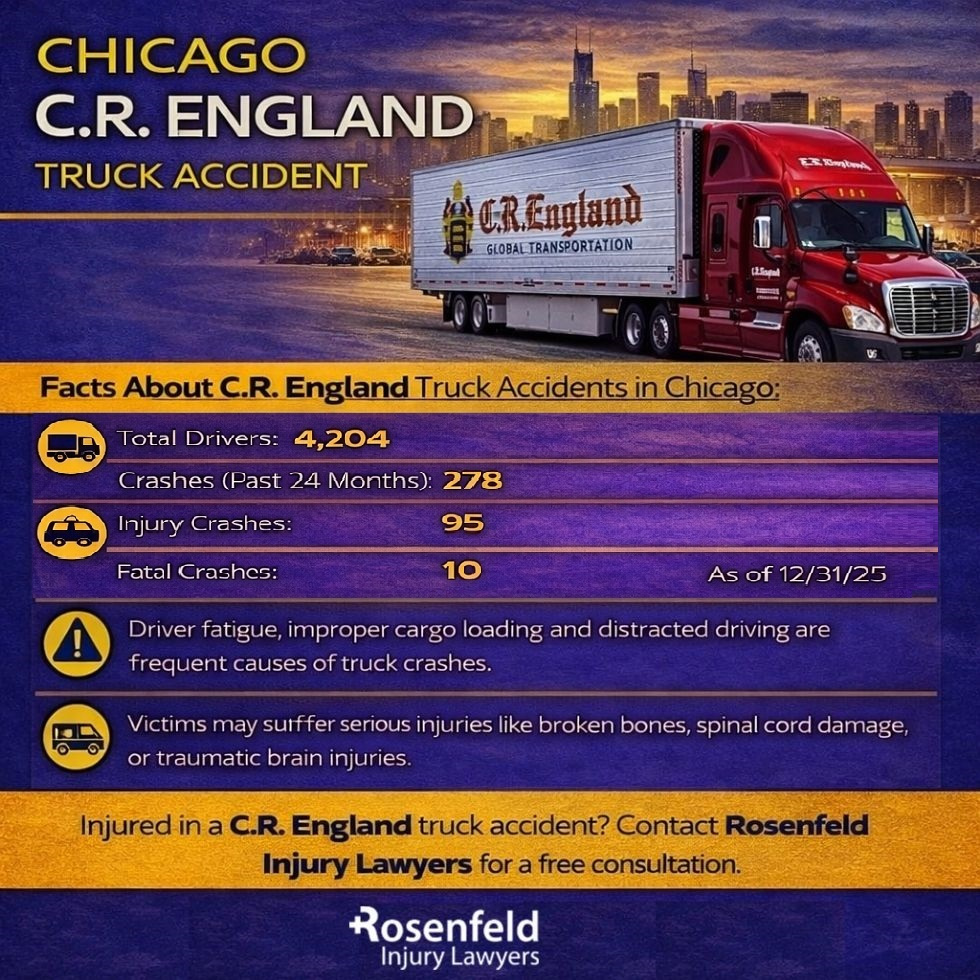
| C R ENGLAND INC – Safety Snapshot | |
|---|---|
| USDOT Number | 28406 |
| Mailing Address | 4701 W 2100 S, Salt Lake City, UT 84120 |
| Telephone | (801) 972-2712 |
| Website | https://www.crengland.com/ |
| Total Power Units | 4,254 |
| Total Drivers | 4,204 |
| Crashes (Past 24 Months) | 278 |
| Injury Crashes | 95 |
| Fatal Crashes | 10 |
| Date | 12/31/25 |
A reported truck crash settlement involving C.R. England arose from a rear-end collision where a tractor-trailer struck a stopped vehicle during a roadside stop. The accident resulted in career-ending harm, including multiple surgeries, and the claim was resolved for $9,000,000.
In rear-end semi collisions, the liability fight often centers on the driver’s speed management and following distance as traffic compresses, while the damages fight turns on medical documentation that ties the long-term limitations to the impact and treatment timeline.
In O’Connell v. C.R. England, Inc., C.R. England was the defendant in a negligence case that resulted in a $3,000,000 verdict after a motorcyclist injured in a truck accident suffered cracked ribs, bruised internal organs, and broken bones in his legs.
An appellate-focused write-up reports two wrongful death claims involving C.R. England that resolved for a combined $1,650,000.
Wrongful death trucking cases frequently come down to early investigation and record preservation, including driver logs, dispatch timing, and vehicle condition evidence, because once the crash reconstruction window closes, the defense gains leverage by narrowing what can be proven about preventability.
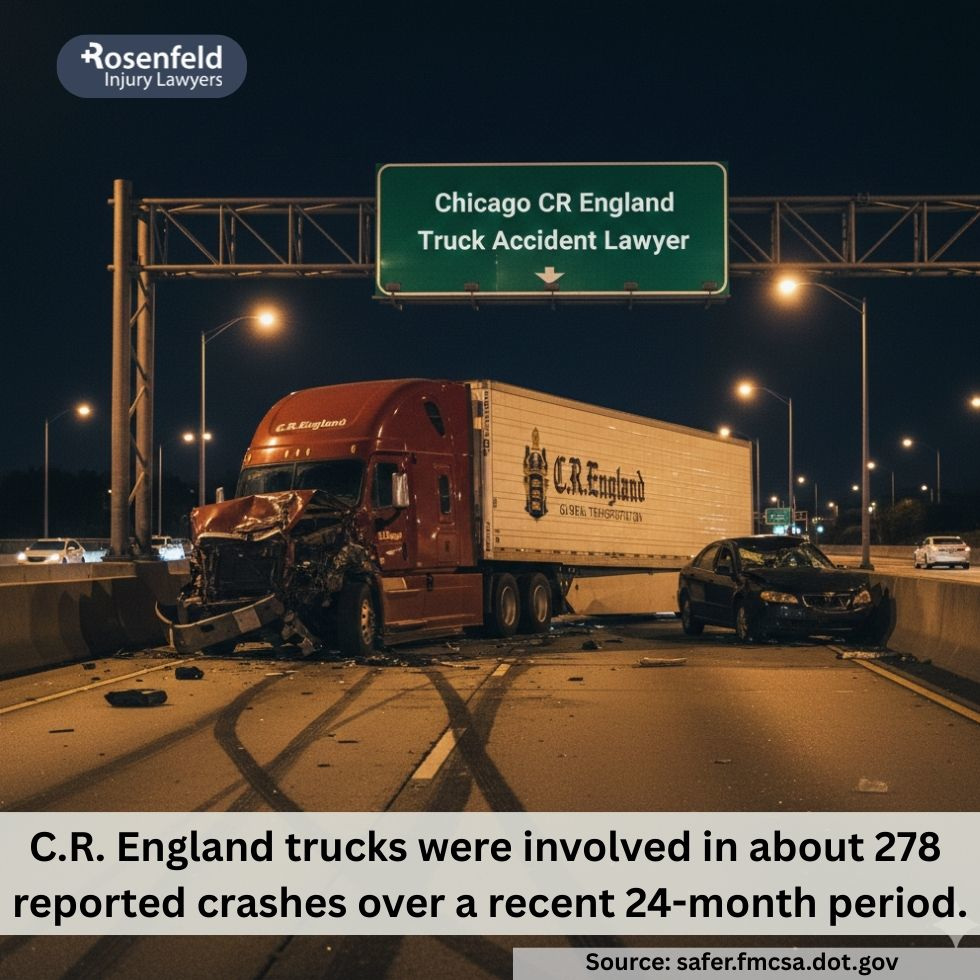
CR England is known for temperature-controlled trucking, and reefer freight runs on appointment windows that do not flex when Chicago traffic stacks or a dock yard jams.
When a driver loses time at a gate or sits in a dock line, the temptation is to recover the schedule on the road. That is where avoidable truck crashes happen: hurried lane changes, tighter following distance, and late exit decisions made with a fully loaded tractor-trailer.
In the Chicago industrial belt, the pressure points are often the transition zones between freight corridors and warehouse access roads, where trucks must slow, merge, and turn repeatedly while still trying to stay on time.
CR England’s scale is associated with a steady pipeline of drivers. In a serious truck accident, the practical issue is not branding, but supervision: who cleared the driver for the run, what restrictions applied, and whether the trip plan matched the driver’s experience level.
We look for verifiable proof of how the run was managed, including onboarding and qualification materials, any trainer or team assignments, route guidance given before the trip, prior incident history tied to the driver, and dispatch messages that reveal whether the schedule was realistic for the conditions the driver encountered.
Some long-haul operations rely on team driving and sleeper-berth handoffs. When a Chicago truck crash occurs, the timeline matters: who was driving, who was resting, when the shift changed, and whether the run was structured in a way that made alert driving less likely.
We reconstruct the sequence using log data and supporting records to identify extended duty periods, compressed rest, and handoff timing that can correlate with delayed reaction, missed slowdowns, or drift events that lead to catastrophic collisions.
A CR England tractor-trailer moving through Chicago commonly relies on the same core truck routes as other national carriers, but the crash patterns become distinct when time pressure is layered on top of heavy freight geometry.
On the Dan Ryan Expressway, dense compression and abrupt speed changes create classic rear-end risk when a semi’s stopping distance is misjudged. Along I-294, trucks must commit early for interchanges, and late lane corrections can produce sideswipes and forced-merge impacts.
On I-55 Stevenson, industrial exits and short approach distances increase the danger of last-second moves, especially when a driver is trying to claw back lost time from detention or a delayed pickup.
Refrigerated operations often rely on drop-and-hook practices and frequent trailer turnover. After a truck accident, that raises specific fact questions: which trailer was attached at the time of the crash, whether there were recent swaps, and whether inspection and repair notes followed the equipment or got lost in the churn.
We trace the tractor and trailer identifiers through inspection reports, service history, and defect write-ups for brakes, tires, lights, and prior out-of-service issues, then connect that record to what the physical evidence shows about stopping ability and vehicle control.
A commercial collision is proven through documents and data, not assumptions. In CR England cases, a Chicago truck accident lawyer from our team will prioritize the items that lock down timing, decisions, and equipment condition, such as:
A truck accident injury claim in Illinois is governed by a two-year filing deadline under 735 ILCS 5/13-202, but the bigger threat in CR England cases is usually evidence loss, not the calendar.
If you were hit by a CR England tractor-trailer in Chicago, Rosenfeld Injury Lawyers can preserve the records that tend to vanish first, including driver logs, dispatch instructions, equipment identifiers, and any available onboard or nearby video, then build the case around a documented timeline instead of an insurance narrative. Contact us to speak with a Chicago personal injury lawyer as soon as you can.
All content undergoes thorough legal review by experienced attorneys, including Jonathan Rosenfeld. With 25 years of experience in personal injury law and over 100 years of combined legal expertise within our team, we ensure that every article is legally accurate, compliant, and reflects current legal standards.