

Chicago Personal Injury Lawyer
Award-Winning Chicago Personal Injury Lawyer - Securing Justice
for Illinois Injury Victims - Over $450 Million Recovered



A crash involving a FedEx truck in Chicago can look deceptively ordinary until you are the one dealing with the injuries, the medical bills, and the pressure from an insurance adjuster who wants a quick statement and a quick resolution.
FedEx-related truck collisions often happen in dense delivery environments, where tight schedules, curbside stops, and constant right turns create predictable hazards for drivers, pedestrians, and cyclists.
We move quickly to preserve the evidence that tends to disappear first, including route and scan data, vehicle identifiers, delivery timing records, and any nearby camera footage. If you need a Chicago FedEx truck accident lawyer who knows how delivery cases are defended and how they are proven, Rosenfeld Injury Lawyers is ready to help.
FedEx is one of the largest delivery and logistics networks in the country, moving packages through a system that includes local delivery routes, pickup runs, and longer-haul transportation. Its vehicles on Chicago streets can range from step vans and box trucks to tractor-trailers, depending on the service line and the delivery leg.
What matters for an injury claim is how that delivery operation functioned on the day of the crash, including who controlled the driver, how the route was scheduled, and what the records show about timing, stops, and safety practices.
| FEDERAL EXPRESS CORPORATION – Safety Snapshot | |
|---|---|
| Company Name | Federal Express Corporation |
| USDOT Number | 86876 |
| Mailing Address | 3660 Hacks Cross Rd Bldg F 2nd Fl, Memphis, TN 38125 |
| Telephone | (412) 747-8482 |
| Website | https://www.fedex.com/ |
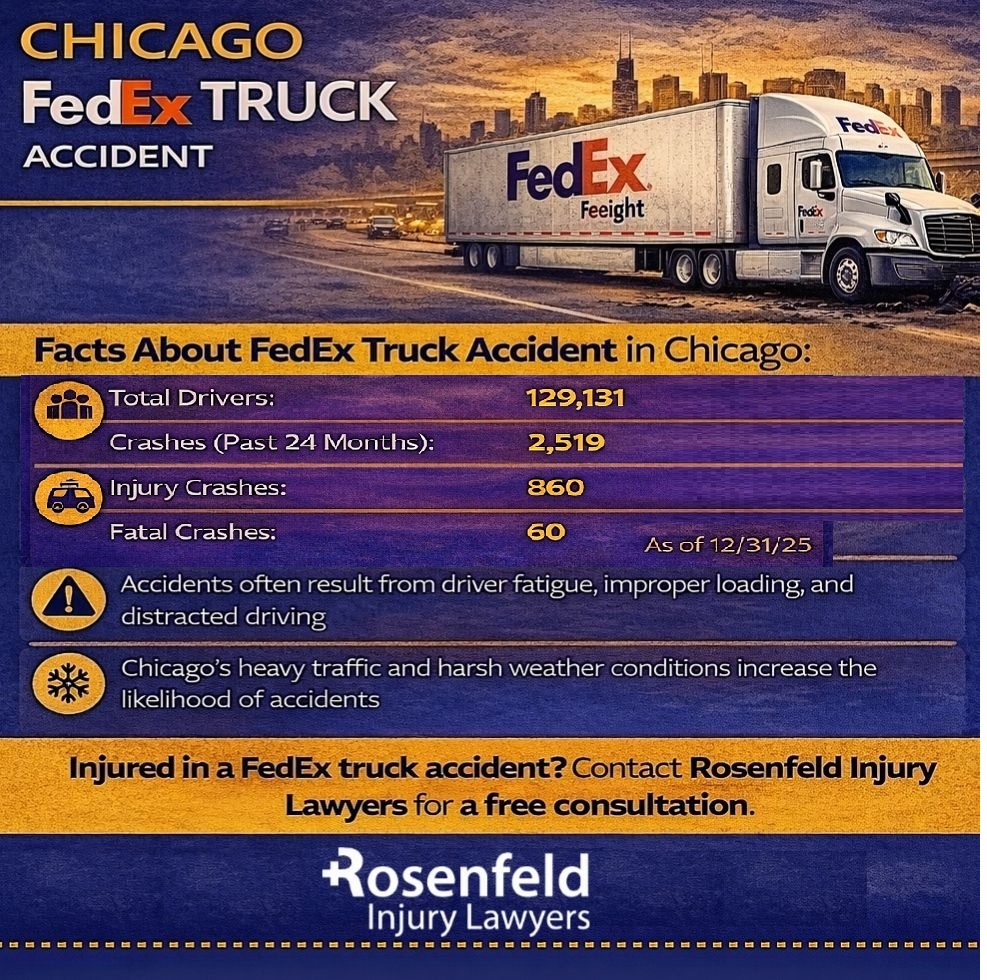
| Total Power Units | 138,481 |
| Total Drivers | 129,131 |
| Crashes (Past 24 Months) | 2,519 |
| Injury Crashes | 860 |
| Fatal Crashes | 60 |
| Date | 12/31/25 |
FedEx-related injury cases range from tractor-trailer highway collisions to serious crashes involving local delivery trucks. The examples below show the kinds of outcomes that can follow when preventability is proven with hard evidence.
A court release confirms an appellate decision upholding a $165 million jury verdict arising from a fatal collision involving a FedEx Ground tractor-trailer.
This shows that “contractor” arguments do not automatically shield a delivery network when the evidence supports deeper operational responsibility for safety practices, oversight, and how the work was structured.
Courtroom View Network reported an $8 million jury verdict for a woman who suffered back injuries after being rear-ended by a FedEx truck, noting the verdict came after years of litigation and exceeded a prior $1.8 million settlement offer.
FedEx truck accident cases often involve early pressure to settle before the long-term impact of spinal injuries is fully documented. When the defense contests causation or tries to minimize damages, the difference between a “quick offer” and a trial-tested outcome can come down to medical proof and the credibility of the timeline.
Chelsea Joy Kashergen, 22, was struck and killed by a FedEx Ground home delivery vehicle while riding her bicycle. The jury’s verdict focused on the loss of the relationship between mother and daughter, and the evidence centered on what witnesses described as an unusually close bond.
Shortly before trial, FedEx admitted it was at fault for Ms. Kashergen’s death but heavily disputed the value of the mother-daughter relationship. Before the trial, FedEx offered $750,000.
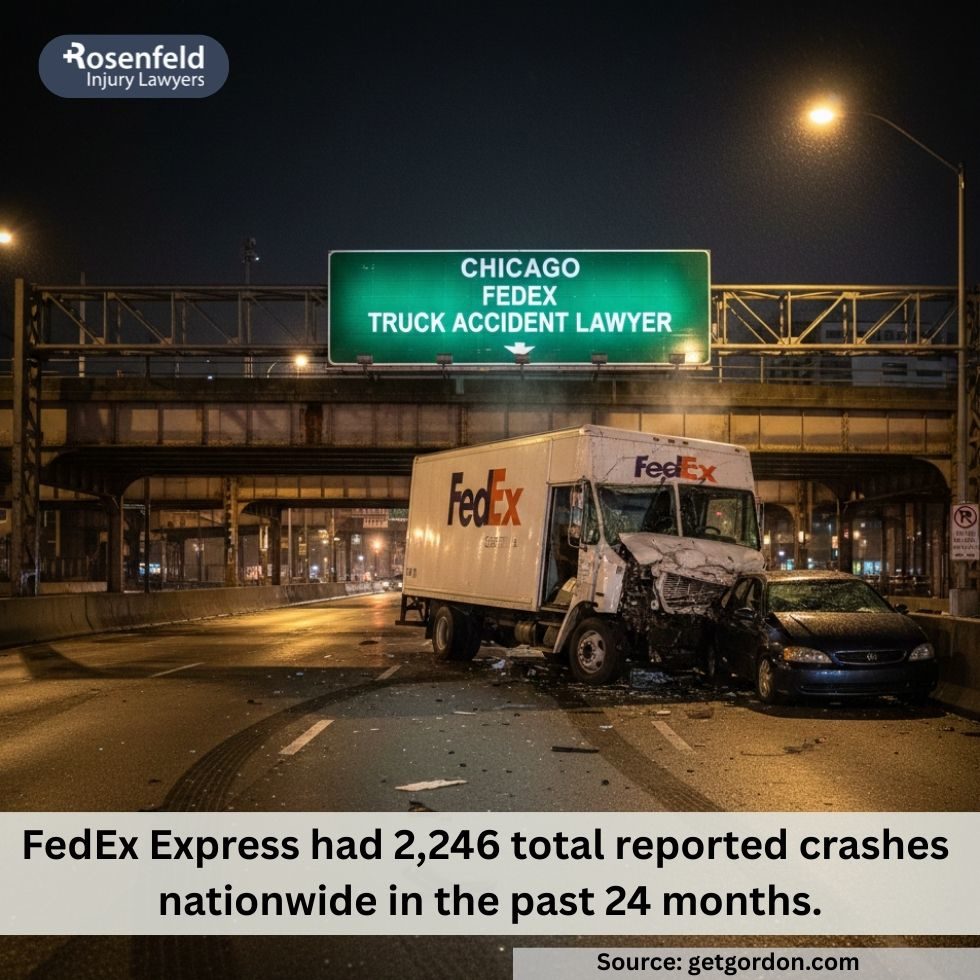
Not every “FedEx truck” is operated by the same company. Depending on the vehicle and the route, a collision may involve FedEx Ground, FedEx Express, or a contracted delivery provider operating under FedEx branding.
Identifying the correct entity early matters because it determines which records exist, who controls them, and how coverage and responsibility are evaluated when a claim is filed.
Delivery operations create a different paper trail than long-haul trucking. In many FedEx truck crash cases, the most important proof is tied to the route and the stop-by-stop timeline rather than a single moment on the roadway.
We often preserve scan timestamps, stop sequence records, proof-of-delivery logs, dispatch messages, and GPS or telematics data that can confirm where the vehicle was, how long it was stopped, and whether the driver was rushing to recover a schedule.
Delivery vehicles spend the day entering and exiting traffic, pulling to curbs, and making frequent right turns. Those ordinary movements can become dangerous quickly in dense Chicago streets.
Common crash patterns include unsafe curb pull-outs, sudden braking in stop-and-go flow, wide right turns that squeeze adjacent lanes, and backing incidents in alleys, loading zones, and tight lot entrances.
Some FedEx injury cases do not begin with a high-speed collision. They happen during the delivery moment, when a vehicle is backing, a driver is maneuvering into a tight space, or a person is caught in the blind zone near the truck.
These incidents often depend on whether the driver had a clear view, whether the stop location was safe, and whether basic precautions were followed to protect people walking, biking, or moving through the delivery area.
FedEx delivery cases often involve early attempts to narrow responsibility or reduce the value of the claim. One of the most common strategies is shifting blame to a contractor or arguing that the driver was not under FedEx’s control.
Our Chicago truck accident attorney team also frequently sees efforts to minimize injuries based on property damage, disputes over who had the right of way during a turn or curb pull-out, and arguments that the victim’s symptoms are unrelated or exaggerated.
FedEx delivery routes concentrate where Chicago traffic, curbside stops, and freight access collide. The risk is not confined to one expressway. It builds in the places where drivers are forced to stop, merge, and turn repeatedly under time pressure.
Around the O’Hare freight lanes through Bensenville and Elk Grove Village, delivery vehicles and box trucks are constantly navigating short merges, warehouse entrances, and tight turn zones near I-190 and the I-294 spurs.
In the Clearing and Bedford Park industrial belt, including the Cicero Avenue and 47th Street corridor feeding I-55 and I-294, curbside pulls, staging decisions, and congested approach lanes create repeat conditions for sideswipes, rear-end crashes, and forced-merge collisions.
In dense neighborhood delivery zones, the predictable hazards include double-parking, abrupt curb pull-outs, and right-turn conflicts with cyclists and pedestrians, especially where sightlines are limited and traffic is stacked at intersections.
If you are able, document the details that help identify the vehicle and lock down the delivery timeline. Start with the FedEx branding, the unit number, and the USDOT information on the truck, along with any trailer identifiers if a trailer is involved.
Photograph the delivery location, lane markings, nearby signage, and the position of the vehicle before it is moved. If there are nearby cameras, note the business name and exact address so the footage can be requested before it is overwritten.
Illinois generally gives injured people two years to file a personal injury lawsuit under 735 ILCS 5/13-202. In FedEx delivery-truck accident cases, the evidence usually disappears long before the deadline becomes a concern. Route and stop data can be overwritten, nearby camera systems recycle footage, and witnesses forget the small details that end up deciding liability.
If a FedEx vehicle caused your injuries in Chicago, we build the claim around preserved delivery records, vehicle identifiers, and a clean timeline that shows exactly where safety broke down. Contact Rosenfeld Injury Lawyers to speak with a Chicago personal injury lawyer before the paper trail fades and the case becomes harder to prove.
All content undergoes thorough legal review by experienced attorneys, including Jonathan Rosenfeld. With 25 years of experience in personal injury law and over 100 years of combined legal expertise within our team, we ensure that every article is legally accurate, compliant, and reflects current legal standards.