

Chicago Personal Injury Lawyer
Award-Winning Chicago Personal Injury Lawyer - Securing Justice
for Illinois Injury Victims - Over $450 Million Recovered



A crash with a FedEx Freight tractor-trailer or city delivery unit in Chicago often involves more than a single driving mistake. LTL operations run on multi-stop pickups, time-sensitive dock appointments, and tight turns in industrial corridors where backing and curbside maneuvering create real danger.
We act quickly to preserve the route sequence, scan timestamps, dispatch communications, and equipment records that explain what happened and why it was preventable. If you need a Chicago FedEx Freight truck accident lawyer who understands how LTL carriers defend injury claims, Rosenfeld Injury Lawyers is ready to help.
FedEx Freight is FedEx’s less-than-truckload carrier, moving palletized shipments through a terminal-based network of local pickup and delivery routes and longer linehaul runs between facilities.
That structure is what makes FedEx Freight cases different from truckload crashes. LTL routes involve multiple stops, tighter delivery windows, and more backing and close-quarters maneuvering at docks and industrial sites, which creates predictable risk patterns and a paper trail of stop-by-stop records that can prove what went wrong.
| FEDEX FREIGHT INC – Safety Snapshot | |
|---|---|
| USDOT Number | 239039 |
| Mailing Address | 2200 Forward Drive, Harrison, AR 72601 |
| Telephone | (844) 521-5125 |
| Website | https://www.fedexfreight.fedex.com |
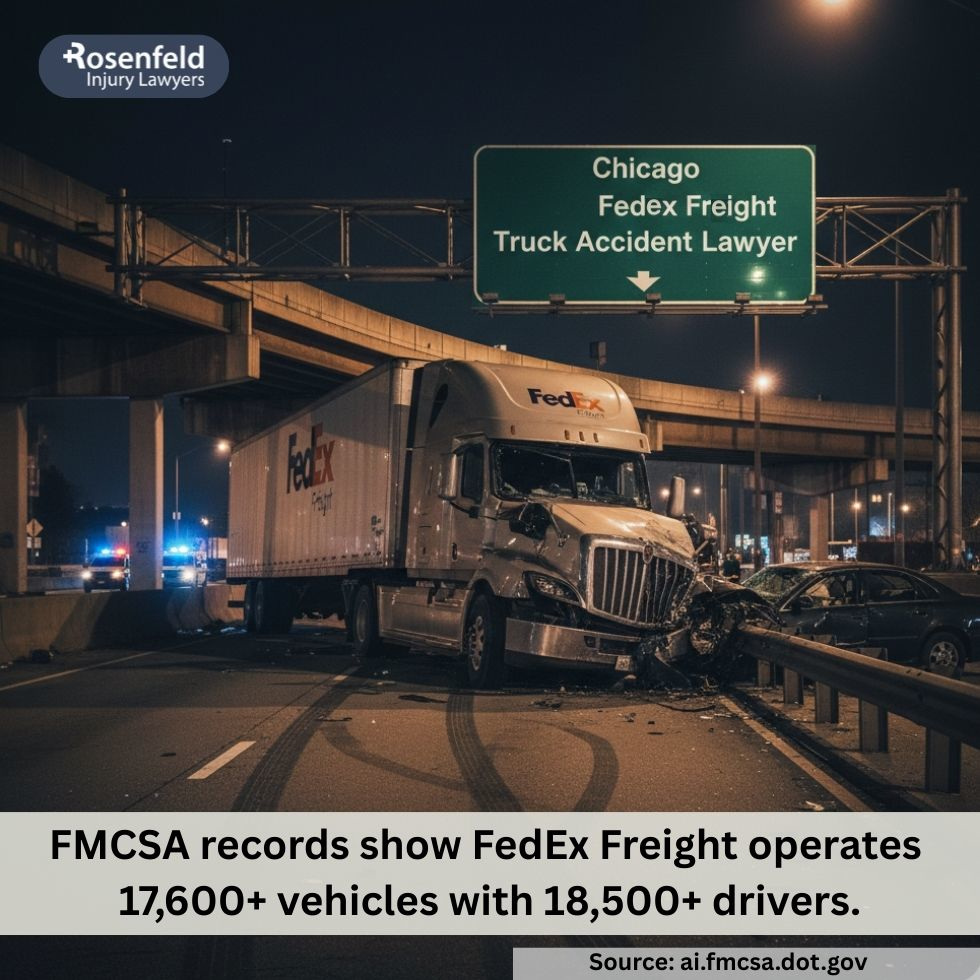
| Total Power Units | 17,633 |
| Total Drivers | 18,539 |
| Crashes (Past 24 Months) | 655 |
| Injury Crashes | 211 |
| Fatal Crashes | 24 |
| Date | 12/30/25 |
When a national LTL carrier is involved, we look at real cases to understand the defenses that appear and the evidence that decides outcomes. The following examples involve serious injury litigation tied to FedEx Freight.
News described a jury verdict of $30 million against FedEx Freight in a wrongful death lawsuit stemming from a fatal head-on collision.
This kind of result shows what happens when the record supports preventability in a commercial crash. Large carriers often contest liability and damages aggressively, but juries can still hold them accountable when the evidence proves unsafe operation under the conditions.
In an order, the court states that the plaintiff filed suit after being injured in a motor vehicle accident involving a defendant driver who was operating a tractor-trailer owned by FedEx Freight, Inc.
Ownership is often the gateway to the most important discovery in a trucking case, including maintenance records, inspection history, and the policies that governed how the truck was operated.
FedEx Freight risk in Chicago is shaped by LTL realities: terminal-driven routes, multi-stop schedules, and the constant need to maneuver in tight industrial environments. These are the locations and scenarios where we repeatedly see preventable collisions and serious injuries.
The I-55 and I-294 freight spine, with heavy industrial access around Cicero Avenue and 47th Street, is built for constant truck movement and constant conflict. LTL drivers are often entering and exiting facilities, switching lanes to reach short ramps, and braking hard as traffic stacks behind turning trucks.
LTL pickups around Bensenville and Elk Grove Village push trucks through I-190 and the I-294 spurs that feed dense logistics parks and warehouse corridors. These routes are notorious for short merges, abrupt slowdowns, and tight facility entrances that force wide turns and sudden braking.
BNSF Corwith Yard sits inside a freight environment where truck density rises, and industrial traffic patterns are unforgiving. When heavy truck volume spills onto nearby arterials, the collision risk increases for turning conflicts, backing maneuvers near facilities, and lane changes made under pressure.
FedEx Freight operations often involve tight turns into docks, backing in constrained yards, and liftgate activity during pickups and deliveries. These environments create injury scenarios that do not look like highway crashes, including impacts during backing, crush zones near trailers, and falls tied to dock and liftgate conditions.
A Chicago truck accident lawyer cannot build an LTL case from a crash report alone. We build it from the operational timeline and the records that show what the driver and carrier were trying to accomplish at each stop.
Evidence we collect includes:
LTL carriers are constantly transitioning between highway travel and close-quarters maneuvering. Multi-stop routes create more backing events, more tight turns, and more opportunities for preventable mistakes in industrial areas where sightlines are limited and traffic is impatient.
That is why we anchor the case to the stop-by-stop timeline, then connect it to the safety choices and operational decisions that made the collision more likely.
FedEx Freight cases often involve third parties because so many injuries occur at or near facilities. A shipper or receiver may share responsibility when unsafe dock layouts, poor lighting, broken dock equipment, or site procedures create a backing hazard or force trucks into unsafe staging.
We also investigate property owners and maintenance contractors when the injury traces back to the condition of the premises, the dock approach, or equipment that should have been repaired before a driver or visitor was put at risk.
LTL-related crashes and delivery incidents can cause traumatic brain injuries, spinal injuries, fractures, and serious orthopedic damage, especially when a smaller vehicle is struck during a wide turn or when a person is hit during a backing maneuver.
When injuries involve head trauma, shoulder and hip damage, or worsening neck and back symptoms, consistent medical documentation and early follow-up care become central to proving the full impact of the harm.
If you are able, photograph the tractor and trailer markings, including the USDOT number, unit numbers, and any trailer identifiers. In LTL cases, the specific unit and trailer can matter because the stop sequence and equipment history often explain what happened.
Preserve dashcam footage, look for nearby security cameras at facilities, and write down witness information and the responding agency while details are fresh. Early preservation matters because terminal and dock video can be overwritten quickly.
After a serious truck crash, the carrier’s insurance team may seek a recorded statement, ask for broad medical authorizations, or push an early offer tied to a release before the injury picture is fully understood.
In LTL cases, it is also common to see quick framing that treats the incident as a minor delivery mishap, even when the evidence shows a preventable safety failure in a high-risk environment.
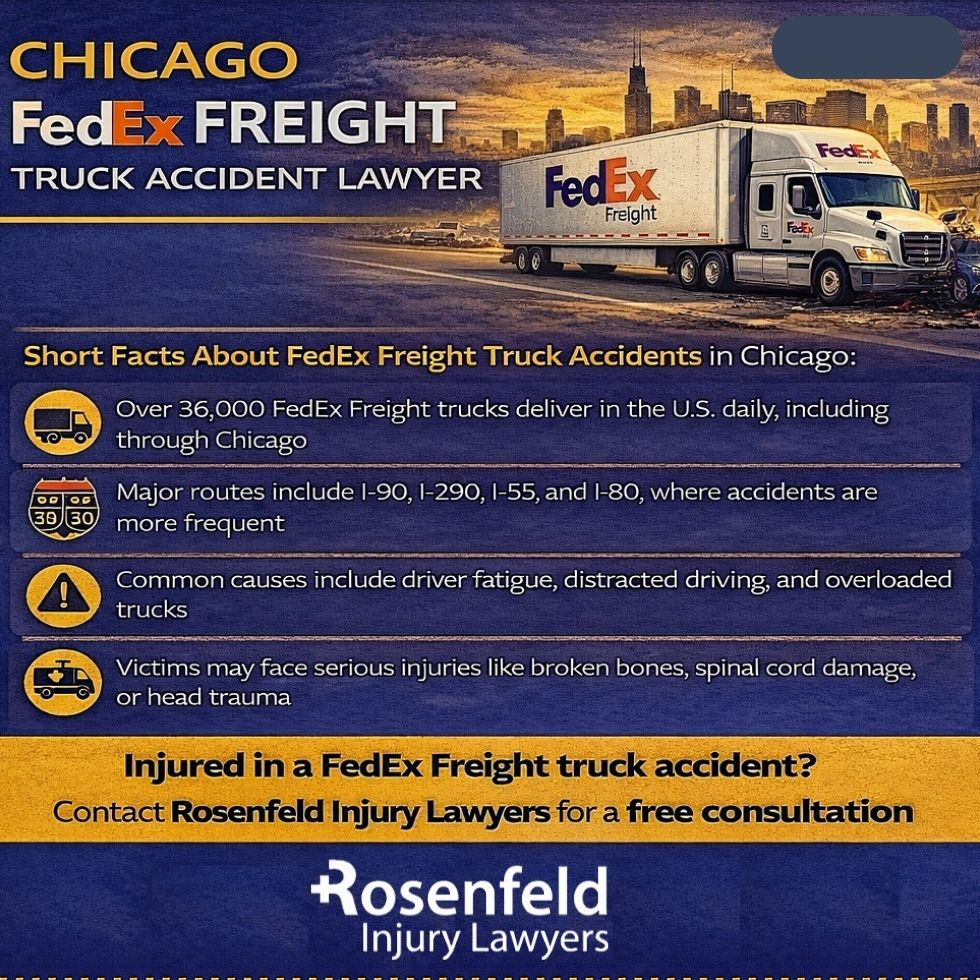
In Illinois, most personal injury actions must be filed within two years under 735 ILCS 5/13-202.
Even if the deadline feels distant, waiting can still hurt the case because route records, facility video, and witness memory do not improve with time.If you were injured in a crash involving FedEx Freight in Chicago, you deserve a case built around the stop-by-stop proof that shows what went wrong and who should be held accountable. Contact Rosenfeld Injury Lawyers to speak with a Chicago personal injury lawyer before the carrier controls the narrative and the evidence fades.
All content undergoes thorough legal review by experienced attorneys, including Jonathan Rosenfeld. With 25 years of experience in personal injury law and over 100 years of combined legal expertise within our team, we ensure that every article is legally accurate, compliant, and reflects current legal standards.