

Chicago Personal Injury Lawyer
Award-Winning Chicago Personal Injury Lawyer - Securing Justice
for Illinois Injury Victims - Over $450 Million Recovered



A collision with a Hirschbach Motor Lines tractor-trailer in Chicago is not a typical crash claim. These cases often hinge on evidence the trucking company controls, like electronic logs, dispatch communications, maintenance records, and post-crash investigation materials.
We move fast to preserve that proof and build a case that reflects the realities of commercial trucking in Chicago. If you need a Chicago Hirschbach Motor Lines truck accident lawyer who understands carrier litigation, Rosenfeld Injury Lawyers is ready to help.
Hirschbach Motor Lines is known for refrigerated and temperature-controlled freight operations.
That operating model matters because cold chain freight is usually governed by appointment times and strict delivery windows, which can create schedule pressure that shows up in the records when a crash happens.
| HIRSCHBACH MOTOR LINES INC – Safety Snapshot | |
|---|---|
| Company Name | Hirschbach Motor Lines Inc |
| USDOT Number | 65769 |
| Mailing Address | 2460 Kerper Blvd, Dubuque, IA 52001 |
| Telephone | (402) 404-2000 |
| Website | https://hirschbach.com/ |
| Total Power Units | 2,948 |
| Total Drivers | 2,556 |
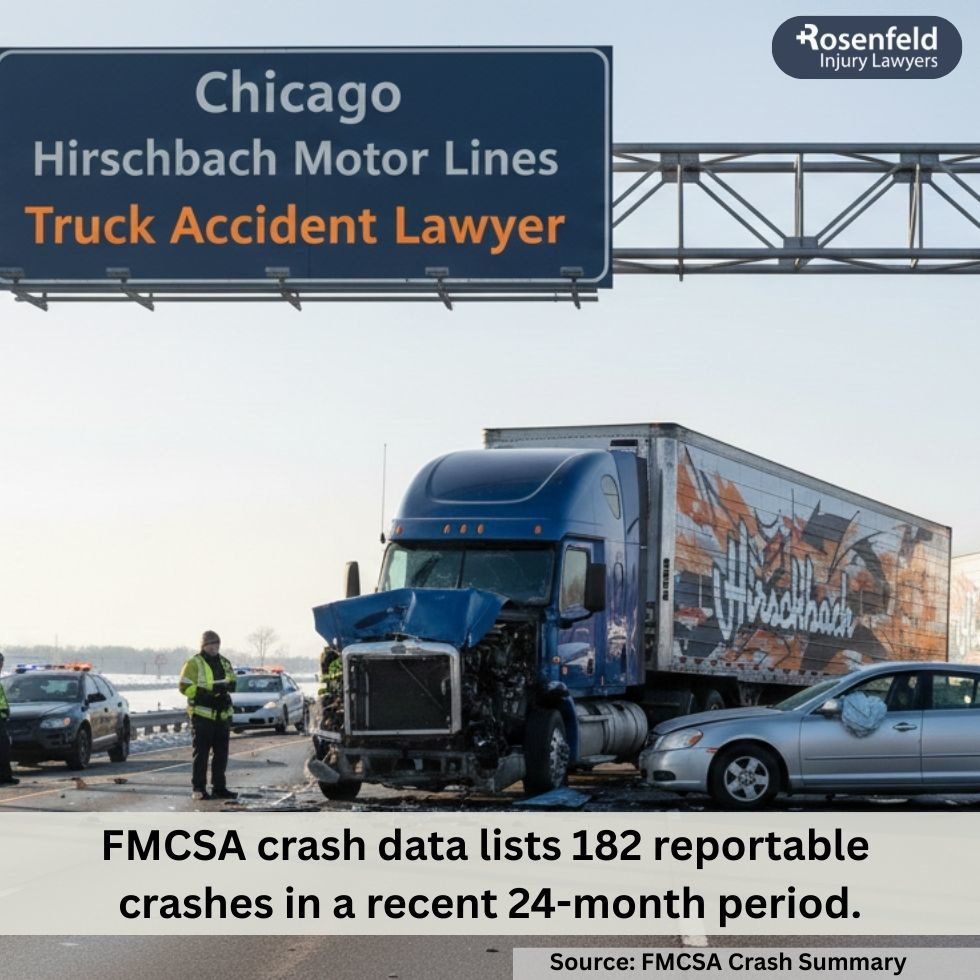
| Crashes (Past 24 Months) | 188 |
| Injury Crashes | 63 |
| Fatal Crashes | 6 |
| Date | 12/28/25 |
When someone is hurt in a tractor-trailer collision, what matters is not how a company brands itself, but what the provable record shows in real cases. The following examples involve truck crash claims tied to Hirschbach Motor Lines.
News reported a $1.67 million settlement involving a woman who suffered a mild traumatic brain injury when her car was rear-ended by a semi-trailer. The report states the truck driver was employed by Hirschbach and discusses alleged logbook violations and how damages were evaluated in light of an internal brain injury that was not visually obvious.
For Chicago victims, this is a familiar crash pattern. Rear-end tractor-trailer collisions often come down to the same questions we pursue here: following distance in compressed traffic, speed management, fatigue, and whether the carrier’s safety oversight was real or only paper-deep.
A published litigation document in Lewis v. Hirschbach Motor Lines states that the driver and Hirschbach Motor Lines settled with at least one underlying plaintiff for nearly $60,000.
That figure is not offered as a benchmark for value. It is useful because it shows the practical reality of trucking litigation: outcomes can vary widely depending on injuries, proof, insurance structure, and who else is brought into the case based on maintenance, technology, or third-party responsibility.
In Jones v. Hirschbach Motor Lines, Inc., a federal court decision addressed a preservation request for crash-related materials and concluded that Hirschbach deleted recorded phone conversations encompassed by that preservation demand, leading the court to impose spoliation sanctions.
This shows why early legal action is not a formality in trucking cases. If recorded statements, internal investigation calls, or key communications are lost under routine retention practices, the case can shift from proving what happened to fighting over what should have been preserved.
Hirschbach’s temperature-controlled freight runs on appointment windows, and Chicago traffic rarely cooperates. When drivers are behind schedule, the same high-risk corridors and error patterns show up again and again.
Bensenville and Elk Grove Village funnel freight traffic through I-190 and the I-294 spurs. Crashes here often involve sudden slowdowns, short merges, and late lane positioning near ramps. We match the driver’s timeline to dispatch instructions, appointments, and ELD data to see whether the run was realistic in Chicago congestion.
Around I-55, I-294, Cicero Avenue, and the 47th Street corridor, heavy freight density meets tight industrial access. The common crash patterns include compressed braking, late lane changes near exits, and side impacts in crowded approach lanes. We look closely at scheduling pressure as well as braking and maintenance records when a stopping failure is suspected.
Intermodal surges in the Joliet and Elwood freight corridor can turn highways into stop-start queues, raising the risk of tractor-trailer rear-end crashes. We analyze speed variation, following distance, and whether trip planning accounted for known bottlenecks.
Trailer swaps and drop lots add bobtail traffic, rushed coupling, and fatigue around shift changes. We preserve dispatch and location data, load status records, and maintenance documentation tied to frequent trailer handling to prove what drove the crash risk.
A Chicago truck accident lawyer cannot build a serious claim off the crash report alone. We build it from the carrier’s records and the physical and electronic trail, such as:
Refrigerated freight runs on delivery windows, and missed appointments can trigger cascading delays. That operational reality can create pressure that shows up in dispatch messages, routing changes, and decisions made in heavy traffic.
These cases also tend to involve frequent trailer swaps, drop-and-hook practices, and time-sensitive staging at docks. When a crash happens, we look closely at whether the schedule was realistic for Chicago congestion and whether the carrier’s safety practices kept pace with the operational tempo.
In a serious tractor-trailer case, liability often extends beyond the person behind the wheel. Depending on how the load was scheduled, maintained, and handled, other parties can share responsibility.
A shipper, broker, or receiver may be liable if unrealistic appointment windows, unsafe loading practices, or dock procedures contributed to the crash.
We also examine whether a maintenance contractor failed to correct known defects, whether a trailer owner provided unsafe equipment, and whether a facility’s staging area or access design created a preventable hazard that pushed the risk onto the roadway.
Rear-end tractor-trailer crashes are often more severe than people expect, even at speeds that do not look catastrophic on paper. The force transfer can cause traumatic brain injuries, including concussions that do not show up on initial imaging, along with neck and back injuries that worsen over time.
We also see fractures, shoulder injuries, and aggravation of prior spinal conditions, especially when a smaller vehicle is pushed forward in a chain-reaction impact. When symptoms evolve in the days after the crash, consistent medical documentation becomes one of the most important parts of proving damages.
Your health comes first, but a few practical steps can protect your case if you are able to take them. Trucking claims often depend on details that are easiest to preserve right away.
Photograph the tractor and trailer markings, including the DOT and MC numbers, the trailer number, and any company identifiers. Save any dashcam footage and ask nearby businesses about security video before it is overwritten. If you can, write down the crash report number, the responding agency, and the names of witnesses while the scene is still fresh.
After a commercial crash, the carrier’s insurance team often moves quickly. They may ask for a recorded statement, request a broad medical authorization, or present paperwork framed as routine that can quietly limit your claim.
It is also common to see early “check” offers or pressure to resolve the case before the full injury picture is clear. If you are dealing with head injury symptoms, back pain, or worsening limitations, locking in a settlement too early can leave you paying for long-term care out of your own pocket.
In Illinois, most personal injury actions must be filed within two years under 735 ILCS 5/13-202.
Even when the deadline is months away, waiting can still damage the case because trucking evidence and witness memory do not improve with time.
If you were hurt by a Hirschbach Motor Lines tractor-trailer in Chicago, you deserve a case built around verifiable proof and a clear narrative of how this crash could have been prevented. We preserve logs, dispatch records, maintenance history, and post-crash materials early, then we use them to pursue accountability from every liable party. Contact Rosenfeld Injury Lawyers to speak with a Chicago personal injury lawyer before the carrier’s version of events becomes the only version in the file.
All content undergoes thorough legal review by experienced attorneys, including Jonathan Rosenfeld. With 25 years of experience in personal injury law and over 100 years of combined legal expertise within our team, we ensure that every article is legally accurate, compliant, and reflects current legal standards.