

Chicago Personal Injury Lawyer
Award-Winning Chicago Personal Injury Lawyer - Securing Justice
for Illinois Injury Victims - Over $450 Million Recovered



A collision with a J.B. Hunt truck in Chicago often reflects the realities of modern freight, not just a single driving mistake.
J.B. Hunt runs a massive logistics operation that blends truckload freight, intermodal container moves, and dedicated contract routes, which means a crash can involve multiple layers of records and multiple parties tied to equipment, scheduling, and oversight.
If you need a Chicago JB Hunt Transport Services truck accident lawyer who understands how major carriers defend serious claims, Rosenfeld Injury Lawyers is ready to help.
J.B. Hunt Transport Services is a national transportation and logistics carrier with major intermodal operations and dedicated contract services in addition to truckload freight. Its drivers and equipment regularly move through Chicago’s freight ring and the corridors that feed rail hubs, distribution centers, and industrial facilities.
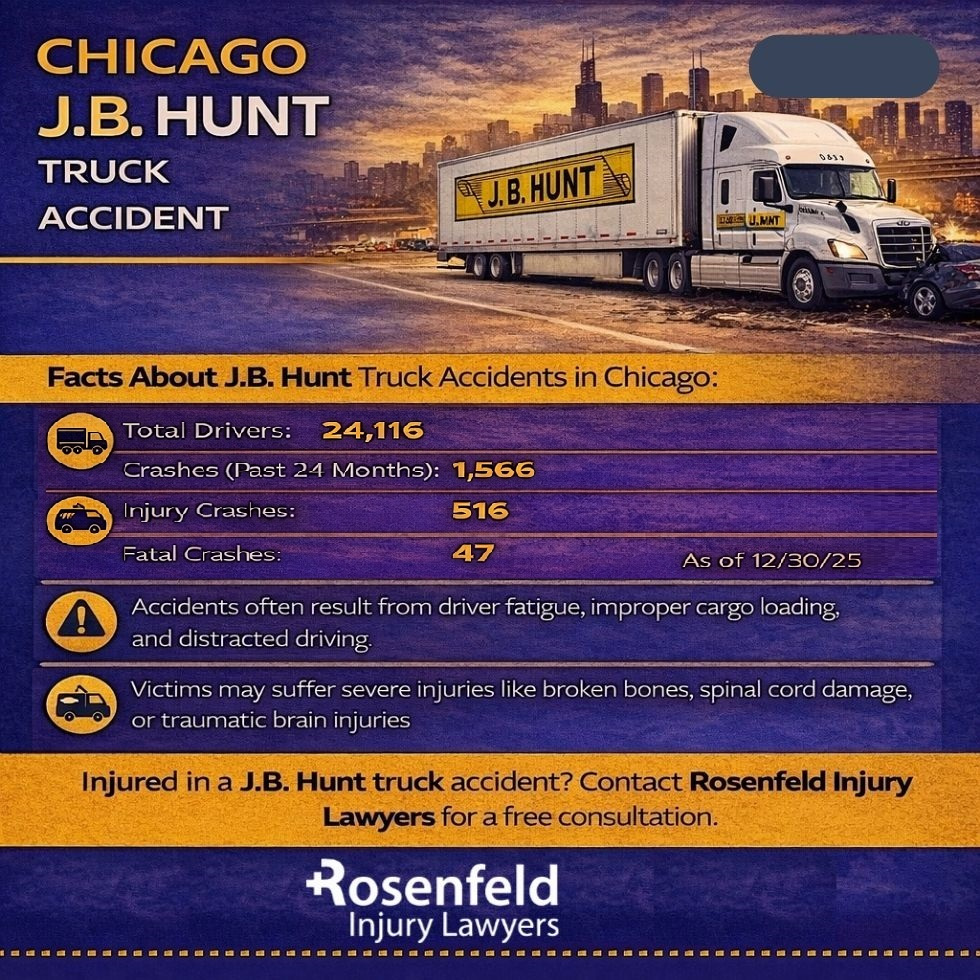
| J B HUNT TRANSPORT INC – Safety Snapshot | |
|---|---|
| USDOT Number | 80806 |
| Mailing Address | 615 J B Hunt Corporate Drive, Lowell, AR 72745 |
| Telephone | (479) 820-0000 |
| Website | https://www.jbhunt.com/ |
| Total Power Units | 25,280 |
| Total Drivers | 24,116 |
| Crashes (Past 24 Months) | 1,566 |
| Injury Crashes | 516 |
| Fatal Crashes | 47 |
| Date | 12/30/25 |
J.B. Hunt truck crash cases often turn on what can be proven about how the truck was being operated, what safety steps were taken before the trip, and whether other parties share responsibility for the condition of the equipment involved. The examples below are personal injury cases involving J.B. Hunt Transport Services.
A federal jury awarded $1,000,000 to a woman after she was injured when a J.B. Hunt Transport, Inc. semi-truck jackknifed and struck the vehicle she was riding in as a backseat passenger.
She suffered a shoulder contusion and muscle strain, but after complaints including headache and cervical and thoracic pain, she ultimately underwent multiple treatments, including injections and a spinal cord stimulator, requiring ongoing migraine treatment and maintenance of the stimulator.
The case proceeded in federal court after the defendants admitted fault, and the trial focused on the extent and duration of Murphy’s injuries.
According to the report, the defense argued her pain should have resolved within weeks and challenged whether the impact could have caused continuing symptoms, while the jury’s verdict reflected acceptance of her ongoing pain and treatment needs.
News reported a $15.57 million verdict in a commercial trucking accident matter, identifying J.B. Hunt Transport as the motor carrier involved.
The report describes the outcome as the result of trial litigation rather than an early settlement and presents the case as one involving serious injuries where damages were proven through medical evidence and the lasting impact of the crash.
ABC7 Chicago reported a $32.5 million jury verdict awarded to an Indiana woman who suffered a devastating brain injury after a chain-reaction crash involving a J.B. Hunt tractor-trailer. The report describes the initial incident as a jackknife in icy conditions and states that the plaintiff’s case alleged the J.B. Hunt driver was traveling too fast for conditions.
According to the reporting, the more catastrophic impact occurred later when the vehicle the plaintiff was riding in lost control on ice and struck the semi, leaving her brain-damaged and wheelchair-bound.
The lawsuit criticized the truck driver’s actions after the initial crash, including allegations involving failure to follow safety steps such as using flashers and placing reflective triangles to warn approaching motorists.
J.B. Hunt is not only a long-haul carrier. It is one of the best-known intermodal operators in the country, and Chicago is exactly the kind of market where intermodal volume reshapes crash risk.
Container moves rely on chassis that may be staged, swapped, or handled across multiple legs, which means a “routine” run can turn into a safety problem when equipment condition and timing pressure collide.
When a crash involves a container and chassis, we treat the identifiers as evidence. A chassis number, container number, and interchange paperwork can reveal whether the equipment was inspected, whether lights and brakes were working, and whether the move began with a preventable defect that never should have reached the road.
Not every crash involving a “J.B. Hunt load” involves a J.B. Hunt-operated truck. Some moves are handled by J.B. Hunt drivers and equipment, while others are arranged through its logistics and brokerage channels and moved by a different motor carrier.
Early identification matters because it determines who controlled the driver, which entity holds the operational records, and what insurance coverage applies. In practice, the case can change significantly once you determine whether the branded name on the paperwork matches the company that actually had the wheel, the dispatch, and the responsibility for safe operation.
J.B. Hunt exposure in the Chicago area concentrates where intermodal freight, distribution traffic, and short-haul terminal runs overlap. The repeat hazards are not scenic stretches of road. They are the corridors where drivers are navigating heavy truck density, short merge zones, and lane compression while trying to meet terminal timing and delivery windows.
Our Chicago truck accident lawyer team often sees the same high-risk patterns build along the I-80 freight corridor, the I-55 spine, and the I-294 connectors, where trucks are constantly moving between intermodal facilities and warehouse clusters.
CenterPoint’s Joliet–Elwood footprint can turn normal driving into stop-start waves of congestion, especially when gate queues, shift changes, and warehouse traffic stack up at the same time. That environment is a repeat setup for rear-end tractor-trailer crashes, forced-merge collisions, and lane-change impacts when a driver tries to recover a slipping schedule.
It also creates a distinct kind of injury exposure because the traffic mix includes bobtails moving between swaps, tractors pulling containers on chassis, and local vehicles trying to enter or exit among heavy trucks that need more space to brake and turn.
Large intermodal ecosystems rely on drop yards and tractor swaps, and those yards create risk that does not look like a typical highway crash. Bobtails move in and out repeatedly, coupling and uncoupling happen under time pressure, and backing decisions are made in tight spaces where visibility is limited.
When injuries occur in this context, the case often depends on whether procedures were followed, whether the yard layout created a foreseeable hazard, and whether the equipment involved was properly maintained and safe to move.
J.B. Hunt cases often rise or fall on proof that does not exist in an ordinary crash file. We preserve container numbers, chassis numbers, interchange receipts, and gate transaction timestamps that show when equipment moved and who had it at each point in the chain.
We also secure dispatch and routing records tied to the move, along with any terminal appointment documentation or facility video that captures yard movement or dock approaches. When the defense tries to narrow the claim to a single moment on the road, these records can show the operational context that created the risk in the first place.
Large carriers generate the most important evidence internally, and that proof does not stay available forever. Telematics events, dispatch communications, and third-party camera footage can disappear quickly, especially when the crash involves an intermodal move where multiple entities hold pieces of the record.
If a J.B. Hunt truck caused your injuries in Chicago, we preserve the electronic trail and equipment identifiers early, then we use them to build a clear timeline of what happened and why it could have been prevented. Contact a Chicago personal injury lawyer from our team before key proof is overwritten, and the carrier’s narrative hardens into the file.
All content undergoes thorough legal review by experienced attorneys, including Jonathan Rosenfeld. With 25 years of experience in personal injury law and over 100 years of combined legal expertise within our team, we ensure that every article is legally accurate, compliant, and reflects current legal standards.