

Chicago Personal Injury Lawyer
Award-Winning Chicago Personal Injury Lawyer - Securing Justice
for Illinois Injury Victims - Over $450 Million Recovered



Knight-Swift trucks move through Chicago every day, from the freight lanes around O’Hare to the industrial belt that feeds I-55 and I-294. When a crash happens, this is not a routine claim. These cases turn on the records the carrier controls, including electronic logging data, dispatch instructions, maintenance history, and post-crash investigative materials.
We move quickly to preserve the proof and build a case that reflects how commercial trucking actually operates in Chicago. If you need a Chicago Knight-Swift Transportation Holdings truck accident lawyer who understands how major carriers defend injury claims, Rosenfeld Injury Lawyers is ready to help.
Knight-Swift Transportation Holdings is a large North American trucking and logistics company headquartered in Phoenix, Arizona. Its operations include major truckload services and logistics lines connected to the legacy Knight and Swift brands.
Scale matters in litigation. Larger fleets mean more freight moving through high-density corridors, more layered corporate decision-making, and more carrier-side records that can help prove what happened and why a safety failure was preventable.
| KNIGHT TRANSPORTATION INC – Safety Snapshot | |
|---|---|
| USDOT Number | 428823 |
| Mailing Address | 2002 West Wahalla Lane, Phoenix, AZ 85027 |
| Telephone | (623) 907-7231 |
| Website | https://knight-swift.com/ |
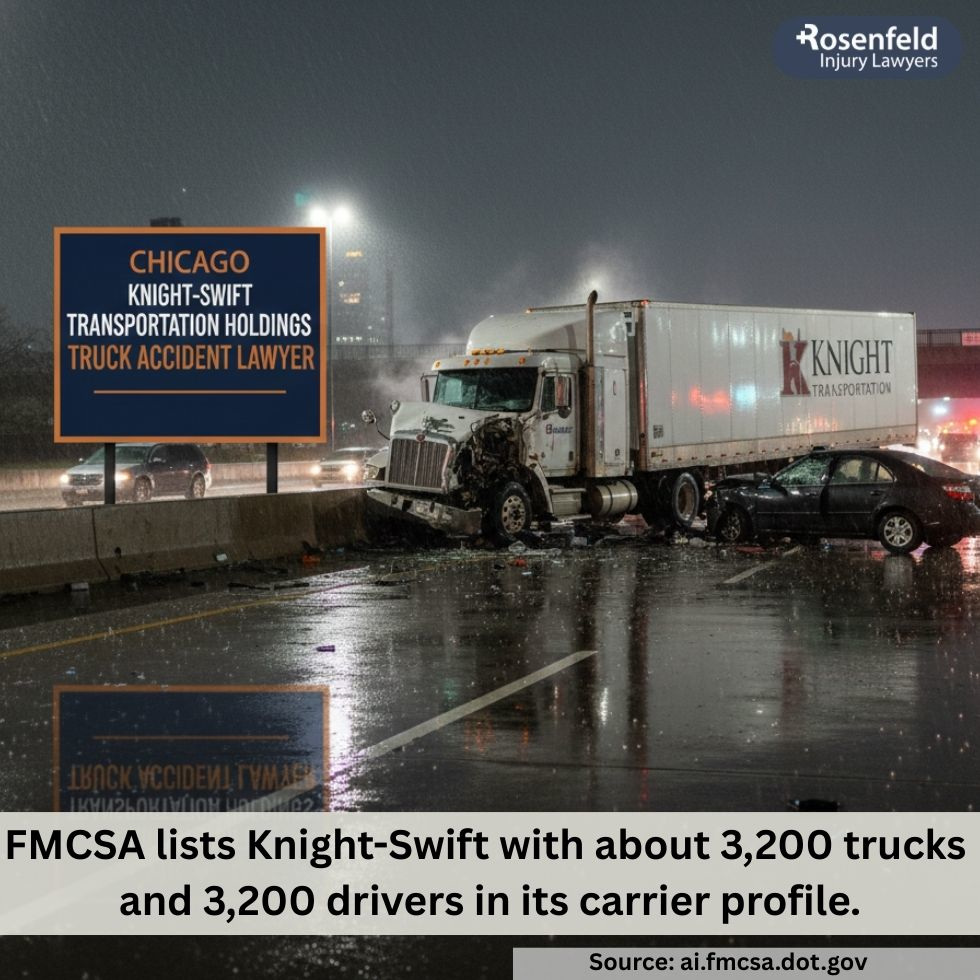
| Total Power Units | 3,200 |
| Total Drivers | 3,200 |
| Crashes (Past 24 Months) | 177 |
| Injury Crashes | 50 |
| Fatal Crashes | 5 |
| Date | 12/30/25 |
When you are up against a national carrier, we focus on the provable record. The following examples involve injury claims connected to Knight-Swift or its truckload operations.
A published report describes a $7.4 million verdict in a case involving a truck driver employed by Knight-Swift, arising from a multi-vehicle crash.
For victims, this matters because it shows how quickly damages can escalate when commercial driving errors cause serious harm. The key is not the location of that case. It is the litigation reality that a large carrier can be held financially accountable when the evidence proves unsafe driving decisions or operational failures.
A published report describes a Cook County jury verdict of $2.4 million in Pitchford v. Knight Transportation, arising from a truck crash involving a Knight tractor-trailer.
This example is especially relevant to Chicago victims because it shows that claims involving the Knight-Swift enterprise have been litigated in Cook County, where juries evaluate the credibility of trucking defenses against the injury evidence.
In Xiong v. Knight Transportation, the plaintiff’s vehicle collided with a Knight Transportation truck while she was merging onto the highway and then rolled multiple times. The jury assigned 60% fault to Knight and 40% fault to the plaintiff, and awarded $832,000 in total damages. After applying the comparative-fault reduction, the judgment was $499,200.
Knight Transportation tried to get a new trial by attacking the damages and the plaintiff’s credibility, including relying on a medical record and post-trial social media photos, but both the district court and the Tenth Circuit rejected those arguments and left the verdict intact.
Knight-Swift operates as a high-volume truckload carrier, and Chicago is one of the places where truckload math breaks down. A trip plan that looks fine on a dispatch screen can become unsafe when it collides with Chicago compression, short ramp spacing, and the stop-start flow created by intermodal surges.
In Knight-Swift cases, we focus on where those pressures show up most clearly and what the records can prove about the driver’s true timeline.
Knight-Swift truckload runs that cut through I-90 and I-94 are exposed to rapid speed changes near downtown interchanges and lane-drop patterns that force sudden braking. These are the conditions that turn a routine lane hold into a rear-end truck crash, especially when a truck is loaded and the driver is trying to stay on schedule in dense traffic.
We preserve the ELD event trail and compare it to dispatch messages and ETA expectations to see whether the driver was pushed into running tighter following distances than Chicago congestion allows.
The I-55 and I-294 spine, with constant freight movement near the Bedford Park and Clearing industrial belt, is one of the most punishing environments for truckload carriers.
Trucks are often required to cross multiple lanes quickly to reach exits, staging areas, and industrial access points. That is where we see side-impact truck collisions, forced merges, and loss-of-control events when drivers try to thread between fast lanes and exit queues.
What makes this more Knight-Swift-specific is the way a truckload network reacts to delay. We look for dispatch-driven reroutes, “make-up time” expectations, and any safety monitoring data that should have flagged risky lane behavior before the crash.
Freight access on I-190 and the I-294 spurs feeding Bensenville and Elk Grove Village creates short-merge conflicts and abrupt braking, especially when trucks are navigating airport-adjacent logistics parks with tight turn zones and heavy local traffic.
In Knight-Swift cases, we test whether the route was scheduled with realistic buffers for O’Hare-side congestion or whether a late pickup or relay effectively forced the driver to compress time in one of the region’s most unpredictable freight corridors.
Intermodal volume linked to the Joliet and Elwood freight corridor can turn highway driving into stop-start queues that punish heavy trucks’ stopping distance. Even when a Knight-Swift truck is not hauling a container, container surges change speed patterns across the same routes that truckload carriers use to move through the region.
We analyze speed variation and hard-braking patterns alongside dispatch timing to determine whether congestion was predictable and whether trip planning accounted for it or ignored it.
Knight-Swift’s scale often depends on trailer pools and drop-and-hook tempo. That operational model creates its own risk set in Chicago, including bobtail tractors repositioning between lots, rushed coupling and uncoupling, and fatigue that rises around shift changes and relay handoffs.
We preserve trailer assignment and swap records, location data, DVIR patterns, and dispatch instructions tied to those moves to determine whether operational pace created the conditions for the collision.
Knight-Swift operates at a scale where the story is rarely limited to a single driver mistake. The risk often starts earlier, with trip planning that assumes Chicago traffic will stay fluid, dispatch expectations that reward making up time, and relay-style operations that rely on trailer pools and drop-and-hook efficiency.
In Knight-Swift cases, we often begin with the bill of lading and the trailer history because the company on the door is not always the only party that shaped the risk.
Shippers, brokers, and receivers can share fault when pickup and delivery windows are unrealistic, when loading practices create stability hazards, or when facility procedures force unsafe staging on access roads.
We also investigate maintenance vendors and trailer owners when a swapped or pooled trailer was involved, and we examine whether a facility’s yard layout, dock approach, or traffic controls created a preventable hazard that pushed danger onto public roads.
Chicago truck crashes often involve sudden compression and heavy merging, which is why we see traumatic brain injuries, including concussions that do not appear clearly on early imaging, along with neck and back injuries that worsen as inflammation sets in.
Side-impact and forced-merge collisions also produce fractures, shoulder and hip injuries, and aggravation of prior spinal conditions when a smaller vehicle is pushed sideways or spun.
When symptoms evolve over days or weeks, our Chicago truck accident law firm builds compensation claims through consistent medical documentation, specialist evaluation when needed, and a clear connection between the crash mechanics and the limitations our clients are living with.
If you are able, photograph the tractor and trailer markings, including the USDOT number, trailer number, and any Knightidentifiers, because those details help confirm the correct carrier entity and preserve the chain of responsibility. Save dashcam footage, and ask nearby businesses or facilities for security video quickly, since many systems overwrite within days.
Write down the crash report number and the responding agency, and keep copies of your discharge instructions and follow-up appointments. In truck cases, early documentation helps protect your health and prevents the carrier from defining the timeline before the evidence is secured.
In Illinois, most personal injury actions must be filed within two years under 735 ILCS 5/13-202. Even when the deadline is months away, waiting can still hurt the case because commercial evidence and witness memory do not improve with time.If you were injured in a crash involving a Knight-Swift truck in Chicago, we build your claim around the evidence that proves fault and the full impact of your injuries. Contact Rosenfeld Injury Lawyers to speak with a Chicago personal injury attorney before the carrier’s version of events becomes the only version in the file.
All content undergoes thorough legal review by experienced attorneys, including Jonathan Rosenfeld. With 25 years of experience in personal injury law and over 100 years of combined legal expertise within our team, we ensure that every article is legally accurate, compliant, and reflects current legal standards.