

Chicago Personal Injury Lawyer
Award-Winning Chicago Personal Injury Lawyer - Securing Justice
for Illinois Injury Victims - Over $450 Million Recovered



A crash involving an Old Dominion Freight Line truck in Chicago is rarely a simple “one-driver” claim. Old Dominion operates as a national LTL carrier, which means its trucks are constantly cycling between terminal yards, tight dock approaches, and multi-stop pickup and delivery runs where backing, short merges, and compressed braking are routine.
We move quickly to secure the proof that defines LTL cases, including the stop sequence, dispatch timing, trailer assignment history, and any terminal or facility video that can be overwritten fast. If you need a Chicago Old Dominion Freight Line truck accident lawyer who understands how LTL carriers defend injury claims, Rosenfeld Injury Lawyers is ready to help.
Old Dominion Freight Line is a less-than-truckload carrier that moves palletized freight through a terminal-based network, combining local pickup and delivery routes with linehaul runs between facilities.
That operating model creates repeat risk patterns in Chicago, especially where industrial access forces frequent lane changes, wide turns into docks, and backing maneuvers in tight yards.
For an injury claim, a Chicago trucking accident lawyer from our team will focus on how the route was built and executed, who controlled the trailer and load at each stage, and what the records show about timing pressure, equipment condition, and the decisions made in the minutes leading up to the crash.
| OLD DOMINION FREIGHT LINE INC – Safety Snapshot | |
|---|---|
| USDOT Number | 90849 |
| Mailing Address | 500 Old Dominion Way, Thomasville, NC 27360-8923 |
| Telephone | (800) 235-5569 |
| Website | https://www.odfl.com |
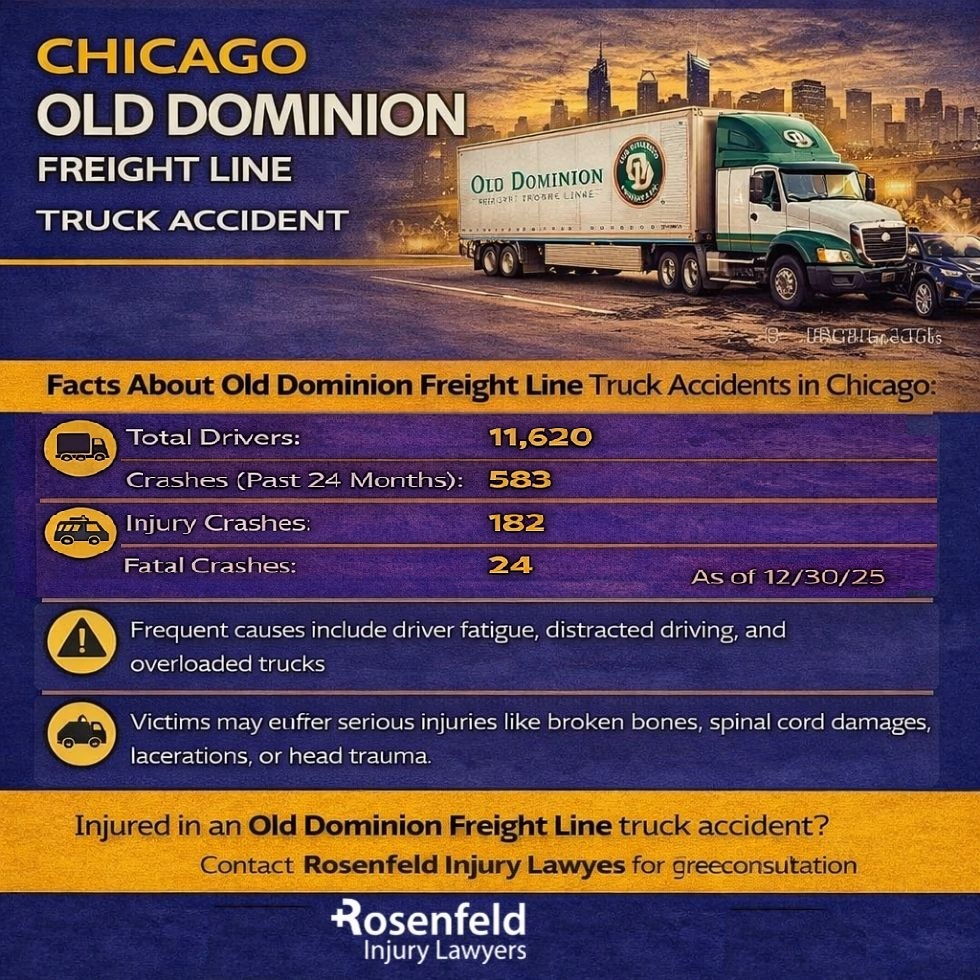
| Total Power Units | 10,974 |
| Total Drivers | 11,620 |
| Crashes (Past 24 Months) | 583 |
| Injury Crashes | 182 |
| Fatal Crashes | 24 |
| Date | 12/30/25 |
Old Dominion appears in crash litigation that ranges from catastrophic injury trials to contested liability cases where the fight turns on right-of-way decisions, visibility, and whether the conduct alleged supports punitive damages. The examples below are grounded in published court opinions and court-hosted records.
A published appellate decision in Old Dominion Freight Line, Inc. v. McMillion states that after a week-long jury trial, the plaintiffs received a combined verdict of $75 million in compensatory damages, and it addresses multiple issues raised on appeal.
The plaintiffs were law enforcement officers and clean-up crew members who alleged exposure to hazardous materials tied to the underlying event, which is why the damages presentation did not resemble a typical two-vehicle injury trial.
In Drake v. Old Dominion Freight Line, Inc., a federal court decision addresses claims arising from a collision involving an Old Dominion-operated semi-truck. The plaintiffs pleaded negligence and loss of consortium and also sought punitive damages.
The opinion describes a fact conflict about visibility and right of way at an intersection, with the driver testifying he perceived no oncoming traffic and the plaintiff testifying he had a clear view of the truck as it crossed into his path.
In Robinson v. Old Dominion Freight Line, Inc., a state supreme court decision describes an injury case where the jury returned a plaintiff’s verdict for $30,000, the trial court ordered a remittitur of $15,000 or a new trial, and the plaintiff accepted the remittitur under protest and appealed.
This is a clean example of how trucking defendants often fight the value of damages after trial, not just fault, especially when they believe an award exceeds what the evidence supports.
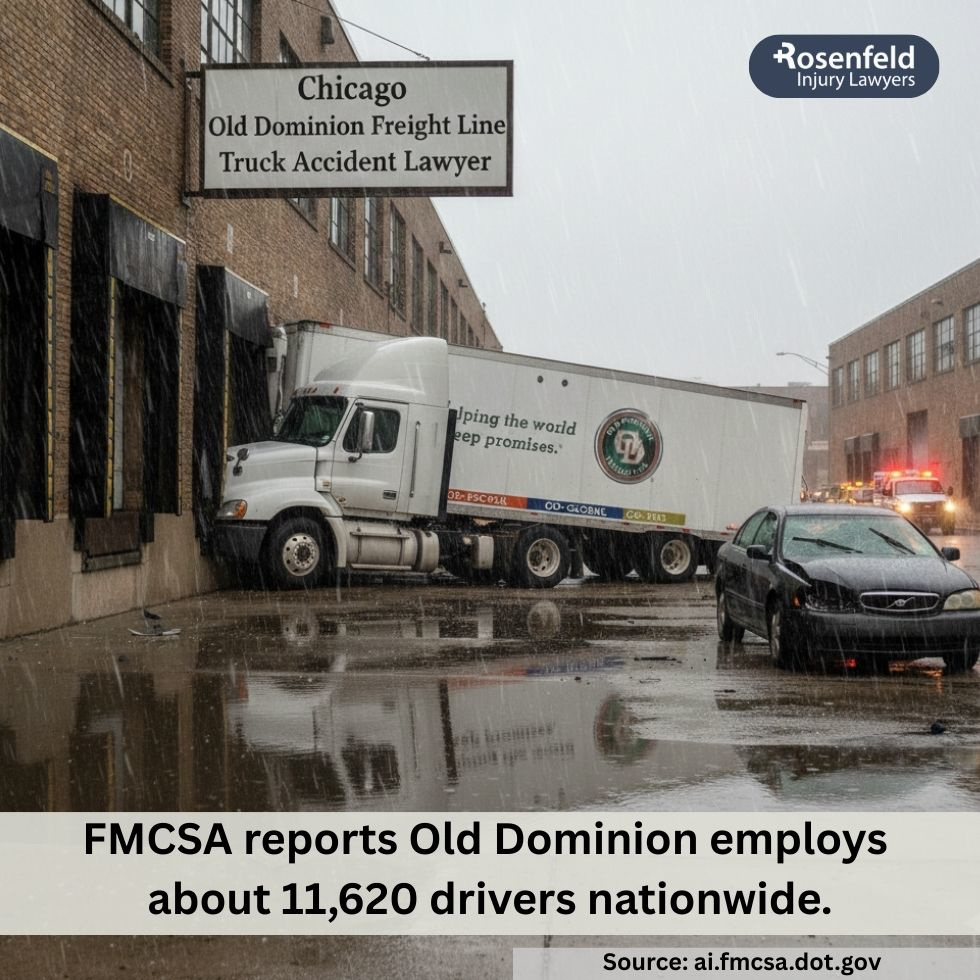
Old Dominion operates as an LTL carrier, and that network runs on terminals, handoffs, and tightly sequenced schedules. In practice, the risk often builds across a day of pickups, yard moves, and linehaul departures, not only in the final seconds before impact.
When routes are compressed, and trailers need to be staged for the next run, the same issues surface in the record: rushed approaches, tight merges back into traffic, last-minute lane positioning near industrial entrances, and decisions made to keep a schedule moving even when Chicago congestion makes the timing unrealistic.
LTL operations frequently involve trailer swaps and, in many fleets, combinations that change how a rig tracks through turns and stops in traffic. A set configuration can increase off-tracking, widen the sweep of turns, and make stopping distance and stability more sensitive to speed changes.
In crash investigations, we document the configuration involved and preserve the identifiers tied to the tractor and each trailer, because liability and maintenance questions often follow the equipment, not just the driver.
Old Dominion cases do not always start on an expressway. They can start in the yard, at the dock, or in a tight industrial approach where backing and repositioning are part of normal operations.
Backing incidents, blind-zone impacts, and conflicts at dock entrances often depend on the site layout, whether the maneuver was necessary, and whether basic precautions were taken to protect people moving through the area.
When the crash is tied to a facility approach, we also examine whether yard procedures and access design pushed preventable risk onto the roadway.
LTL carriers generate a different evidence set than truckload fleets. In many Old Dominion cases, the most persuasive proof comes from records that show how the freight was staged and moved through the network, including which trailer was assigned, when it was swapped, and how the route was sequenced.
We often focus on dispatch timing, trailer assignment history, terminal check-in and gate activity, linehaul scheduling records, and any facility video that captures yard moves or dock approaches. Those details can confirm whether the run was built safely or whether the schedule and staging choices made a collision more likely.
Old Dominion’s work in Chicago tracks where industrial access, dock traffic, and terminal-driven freight density overlap. The repeated hazards are not scenic stretches of highway. They are the corridors where trucks are constantly merging, turning into facilities, and maneuvering near congested entrances.
The freight belt around Cicero Avenue and 47th Street feeding I-55 and I-294 is built for constant truck movement, but it still produces the same predictable conflict points: stacked traffic at lights, short gaps for turns into industrial driveways, and lane changes packed into a few hundred feet near entrances.
Collisions in this corridor often involve sideswipes, rear-end impacts in compressed braking, and turn-related crashes tied to wide swings into facilities or abrupt corrections when a driver realizes too late that an entrance was missed.
Freight surges in the Joliet–Elwood corridor feeding CenterPoint bring long lines of trucks into stop-start patterns that increase the risk of rear-end crashes and lane-change impacts. When traffic stacks and moves in waves, following distance and speed variation become decisive evidence points.
For LTL carriers, that corridor also reflects the broader logistics reality: tight linehaul timing and staging requirements can push drivers into decisions that look small in isolation but become dangerous when congestion is already doing the same to every vehicle around them.
In Old Dominion cases, the defense often tries to narrow the claim to a single driver decision while minimizing the operational context that made that decision more likely. It is common to see arguments that the injured person moved unpredictably, entered a blind zone, or failed to yield, especially in backing or turn-related incidents.
We also see efforts to shift responsibility toward a shipper, receiver, or facility layout when the crash occurred near a dock or yard entrance, along with damage defenses that hinge on minimizing injury severity or disputing causation when symptoms evolve over time.
If you are able, photograph the tractor and trailer identifiers, including the USDOT and MC numbers, tractor unit numbers, and every trailer number involved, especially if more than one trailer is attached. Document the configuration, the point of impact, and the roadway markings that show how the vehicles were positioned.
If the crash happened near a facility, photograph the entrance, dock approach, signage, and any cameras that may have captured the maneuver. Write down the crash report number and responding agency, then save your own photos and dashcam footage immediately so the timeline can be reconstructed before key evidence is overwritten.
Illinois generally gives injured people two years to file a personal injury lawsuit under 735 ILCS 5/13-202. In freight cases, the bigger threat is evidence loss, not the calendar, because stop data, yard footage, and dispatch communications can disappear before the claim is fully understood.
If an Old Dominion Freight Line truck caused your injuries in Chicago, we build the case around preserved LTL records, trailer and route identifiers, and a clear timeline that shows how the collision could have been prevented. Contact Rosenfeld Injury Lawyers to speak with a Chicago personal injury attorney before critical proof is overwritten, and the carrier’s version becomes the only version left.
All content undergoes thorough legal review by experienced attorneys, including Jonathan Rosenfeld. With 25 years of experience in personal injury law and over 100 years of combined legal expertise within our team, we ensure that every article is legally accurate, compliant, and reflects current legal standards.