

Chicago Personal Injury Lawyer
Award-Winning Chicago Personal Injury Lawyer - Securing Justice
for Illinois Injury Victims - Over $450 Million Recovered



A collision with a Schneider National tractor-trailer in Chicago often raises questions that do not come up in ordinary crash claims.
Schneider runs a large national fleet that includes dedicated contract freight, intermodal drayage, and long-haul truckload operations, which means a single crash can involve multiple layers of responsibility tied to equipment, dispatch expectations, and customer-driven schedules.
We move quickly to secure the records that explain what was happening before impact, including electronic logs, trip and dispatch data, tractor and trailer assignment history, onboard event data where available, and maintenance documentation that can reveal whether a preventable defect was already in the file.
If you need a Chicago Schneider National truck accident lawyer who knows how large-carrier cases are built, Rosenfeld Injury Lawyers is ready to help.
Schneider National is a major transportation and logistics carrier with truckload, dedicated, and intermodal operations moving freight through the Midwest and into the Chicago freight network. Its trucks regularly operate on the expressway ring and industrial connectors that feed rail hubs, distribution centers, and high-volume shipping corridors.
For an injury claim, the key is connecting the crash to the operational context behind it: whether the run was intermodal or dedicated, what time pressures were in play, what equipment was assigned, and what the carrier’s own records show about driver readiness, route planning, and equipment condition.
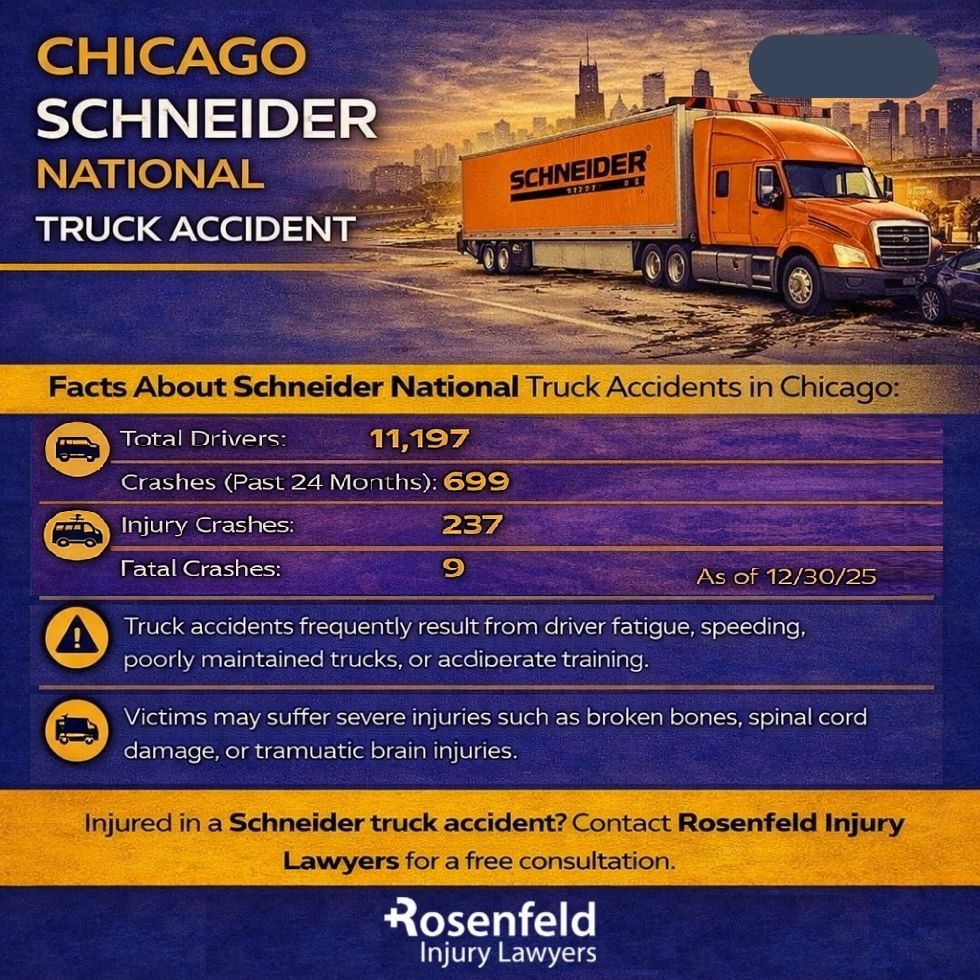
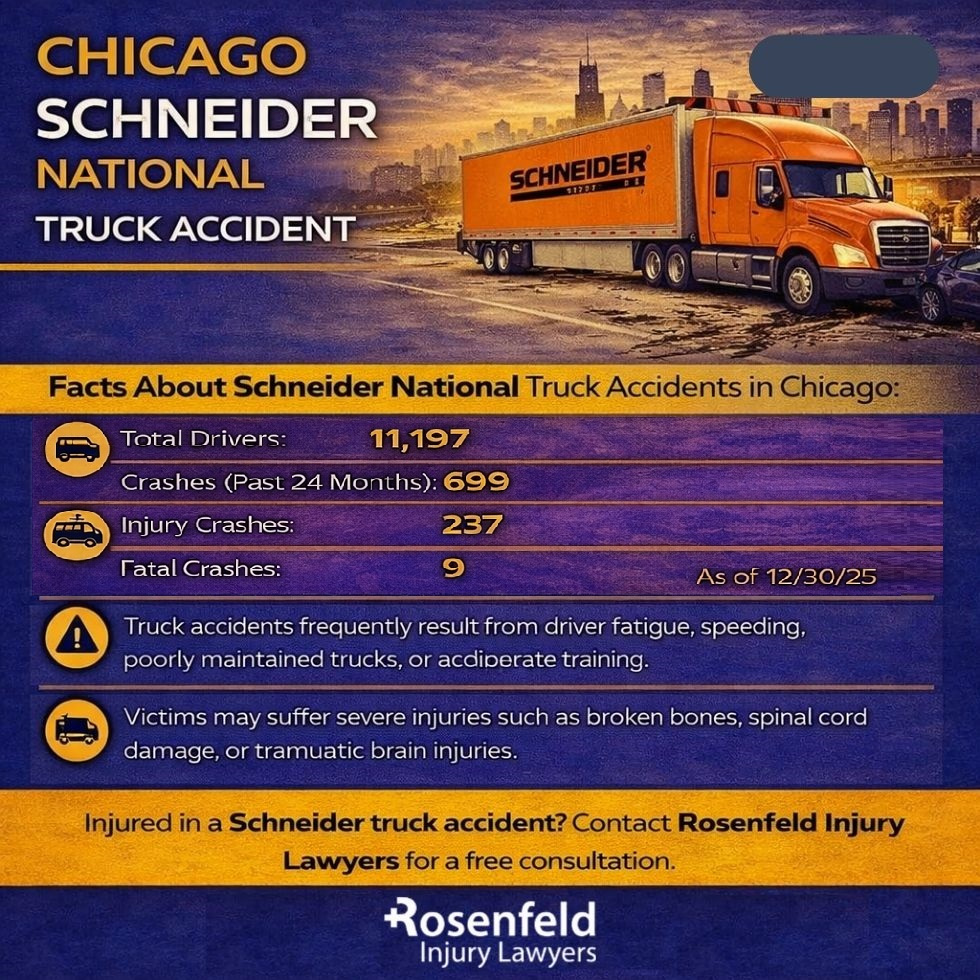
| SCHNEIDER NATIONAL CARRIERS INC – Safety Snapshot | |
|---|---|
| USDOT Number | 264184 |
| Mailing Address | 3101 South Packerland Drive, Green Bay, WI 54313 |
| Telephone | (800) 558-6767 |
| Website | https://schneider.com/ |
| Total Power Units | 9,959 |
| Total Drivers | 11,197 |
| Crashes (Past 24 Months) | 699 |
| Injury Crashes | 237 |
| Fatal Crashes | 9 |
| Date | 12/30/25 |
Schneider appears in high-stakes crash litigation where the outcome is driven by what can be proven about preventability, prior knowledge, and how the work was structured.
FreightWaves reported a jury award of more than $47 million to the family of an owner-operator killed in a crash involving a former Schneider driver.
The case is one where the plaintiff’s theory extended beyond the collision itself and into what the carrier allegedly knew before the crash and whether it acted on that information. The scale of the award reflects how catastrophic-loss cases can expand when a jury is presented with evidence of preventable risk at the operational level, not only a momentary driving error.
A report describes a $36,482,302.56 verdict against Schneider National Carriers and provides a breakdown of damages, including economic and non-economic components, along with a liability finding as to Schneider.
In cases of this scale, the damages presentation typically hinges on hard proof of long-term medical consequences, future care needs, and how the injuries altered work capacity and daily function.
The verdict figure reflects not only the severity of harm but the jury’s acceptance of a narrative that the collision was preventable under the safety standards expected of a professional carrier.
A jury award of $4.6 million in a crash-related crush injury matter involving Schneider was reduced to $2,530,000 based on comparative negligence and further reports a final amount of $2,912,688.49 after the court added delay damages.
Even when the trial number changes after post-verdict motions and fault allocation, this type of case illustrates how commercial-vehicle injury claims can turn on equipment movement, control of the work area, and whether safety steps were followed before the incident.
It also shows why carriers often litigate damages aggressively even after liability is established, especially when the injury mechanism produces long-term impairment.
Schneider has a major intermodal footprint, and that changes how crashes happen. Intermodal work is built around pickups and drops tied to terminal timing, container availability, and gate queues that can stretch a “simple move” into a time-compressed run.
When drivers are cycling between terminals and distribution centers, the risk pattern tends to cluster around short merges, abrupt lane positioning near exits, and rear-end collisions in stop-start congestion where a loaded chassis cannot stop like a passenger vehicle.
Intermodal crashes are often equipment-driven in ways ordinary truckload cases are not. A container move may involve a chassis that is swapped, staged, or handled by multiple parties, which means the evidence has to identify the chassis and container, not only the tractor.
We preserve the chassis number, container number, interchange documentation, and any inspection records that show whether lights, tires, brakes, and securement were in safe condition. When a mechanical issue is alleged, those identifiers are often the fastest path to proving where responsibility actually sits.
Schneider also runs large dedicated fleets where drivers repeat the same lanes for the same customer day after day. That consistency can create predictable risk points, especially when delivery windows and dock procedures reward speed over margin.
In Chicago, dedicated freight often means recurring bottlenecks at the same distribution corridors and the same shift-change surges, so we test whether the schedule was realistic for the route and whether the carrier’s expectations pushed drivers into unsafe decisions to stay on time.
Schneider’s Chicago crash exposure is heavily influenced by intermodal flow and industrial access, not neighborhood delivery dynamics. The highest-risk locations tend to be where terminal moves and distribution traffic overlap and where drivers are forced into tight merges, fast lane changes, and stop-start traffic around freight entrances.
We commonly see severe collision patterns build along the I-55 and I-294 freight spine, where trucks are constantly positioning for exits, re-entering traffic after industrial stops, and braking hard when lanes compress without warning.
Freight density near BNSF Corwith Yard adds another layer of complexity because intermodal activity pulls heavy truck traffic into industrial arterials where sightlines are limited and turning space is tight. Container and chassis moves near rail hubs increase the frequency of wide turns, short approach lanes, and backing maneuvers near facility entrances.
When a crash occurs in this environment, we tie the scene evidence to the intermodal paper trail, including gate activity and equipment identifiers, so the case does not collapse into a finger-pointing fight over who controlled the chassis or the container on that move.
Intermodal operations generate their own proof set, and those documents can answer questions that a crash report will never address. Gate transaction times, interchange receipts, terminal appointment logs, and dispatch instructions can show whether the run was built around congestion realities or treated like open-road miles.
We use those records to reconstruct the timeline and to pinpoint which tractor, chassis, and container were involved, which is essential when responsibility may be spread across carrier operations, terminal procedures, and equipment handling.
Intermodal defense strategies often focus on narrowing responsibility to the driver alone or shifting the equipment issue to someone else. It is common to see arguments that the chassis was outside the carrier’s control, that terminal procedures were followed, or that a mechanical issue could not have been detected before the move.
We counter those defenses by locking down identifiers, interchange documentation, and timing records early, then aligning them with the physical evidence and the crash sequence so the case is built around verifiable proof rather than competing narratives.
Chicago trucking accident cases can turn on evidence that is time-sensitive, especially when the carrier’s internal systems hold the most important answers. Delays can mean lost video, overwritten telematics, and dispatch or routing records that are harder to recover once the defense has shaped the file.
If a Schneider truck caused your injuries in Chicago, we preserve the electronic trail and the equipment records early, then we use them to build a clear timeline of what happened and why it could have been prevented. Contact Rosenfeld Injury Lawyers to speak with a Chicago personal injury lawyer before critical proof disappears and the case becomes harder to prove.
All content undergoes thorough legal review by experienced attorneys, including Jonathan Rosenfeld. With 25 years of experience in personal injury law and over 100 years of combined legal expertise within our team, we ensure that every article is legally accurate, compliant, and reflects current legal standards.