

Chicago Personal Injury Lawyer
Award-Winning Chicago Personal Injury Lawyer - Securing Justice
for Illinois Injury Victims - Over $450 Million Recovered



A collision involving a UPS truck in Chicago can happen in a blink, then turn into months of treatment, missed work, and calls from insurers who want to lock in your version of events before the full picture is clear.
UPS runs constant delivery routes across the city, and that pace creates recurring hazards, especially around curbside stops, frequent right turns, and tight maneuvering in traffic that never really opens up.
We act quickly to preserve the records that define UPS cases, including route and stop data, vehicle identifiers, driver communications where available, and nearby video footage that can disappear within days. If you need a Chicago UPS truck accident lawyer who knows how delivery-truck claims are built and defended, Rosenfeld Injury Lawyers is ready to help.
United Parcel Service (UPS) is one of the largest parcel delivery carriers in the world, moving shipments through a network that includes local package car routes, hub-and-spoke sorting operations, and linehaul transportation between facilities.
For an injury claim, the critical questions are practical: which UPS operation and vehicle type was involved, who controlled the driver that day, what the route demanded, and what the records show about timing, stops, and safety practices in the hours leading up to the crash.
| UNITED PARCEL SERVICE INC – Safety Snapshot | |
|---|---|
| USDOT Number | 21800 |
| Mailing Address | 55 Glenlake Parkway NE, Atlanta, GA 30328 |
| Telephone | (404) 828-2525 |
| Website | https://www.ups.com/us/en/home |
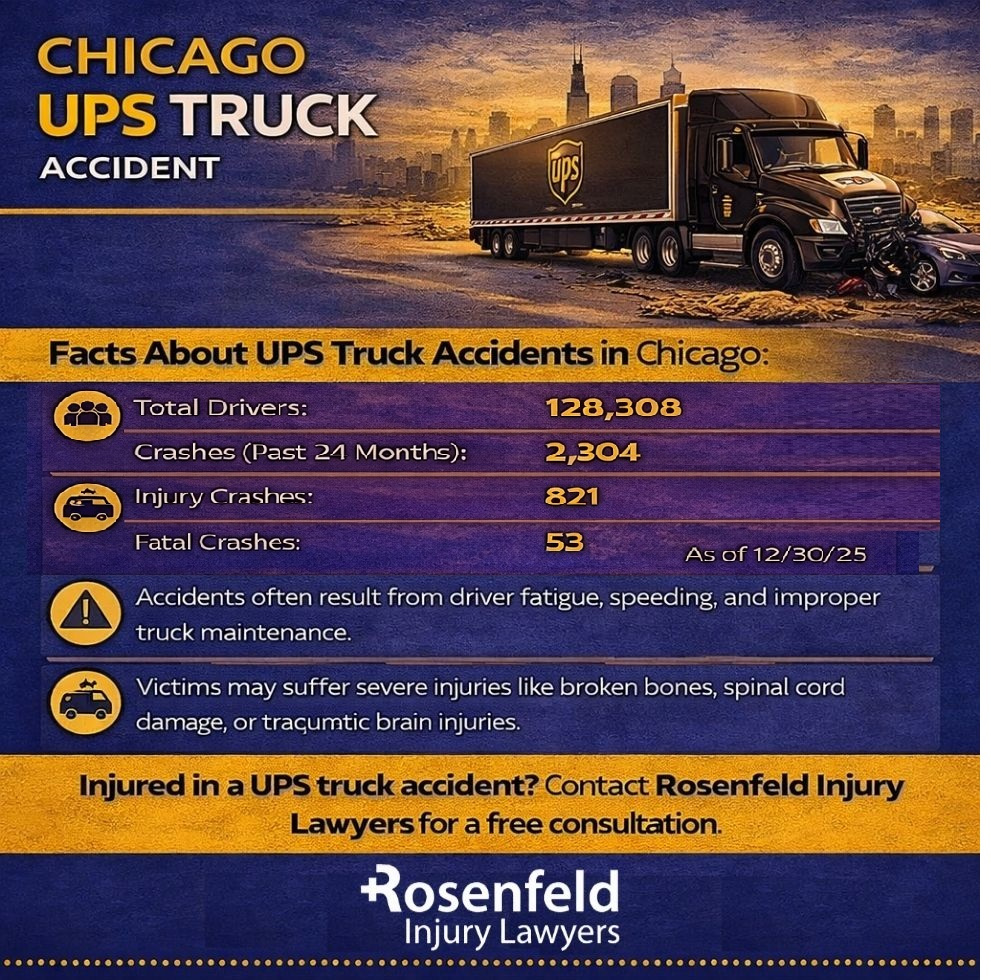
| Total Power Units | 117,153 |
| Total Drivers | 128,308 |
| Crashes (Past 24 Months) | 2,304 |
| Injury Crashes | 821 |
| Fatal Crashes | 53 |
| Date | 12/30/25 |
UPS injury cases range from package car collisions during local routes to tractor-trailer crashes that trigger complex litigation over fault and damages.
Court reporting describes a crash in which a UPS driver ran a stop sign and caused a catastrophic brain injury, followed by litigation focused heavily on the scope of damages and the medical proof supporting long-term impairment.
On appeal, UPS challenged the result, but the court upheld the judgment, reflecting a record that the appellate court considered strong enough to survive a post-trial attack.
A published case summary reports a brain injury crash case that resulted in $65 million in compensatory damages, plus $10 million in prejudgment interest, for a $75 million total judgment.
The summary describes the case as one where damages were central, with the final number reflecting both the jury’s valuation and the way interest accumulated through the litigation timeline.
Court reporting described a wrongful death case arising from a truck crash involving a UPS tractor-trailer, with the award including damages to the estate and a separate loss of consortium award to the spouse.
The appeal focused on trial-level issues, but the appellate court left the verdict intact, showing how these cases can remain defensible when liability and damages are supported by consistent testimony and documentation.
A reported case alleged a double-parked UPS truck contributed to a collision, a scenario that often turns into a fight over visibility, lane obstruction, and whether the stopping choice created a hazard for approaching traffic.
The report describes a jury verdict that included $1.5 million for pain and suffering and notes the total recovery was reported as $1.78 million, illustrating how a delivery decision at the curb can become the core liability issue.
Media reporting described litigation where a court found a UPS driver’s negligence was the sole cause of a crash and awarded $27 million in damages, followed by an appeal that raised procedural and evidentiary arguments.
This type of case often turns on whether the defense can create doubt through technical issues and trial rulings, even when liability is already framed as driver-caused in the record.
A UPS truck attempted to pass and then moved back into the plaintiff’s lane, causing a crash that resulted in alleged neck and back injuries, including disc herniations. The settlement is an example of how lane-encroachment impacts by delivery vehicles can produce high-value claims when treatment, imaging, and limitations are documented consistently.
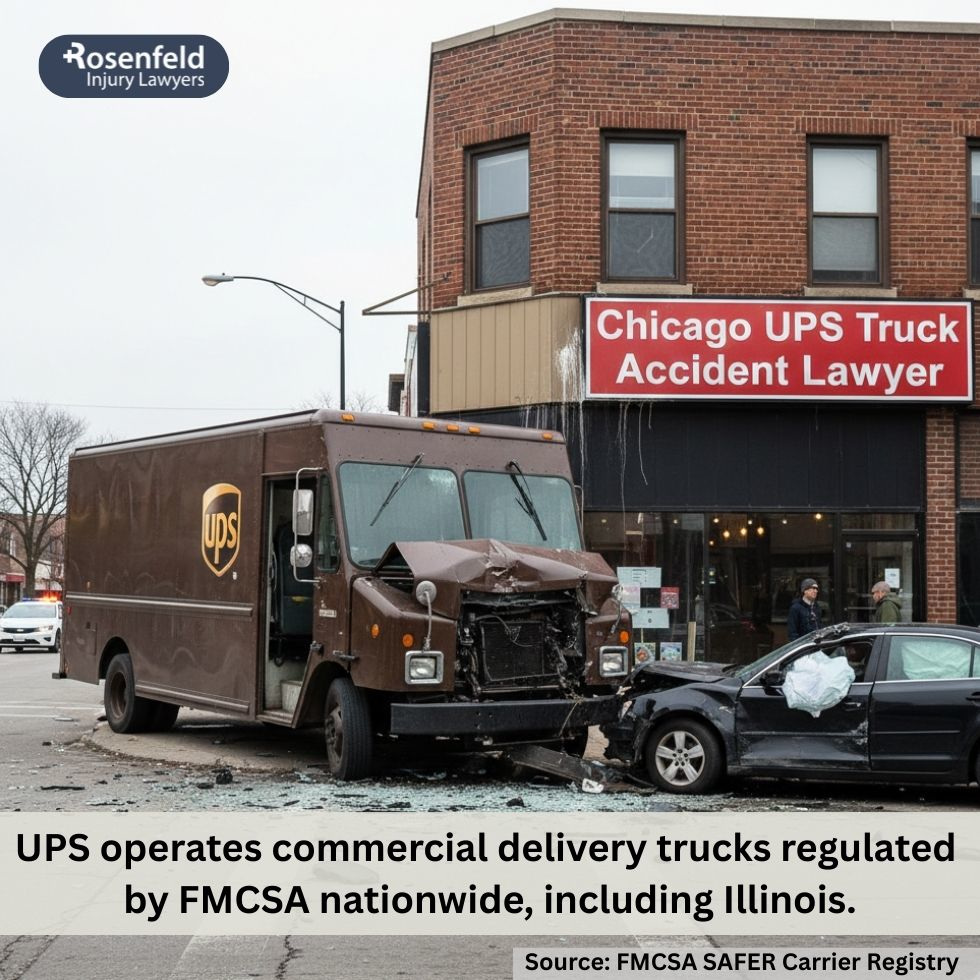
UPS traffic in Chicago is not one-size-fits-all. Some collisions involve local package cars making constant curbside stops, others involve box trucks handling heavier commercial routes, and some involve UPS tractor-trailers running linehaul between facilities.
The vehicle type changes everything from turning radius and blind spots to the records available after the crash, so our Chicago truck accident attorney team identifies it early and builds the investigation around how that unit was operating that day.
UPS delivery work creates a time-stamped trail that can confirm where the truck was, when it stopped, and how the driver moved through a route. In many UPS cases, the most persuasive proof comes from the stop sequence and timing records, not the driver’s recollection after the fact.
We focus on route assignments, stop data, GPS or telematics, and any handheld delivery documentation that can reconstruct the minutes before impact and expose whether the driver was rushing to recover time or making decisions that increased risk.
UPS vehicles spend much of the day pulling out from curbs, crossing traffic lanes to set up turns, and making frequent right turns in dense flow. That pattern creates repeat crash scenarios, especially when a delivery vehicle swings wide, cuts back, or turns across space used by cyclists and pedestrians.
We tie the truck collision to the route context, including the delivery location, the stop the driver was approaching, and the street conditions that made visibility and speed control essential.
Some of the most serious UPS truck accident cases occur at low speeds during delivery and pickup maneuvers. Backing into alleys, turning into tight dock approaches, or repositioning in crowded lots can put people directly into blind zones where a driver cannot see them.
These cases often depend on the site layout, whether a safe backing process was followed, and whether the stop choice itself created a preventable hazard for people moving through the area.
UPS routes concentrate where delivery density meets freight access and constant congestion. The highest-risk areas are typically the places where drivers are forced into repeated stops, short merges, and tight turns while trying to keep a route moving.
Delivery traffic around the O’Hare side freight lanes often runs through I-190 and the I-294 spurs, with constant movement in and out of warehouse entrances and tight turn zones. In this environment, short merges, sudden slowdowns, and curbside decisions can turn a routine stop into a collision.
The Cicero Avenue and 47th Street corridor feeding I-55 and I-294 is packed with commercial driveways, staging choices, and heavy truck presence. Common crash patterns include sideswipes, rear-end impacts in stacked traffic, and turn-related conflicts when a delivery vehicle has to re-enter the flow quickly.
Freight density near BNSF Corwith Yard increases the complexity of truck traffic on surrounding industrial arterials. When congestion builds and sightlines are tight, delivery vehicles are more likely to be involved in turning conflicts, backing incidents near facilities, and lane-change crashes driven by last-second positioning.
UPS cases often involve early efforts to narrow the claim to a momentary mistake or to shift responsibility away from the driver’s delivery decisions. It is common to see arguments about right of way, sudden movement by the injured person, or claims that the impact was minor and could not have caused serious injury.
We counter those strategies with route-level proof, consistent medical documentation, and a timeline that shows the collision was not random, but the predictable result of choices made in a high-risk delivery environment.
If you are able, photograph the UPS branding, the unit number, and the USDOT information on the vehicle, along with any trailer identifiers if a trailer is involved. Document the delivery location, lane markings, curb position, and the vehicle’s placement before it is moved.
If there are nearby cameras, note the business name and exact address so footage can be requested before it is overwritten, and keep the crash report number and responding agency information so the timeline can be matched to official records.
Illinois generally gives injured people two years to file a personal injury lawsuit under 735 ILCS 5/13-202. In delivery-truck cases, evidence usually becomes the limiting factor long before the filing deadline does.
If a UPS vehicle caused your injuries in Chicago, we build the case around preserved route records, vehicle identifiers, and a clean timeline that shows how the collision could have been prevented. Contact Rosenfeld Injury Lawyers to speak with a Chicago personal injury lawyer before key proof is overwritten, and the carrier’s account becomes the only one that survives.
All content undergoes thorough legal review by experienced attorneys, including Jonathan Rosenfeld. With 25 years of experience in personal injury law and over 100 years of combined legal expertise within our team, we ensure that every article is legally accurate, compliant, and reflects current legal standards.