

Chicago Personal Injury Lawyer
Award-Winning Chicago Personal Injury Lawyer - Securing Justice
for Illinois Injury Victims - Over $450 Million Recovered



A U.S. Xpress tractor-trailer crash in Chicago can leave you dealing with far more than vehicle damage. When a commercial truck hits a passenger car, the injuries often involve weeks of treatment, lost income, and a claims process that starts working the case before you have a full diagnosis.
The proof that decides fault is usually not on the crash report. It is in the carrier’s records: electronic logs, dispatch and route data, onboard tracking, and the inspection history for the tractor and trailer that entered Chicago traffic.
Rosenfeld Injury Lawyers acts quickly to secure that evidence and build a case that reflects what actually happened. If you need a Chicago U.S. Xpress truck accident lawyer, we are ready to help.
U.S. Xpress is a major interstate trucking carrier tied to long-haul freight and high-volume routing through large metro corridors.
That scale matters because safety failures can originate well before the moment of impact, including trip planning that leaves no margin for congestion, supervision gaps, and equipment issues that show up in maintenance records only when someone pulls them.
For an injury claim, we confirm the correct U.S. Xpress-related entity connected to the truck, capture the tractor and trailer identifiers, and reconstruct the run’s timeline so responsibility cannot be blurred by paperwork or shifting explanations.
| US XPRESS INC – Safety Snapshot | |
|---|---|
| USDOT Number | 303024 |
| Mailing Address | 4080 Jenkins Rd, Chattanooga, TN 37421 |
| Telephone | (423) 510-3000 |
| Website | https://www.usxpress.com/ |
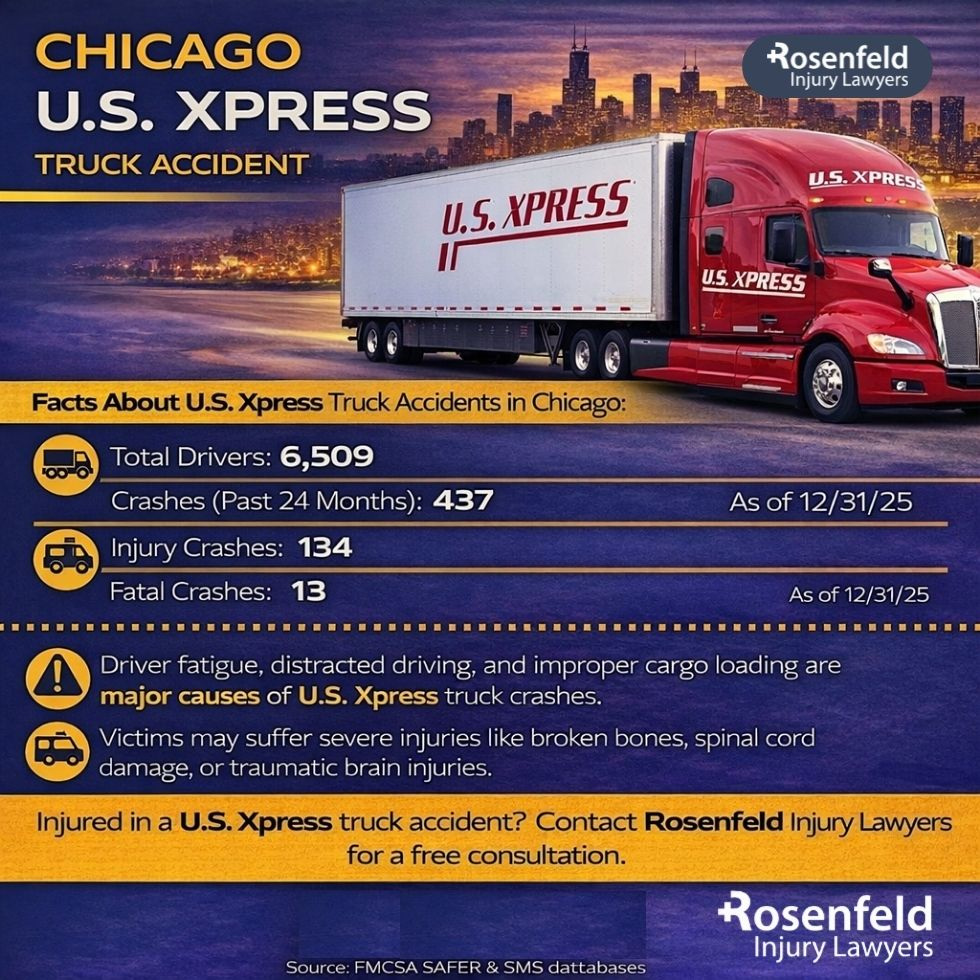
| Total Power Units | 5,738 |
| Total Drivers | 6,509 |
| Crashes (Past 24 Months) | 437 |
| Injury Crashes | 134 |
| Fatal Crashes | 13 |
| Date | 12/31/25 |
A tractor-trailer crashed into a line of vehicles in front of it, triggering a catastrophic chain reaction. Five people were killed, and one person survived with a traumatic brain injury. The trucking defendants included Total Transportation and U.S. Xpress-related entities.
A jury placed full responsibility on the defense side and returned a $15,000,000 verdict, with reports also describing punitive-damages findings and a confidential high-low arrangement used while the jury deliberated.
In another litigated truck crash, a jury awarded $1,500,000 in damages and assigned 3% of the fault to U.S. Xpress, with the remainder attributed to other parties. The appellate record describes later disputes over how that jury allocation interacted with a high-low agreement and the post-trial motions that followed, including a new-trial order referenced in the opinion.
A tire failure on a tractor-trailer allegedly sent debris into the roadway, leading to a fatal crash. The truck was tied to a U.S. Xpress-related entity, and the accident resulted in a $6,800,000 verdict.
The fact pattern matters in trucking litigation because tire and truck maintenance cases often turn on inspection documentation, prior defect write-ups, and whether the carrier can show a consistent maintenance and replacement program for critical components.
In Annese v. U.S. Xpress, Inc., the court record describes allegations that a tractor-trailer moved into a motorist’s lane during a turning sequence and struck her vehicle, with the driver leaving the scene.
The litigation is notable for how it addresses claims aimed at the carrier itself and disputes over what internal crash investigation materials reveal and what plaintiffs can obtain through discovery when they allege broader corporate responsibility beyond the driver’s conduct.
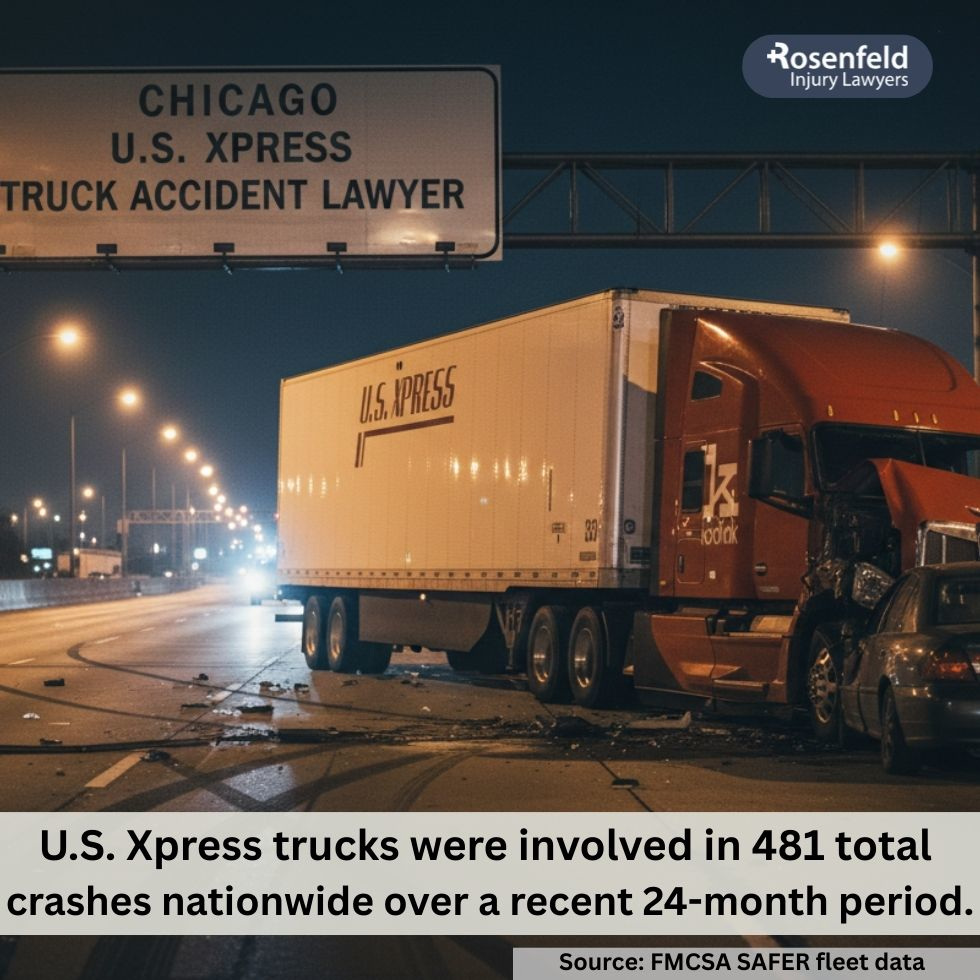
Some truck crashes that people describe as “U.S. Xpress” cases involve related companies operating within the same corporate family or network.
Total Transportation is one of the names that can appear in litigation tied to U.S. Xpress, which is why identification is not a cosmetic detail. It affects which safety records exist, which insurance layers apply, and which corporate policies are actually in play when a tractor-trailer enters Chicago traffic.
In a serious truck crash claim, we confirm the operating authority tied to the unit, document the USDOT and equipment identifiers, and lock down the responsible entity early so the case does not get rerouted into confusion or finger-pointing.
U.S. Xpress runs through Chicago on corridors where long-haul speeds collide with sudden congestion.
On the I-294 Tri-State Tollway, drivers are constantly sorting for interchanges and exits, and late lane commitments can create abrupt braking waves that ripple back into rear-end impacts.
On I-90/94 through the Kennedy and Dan Ryan segments, traffic can collapse without warning near merges and split points, forcing heavy trucks to slow quickly in tight space.
On I-80, the hazard is often closing speed: drivers transition from higher-speed flow into stop-and-go conditions, and one misjudged gap can trigger a chain reaction involving multiple vehicles.
U.S. Xpress settlements and verdict examples include catastrophic rear-end sequences, and those cases are rarely decided by speculation about what the driver “should have done.” They are decided by what the truck’s timeline shows in the seconds before impact.
We focus on speed change patterns, brake application timing, and whether the driver had a realistic stopping window based on traffic conditions.
In the worst chain-reaction crashes, the record often reveals the same core questions: how long the truck was closing on slowing traffic, whether the driver responded early enough, and whether the carrier’s safety oversight allowed predictable risk to build into a high-speed corridor.
A tire failure that sends debris into traffic is a different kind of truck crash case.
Liability frequently turns on whether the carrier can show consistent inspection, replacement, and maintenance practices for critical components. The condition of the tire matters, but so does the documentation that proves whether the condition should have been caught before the truck entered service.
In these cases, we pursue the inspection cadence, tread and casing documentation, roadside repair history, replacement records, and any prior defect write-ups tied to the tractor-trailer. When maintenance is treated as paperwork rather than safety, the gap often shows up clearly once the records are assembled in order.
Some catastrophic truck cases go all the way to a jury, with the parties setting a floor and a ceiling for the financial outcome. That structure does not change what must be proven. The verdict still turns on the strength of liability evidence and the credibility of the medical and life-impact story.
What it does show is how trucking defendants evaluate risk when the facts are hard to explain away. When a carrier faces a clean timeline of avoidable impact mechanics and well-supported damages, the case posture can shift from delay tactics to controlling exposure.
For a U.S. Xpress page, Union Pacific Global 4 in Joliet is a useful freight reference point because it sits within a corridor where intermodal volume and long-haul truck movement blend into the same approach routes.
As that activity surges, congestion and staging effects can spill onto the surrounding highways and arterials, increasing the risk of sudden slowdowns and forced merges that punish heavy trucks with limited stopping distance.
When a truck crash connects to this freight ecosystem, we reconstruct the approach sequence and timing, then match it to dispatch and trip data to understand whether the run was planned with any margin for real-world bottlenecks.
Illinois law (735 ILCS 5/13-202) generally gives injured victims two years to file a personal injury lawsuit, but trucking evidence can disappear long before that deadline. Logs can be overwritten, internal communications can be lost under retention rules, and third-party video can be recycled in days.
If a U.S. Xpress truck caused your injuries in Chicago, contact Rosenfeld Injury Lawyers to speak with a personal injury lawyer and start preserving the records that can prove fault and the full value of your claim.
All content undergoes thorough legal review by experienced attorneys, including Jonathan Rosenfeld. With 25 years of experience in personal injury law and over 100 years of combined legal expertise within our team, we ensure that every article is legally accurate, compliant, and reflects current legal standards.