

Chicago Personal Injury Lawyer
Award-Winning Chicago Personal Injury Lawyer - Securing Justice
for Illinois Injury Victims - Over $450 Million Recovered



A Werner Enterprises truck crash in Chicago can turn a normal day into months of recovery, missed paychecks, and insurer pressure to “wrap it up” before your injuries have a name.
With a national carrier, the most important proof is rarely limited to the crash report. It is in the carrier’s operational trail, including driver hours, dispatch instructions, vehicle tracking data, and the inspection history for the tractor and trailer that were running through Chicago traffic.
Rosenfeld Injury Lawyers moves early to preserve that record and build a claim that is driven by facts instead of assumptions. If you need a Chicago Werner Enterprises truck accident lawyer after a serious truck collision, we are ready to help.
Werner Enterprises is a large truckload carrier with nationwide operations that include long-haul lanes moving through major metro freight corridors.
In a case involving a Werner tractor-trailer, liability questions often extend beyond a single driving mistake, including whether the run was scheduled realistically, whether safety oversight matched the pace of operations, and whether equipment condition contributed to the crash.
For your claim, we identify the exact Werner entity tied to the unit, document the tractor and trailer identifiers, and reconstruct the trip timeline so the case cannot be narrowed to a partial story that omits what the records show.
| WERNER ENTERPRISES INC – Safety Snapshot | |
|---|---|
| USDOT Number | 53467 |
| Mailing Address | 14507 Frontier Road, Omaha, NE 68138 |
| Telephone | (402) 895-6640 |
| Website | https://www.werner.com/ |
| Total Power Units | 9,863 |
| Total Drivers | 9,107 |
| Crashes (Past 24 Months) | 725 |
| Injury Crashes | 216 |
| Fatal Crashes | 17 |
| Date | 12/31/25 |
A Werner tractor-trailer struck an SUV that was stopped in an active travel lane with two children still inside. The collision killed both children. The lawsuit that followed was filed by the children’s parents and ultimately resolved for $150,000,000. Werner said investigators placed no fault on the truck driver and noted that an adult associated with the SUV was criminally charged.
The case reflects the severity of the loss and the risk exposure that can follow a fatal truck collision, even when fault is heavily contested.
A family was traveling in a pickup truck on an icy interstate when the vehicle lost control, crossed the median, and collided with a Werner tractor-trailer. The crash killed a young boy and left a young girl catastrophically injured.
In 2018, a jury returned a verdict of roughly $90,000,000 against Werner and the driver, including large future-care components tied to the child’s lifelong medical needs.
In 2025, the Texas Supreme Court reversed and dismissed the judgment in Werner’s favor, ending the case at the state’s highest court after years of appeals. The court filings and coverage describe the dispute as turning on whether the Werner driver’s conduct could legally be treated as a cause of the collision, given how the family pickup entered the truck’s path.
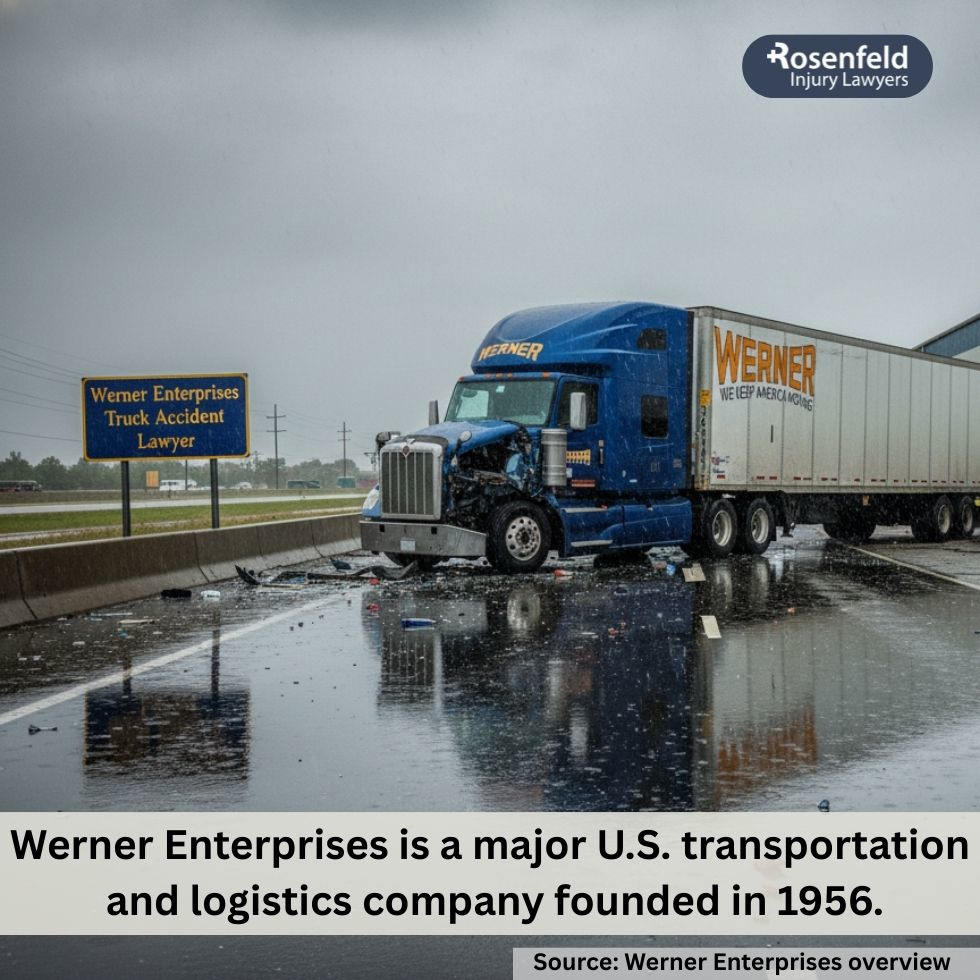
Not every tractor-trailer collision is a speeding story. Some crashes that draw public attention involve unusual roadway setups, such as vehicles stopped in a live lane or sudden loss-of-control events that put a smaller vehicle into a truck’s path.
In those cases, the core question becomes avoidability: what the driver could see, how much time existed to react, and whether the truck had realistic stopping and evasive options given weight, road conditions, and traffic flow.
A truck accident lawyer in Chicago will build a strong claim by turning that question into measurable proof, including speed and braking data, sightline evidence, and reconstruction work that matches the truck’s timeline to the roadway conditions at the moment everything went wrong.
Chicago drivers know how quickly winter turns routine travel into chaos, and large truckload carriers face the same physics with far less margin.
When ice or packed snow triggers a loss of traction, the risk is not only a jackknife. It is the chain reaction that follows: vehicles sliding into adjacent lanes, cross-median impacts, and split-second collisions that defendants later frame as unavoidable.
The evidence that carries weight is specific: roadway condition documentation, speed changes before impact, braking sequence timing, and whether the truck’s handling choices matched the conditions the driver was entering.
Large carriers prepare for major collisions in a way most people never see. When the stakes are catastrophic injury or wrongful death, defendants often deploy rapid-response investigation, reconstruction experts, and early narrative shaping designed to lock in a version of events before the injured person has even finished the first round of medical care.
For a Werner claim, that means the plaintiff side cannot treat the first weeks as “paperwork time.” The case often rises or falls on whether key records and scene evidence are secured before they are lost, overwritten, or reframed through selective documentation.
Werner trucks moving through Chicago commonly intersect with the same high-churn corridors where traffic density and speed differentials punish heavy vehicles.
These are the kinds of settings where serious injuries happen, even when the crash begins as a single “moment” in traffic.
CenterPoint Intermodal Center in the Joliet–Elwood corridor anchors a freight ecosystem that can swell into queues and staging patterns that affect the surrounding highways.
When volumes spike, trucks can end up cycling between stop-and-go flow and higher-speed segments, which creates a predictable setup for rear-end truck impacts and lane-change conflicts, especially in poor weather or low visibility.
In a Werner truck crash tied to this freight environment, we reconstruct the approach sequence and the staging timeline, then compare it to dispatch and trip data to see whether the run was designed with any real margin for congestion and weather.
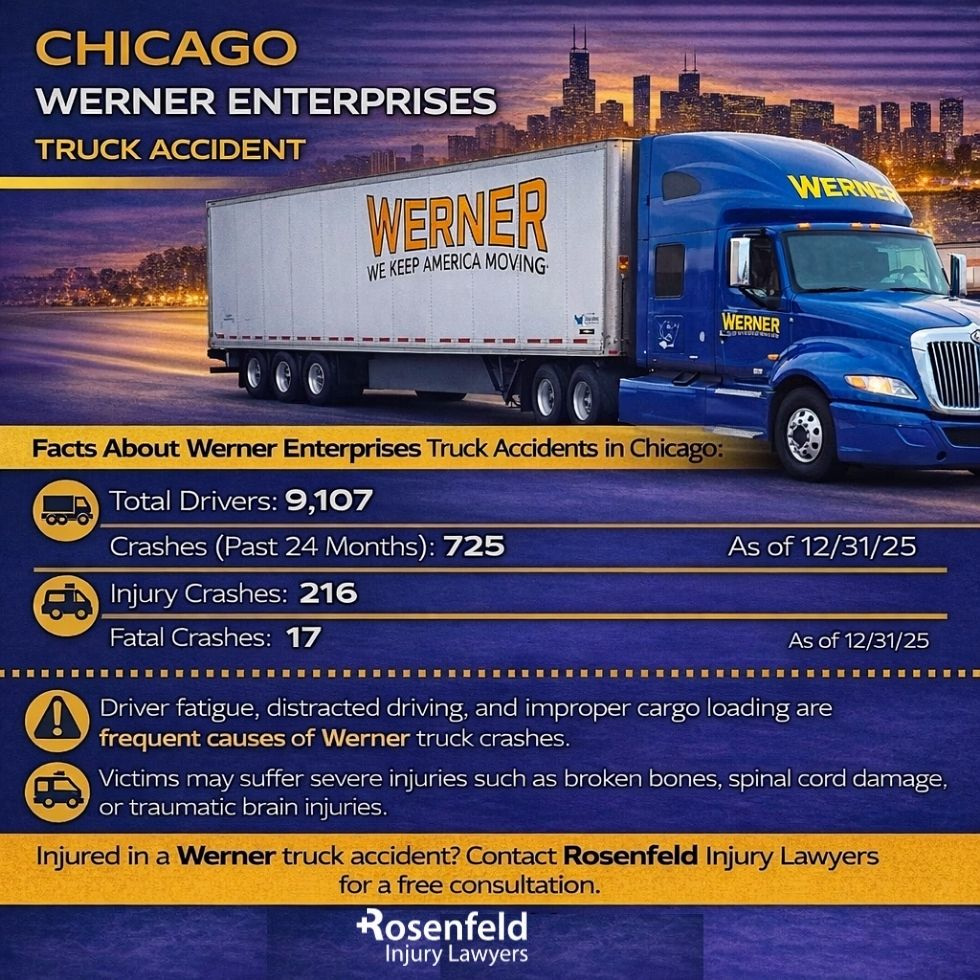
Illinois law (735 ILCS 5/13-202) generally gives truck accident victims two years to file personal injury lawsuits, but trucking evidence can be lost long before the statute runs. Digital logs can be overwritten, internal messages can disappear under routine retention, and nearby video often recycles in days.
If a Werner Enterprises truck caused your injuries in Chicago, contact Rosenfeld Injury Lawyers, so our Chicago personal injury law firm can begin preserving the records that can prove fault and the full value of your claim.
All content undergoes thorough legal review by experienced attorneys, including Jonathan Rosenfeld. With 25 years of experience in personal injury law and over 100 years of combined legal expertise within our team, we ensure that every article is legally accurate, compliant, and reflects current legal standards.