

Chicago Personal Injury Lawyer
Award-Winning Chicago Personal Injury Lawyer - Securing Justice
for Illinois Injury Victims - Over $450 Million Recovered



A collision involving an XPO truck in Chicago often reflects the pressures and blind spots of modern LTL freight, where tight delivery windows, dense terminal routes, and constant dock-to-street transitions create repeat crash patterns.
XPO equipment is regularly moving through the same corridors where Chicago freight traffic compresses quickly, and serious injuries can result from rear-end impacts in stop-start flow, wide turns into industrial entrances, and backing incidents near docks and loading zones.
We move quickly to preserve the evidence that tends to decide XPO cases, including tractor and trailer identifiers, route and dispatch data, delivery timing records, and maintenance and inspection history tied to the specific unit involved.
If you need a Chicago XPO Logistics truck accident lawyer who knows how LTL claims are defended and how they are proven, Rosenfeld Injury Lawyers is ready to help.
XPO is a major transportation and logistics company with a significant less-than-truckload network, operating local pickup-and-delivery routes and linehaul freight movement between terminals.
In Chicago, that translates into frequent daytime runs, dock approaches, and tight turns into industrial properties where box trucks and tractors are constantly merging back into traffic.
For an injury claim, the operational questions are often as important as the crash report: what the stop sequence looked like, whether the driver was working under a compressed delivery window, what equipment was assigned to the route, and whether maintenance issues or prior defect reports were in the file before the collision.
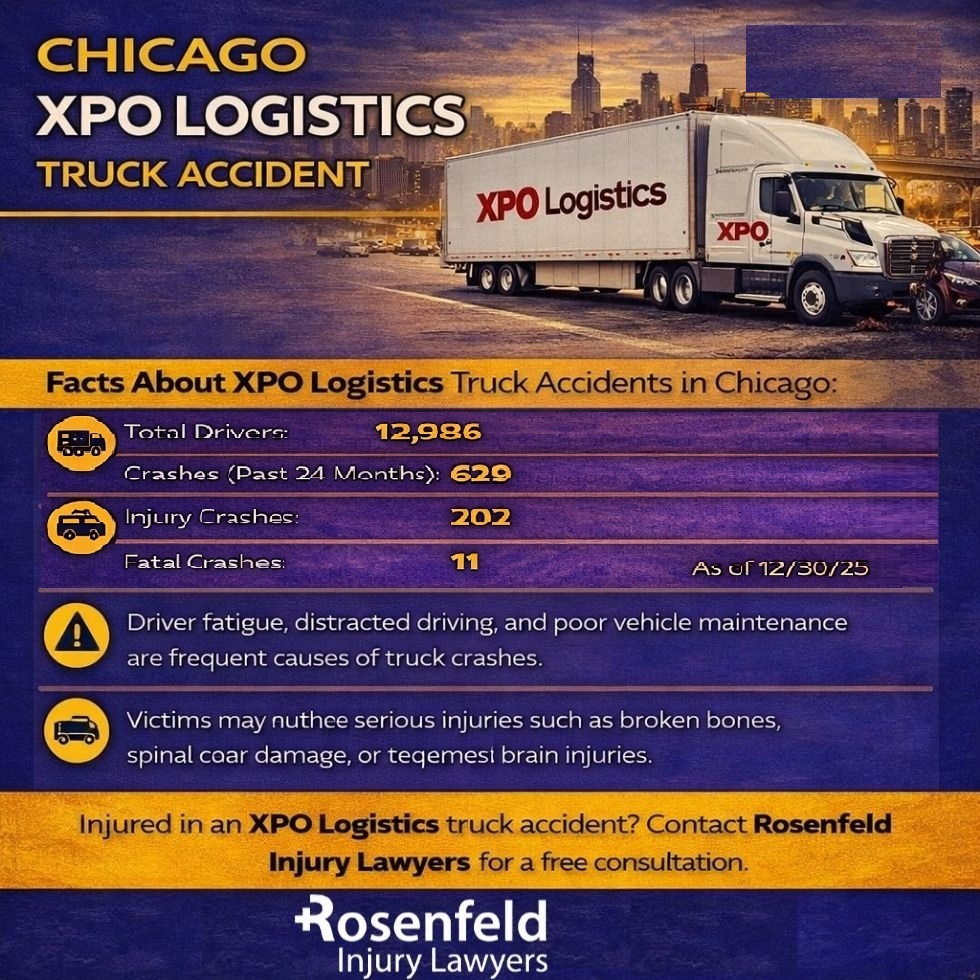
| XPO LOGISTICS FREIGHT INC – Safety Snapshot | |
|---|---|
| USDOT Number | 241829 |
| Mailing Address | 2211 Old Earhart Road, Ann Arbor, MI 48105-2751 |
| Telephone | (734) 757-1667 |
| Website | https://www.xpo.com/ |
| Total Power Units | 10,260 |
| Total Drivers | 12,986 |
| Crashes (Past 24 Months) | 629 |
| Injury Crashes | 202 |
| Fatal Crashes | 11 |
| Date | 12/30/25 |
XPO appears in serious crash litigation where outcomes often turn on what the evidence proves about control, preventability, and how responsibility is allocated between multiple defendants. The examples below describe personal injury or wrongful death matters involving XPO.
A $31 million jury verdict in a wrongful death case arose from a “flying tire” incident. The report states the jury found the driver was acting as an agent of XPO and describes fault allocation, placing 30% on the truck driver and splitting the remaining fault between XPO and another defendant.
A federal jury returned a $17 million verdict for the relatives of a family killed in a tractor-trailer collision. The case was brought against the truck driver, XPO Express, and XPO Logistics.
According to the case summary, the tractor-trailer was traveling with cruise control set at 70 mph and continued past construction warning signs before colliding with an SUV. The impact caused a fire, killed the adult occupants, and ejected the infant passenger still strapped into a car seat.
The lawsuit alleged XPO Express functioned as a shell entity and that XPO Logistics exercised control over safety, pointing to discovery materials that reportedly showed driver logs bearing the XPO Logistics name.
There was also evidence suggesting possible alcohol use, including liquor bottles found in the cab, testimony about the removal of an additional bottle, and the claim that no post-crash alcohol test was conducted despite a federal testing requirement.
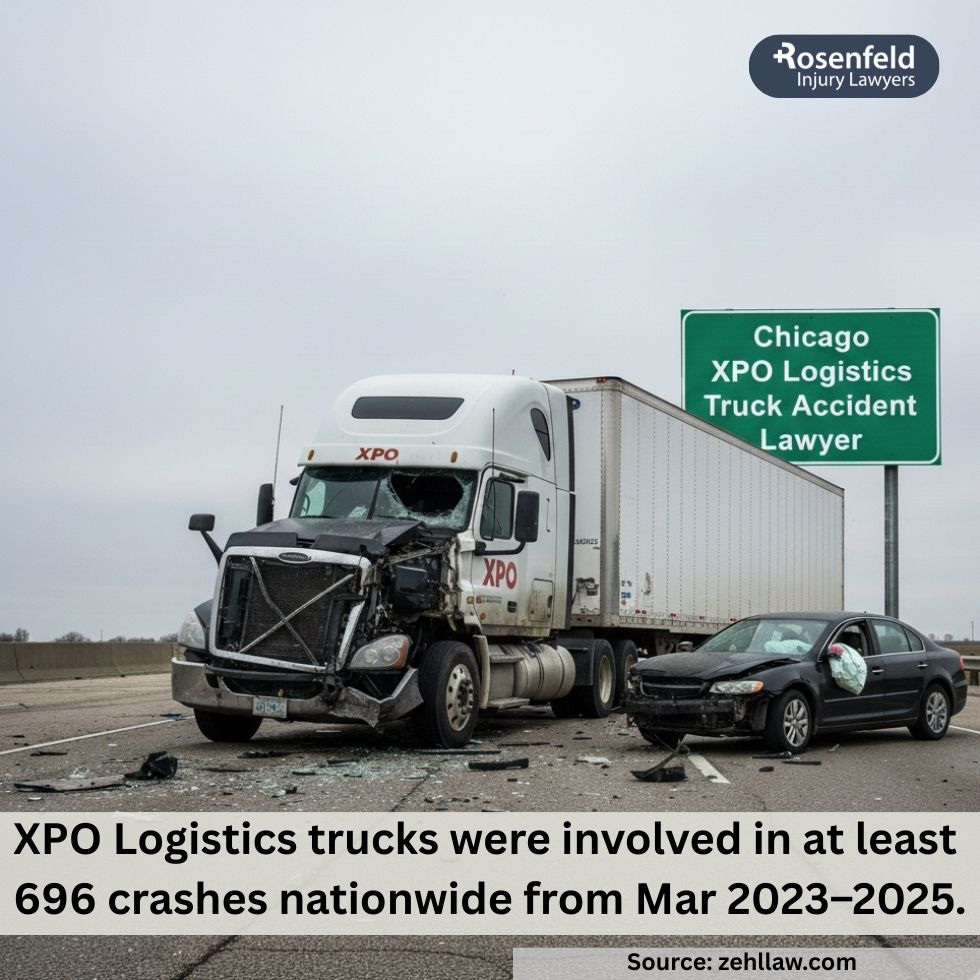
XPO’s Chicago exposure is shaped by LTL linehaul and terminal transfers that funnel freight through the city’s south and west industrial corridors. The crash risk is not limited to one expressway. It concentrates where tractor-trailers are changing lanes for short exits, braking into queue lines, and re-entering traffic after terminal runs that stack up around shift changes.
Our team’s truck accident lawyer in Chicago tests whether the trip plan, timing expectations, and routing choices created predictable pressure that shows up in dispatch instructions and the electronic trail.
LTL work creates repeat crash patterns because drivers are constantly moving from dock approaches back into live traffic. In Chicago’s industrial grid, that often means wide turns into tight entrances, short acceleration lanes back onto arterials, and backing maneuvers in yards and loading zones where sightlines disappear fast.
These cases commonly involve sideswipes during wide right turns, rear-end impacts when traffic stacks unexpectedly, and backing incidents near docks and alley-style access points. The proof is rarely “just the crash report.”
It lives in the route sequence, stop timing, handheld scan activity, and terminal transfer records that show how rushed the run was and what the driver was trying to recover.
BNSF Corwith Yard sits in a part of Chicago where rail-adjacent freight activity spills directly into street-level trucking. The immediate approach corridors force trucks to cycle through tight industrial turns and short merges while sharing space with local traffic, yard vehicles, and other commercial fleets.
From there, the risk patterns build along the same industrial feeders that connect freight movement to the expressway network: the Cicero Avenue corridor, the 47th Street industrial belt, and the on-and-off ramp zones that push trucks toward I-55 and I-294.
These are the locations where we most often see the “repeat” hazards: abrupt lane compression near exits, forced-merge sideswipes, and braking cascades that trigger multi-vehicle rear-end collisions.
Illinois generally gives injured people two years to file a personal injury lawsuit under 735 ILCS 5/13-202. Waiting can still damage the case because LTL route data, yard records, and nearby camera footage may be overwritten long before the deadline.
If an XPO truck caused your injuries in Chicago, we build your claim around preserved company records, equipment identifiers, and a clear timeline of what happened and why it could have been prevented. Contact Rosenfeld Injury Lawyers to speak with a personal injury lawyer before key evidence disappears and the defense controls the narrative.
All content undergoes thorough legal review by experienced attorneys, including Jonathan Rosenfeld. With 25 years of experience in personal injury law and over 100 years of combined legal expertise within our team, we ensure that every article is legally accurate, compliant, and reflects current legal standards.