

Chicago Personal Injury Lawyer
Award-Winning Chicago Personal Injury Lawyer - Securing Justice
for Illinois Injury Victims - Over $450 Million Recovered



Cement truck accidents tend to happen in a distinctive pattern in Chicago: jobsite turns, short merges, sudden stops near pours, and tight lane changes where the mixer’s weight and rotation punish small mistakes.
A cement truck is not just another big truck in traffic. A concrete mixer truck carries a rotating drum filled with wet concrete or wet cement, and that constant movement changes balance and braking in ways a typical passenger vehicle never has to account for.
Even at low speeds, a mixer truck can feel inherently unstable when the drum is turning, the load is partially full, or the truck is moving from street grade to a ramp.
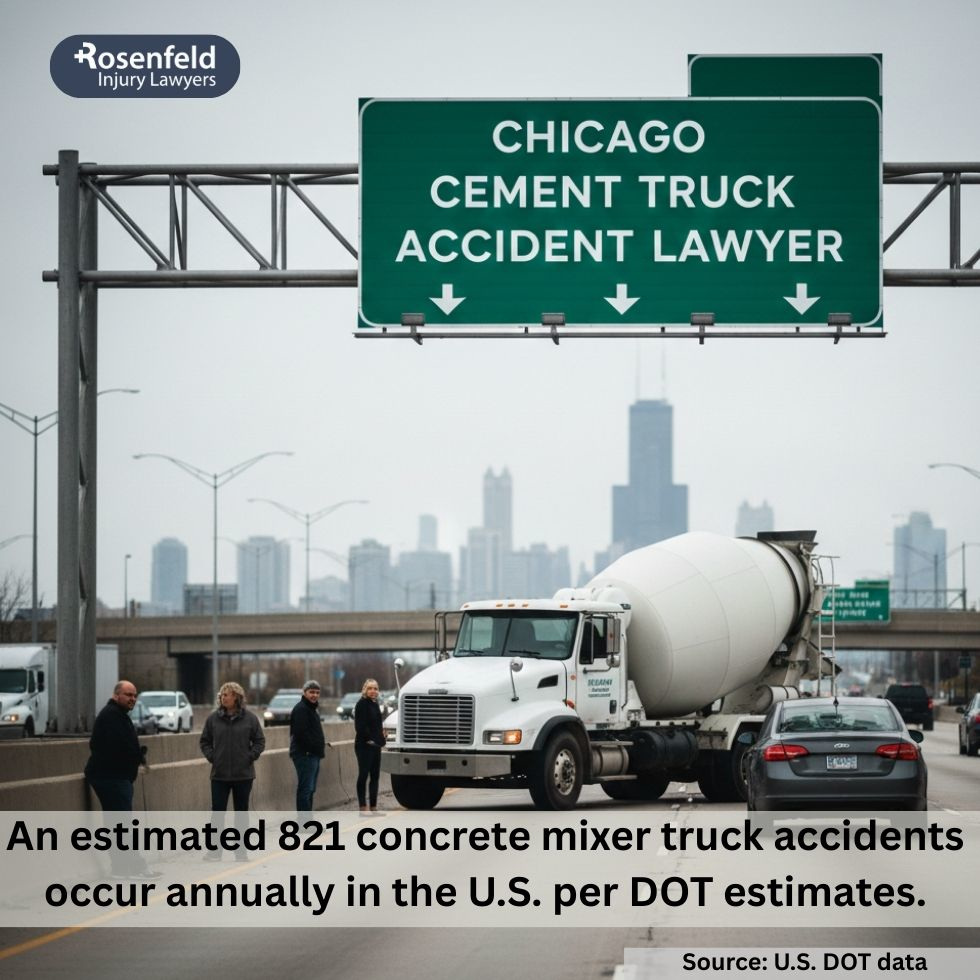
Most cement truck accidents concentrate around construction sites and the corridors that feed them. In Chicago, concrete deliveries are tied to staging and pour windows, which creates bursts of traffic by concrete hauling trucks that are trying to arrive “on time” with material that cannot wait.
We see higher risk near:
A cement truck crash in these areas is often about work sequencing and access design, not random bad luck.
A mixer truck carries cement and concrete high, in a rotating drum, on a chassis that already sits tall. That “high center” reality matters because concrete trucks are heavy even before they are loaded, and once they are carrying material, the massive weight is unforgiving.
Key dynamics we focus on in concrete mixer truck collisions:
These are the mechanics behind many cement truck accidents, including side-swipe collisions, turning crashes, and preventable rollover crashes.
Concrete delivery runs on schedule. When the drum is full of wet concrete, the clock is part of the job. That time pressure is one reason we see speeding more often than the public expects, even on city streets leading into a jobsite.
A cement truck driver may be pushed to keep moving to avoid material setting in the drum, and that can lead to:
When a construction or trucking company sets unrealistic dispatch timing, that business choice can become a liability issue after the crash.
Many concrete truck collisions happen at the edge of a jobsite. The driver is often following signals from a spotter, a foreman, or a gate operator, especially when backing, swinging wide, or entering from an awkward angle.
That changes the legal analysis. Determining liability often requires asking:
In the right case, liability can extend beyond the driver to a construction company or a site manager when they controlled the movement that caused the collision.
Even with specialized equipment, these crashes can still come down to attention. A cement truck driver looking down at a screen for seconds can miss a stop, a pedestrian step-off, or a lane closure shift.
We investigate:
If distracted driving is involved, it strengthens the liability narrative and helps explain why a large truck could not avoid a crash that looked obvious to other motorists.
A cement truck case is won by proof that matches the physics. We secure evidence that ordinary passenger vehicle crashes do not require.
We focus on:
This is how we build a concrete truck accident case that is about objective facts, not competing stories.
A concrete mixer truck can outweigh a smaller vehicle by a wide margin. When that mass meets a passenger car, injuries can be severe.
Common serious injuries include:
Medical bills and recovery costs often climb fast, especially when the collision involves crush forces or multiple impacts.
Concrete truck claims vary, but published results for this category show a tighter range than many trucking segments. One results set reports a median of $2,800,000 and an average of $3,600,000, with a value range from $2,500,000 to $5,500,000.
Those figures do not define what any one claim is worth. They help frame why value rises in such cases:
We use the facts of your crash, not a single “average,” to pursue full compensation.
These cases can involve multiple layers of responsibility. Depending on what the investigation shows, liable parties may include:
Our job is to identify who created the risk, who had control, and who should pay for the harm.
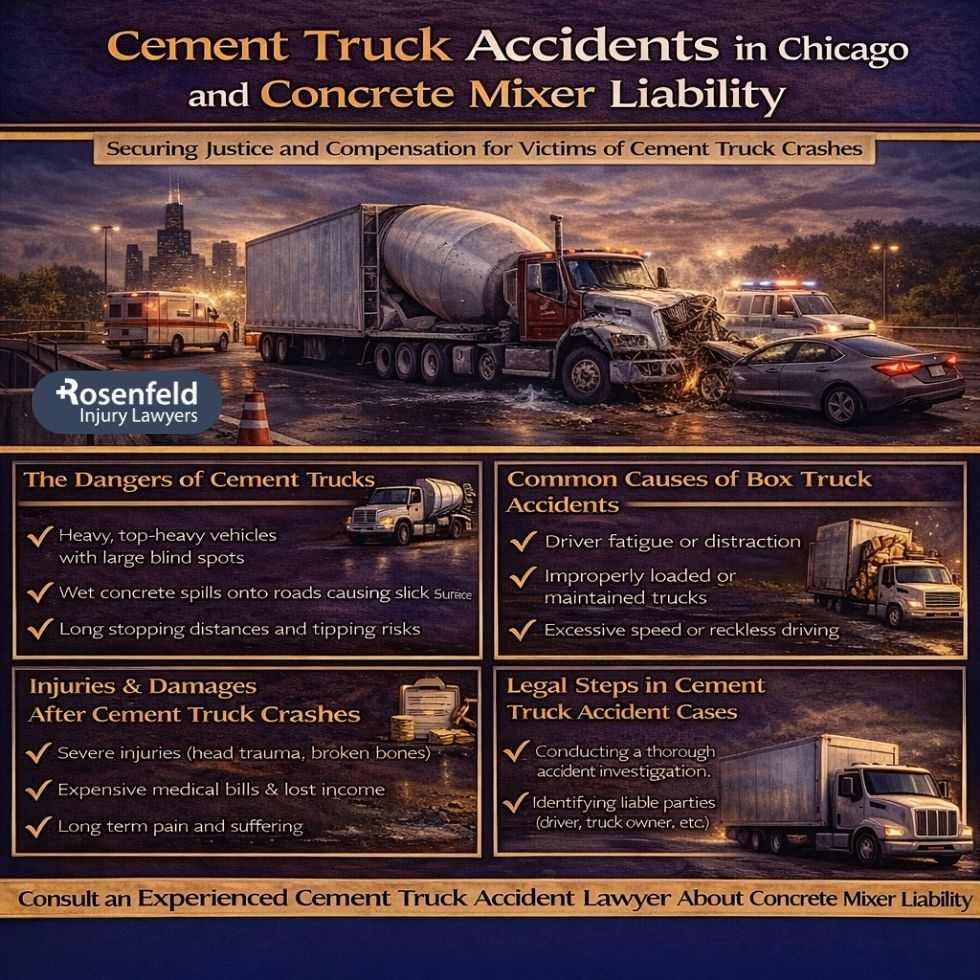
If you or a loved one were injured in a crash involving a cement truck in Chicago, you need a team that understands rotating-load physics, jobsite control, and the evidence unique to concrete mixer trucks. Our truck accident lawyer team moves quickly to secure delivery documentation, jobsite records, and vehicle data before it disappears.
Contact us for a free consultation. A Chicago personal injury attorney will explain your legal options, outline what evidence we can secure, and help you pursue compensation for your injuries and losses.
All content undergoes thorough legal review by experienced attorneys, including Jonathan Rosenfeld. With 25 years of experience in personal injury law and over 100 years of combined legal expertise within our team, we ensure that every article is legally accurate, compliant, and reflects current legal standards.