

Chicago Personal Injury Lawyer
Award-Winning Chicago Personal Injury Lawyer - Securing Justice
for Illinois Injury Victims - Over $450 Million Recovered



When a truck accident is tied to drugs, the case is not only about how the crash happened. It is about what the carrier knew, what it ignored, and what the testing and records should show. In Chicago, we see drugged driving truck accidents on industrial streets near distribution hubs, on arterials feeding the Stevenson and Dan Ryan, and in the tight merge zones where a delayed reaction by a drugged truck driver can turn a routine lane change into a violent chain event.
Such crashes can resemble a rear-end impact, a drift into an adjacent lane, or a missed stop in congestion. The difference shows up in the evidence. A driver’s alertness, reaction timing, and decision-making can be greatly affected by alcohol and drug abuse. That is why drugs and alcohol become the center of the investigation early, not an afterthought.
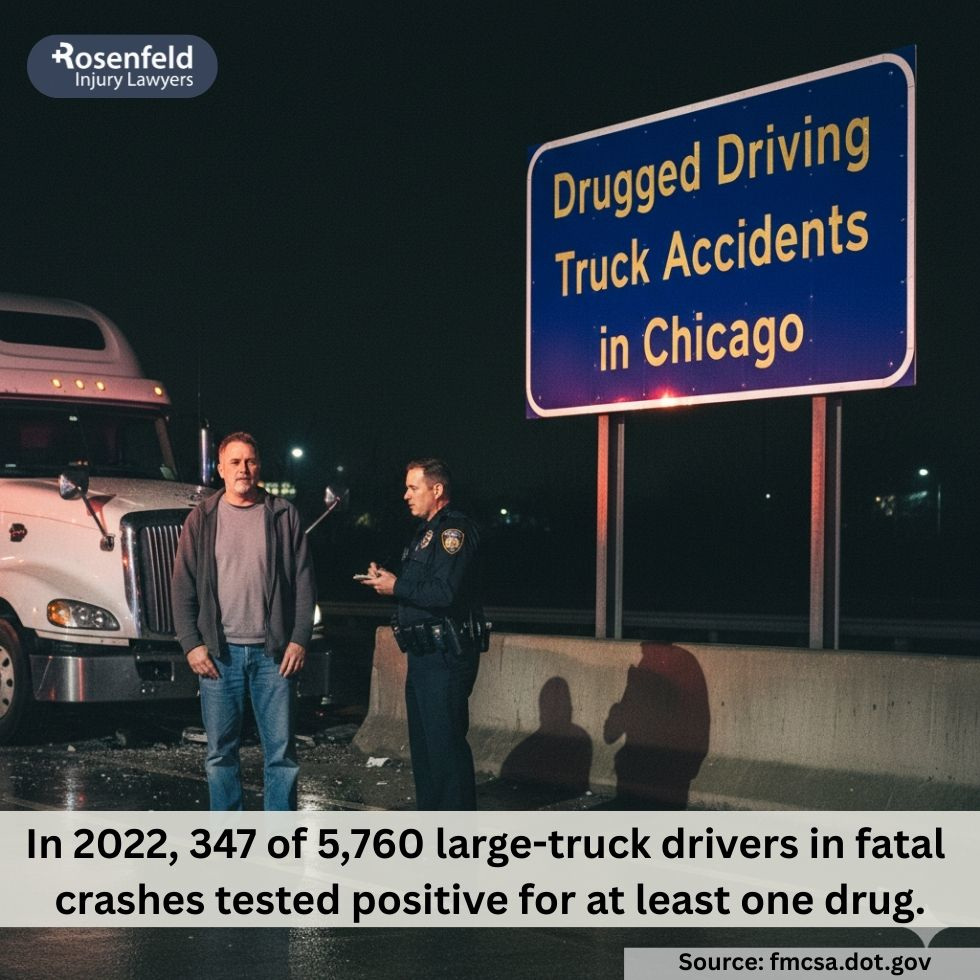
A truck accident caused by impairment usually leaves a pattern that does not match the driver’s story. At the accident scene, we look for indicators that point to impaired driving without relying on guesswork:
These details matter because many truck drivers try to explain away the crash as traffic, weather, or other, non-commercial drivers’ behavior. We build the case on what the evidence says, not what the driver hopes will stick.
Alcohol and drug testing is not optional in commercial operations. The Federal Motor Carrier Safety Administration (FMCSA) requires motor carriers to run a drug and alcohol testing program for commercial truck drivers operating on a commercial driver’s license.
The rules you will hear about most often in truck accident cases include:
Our truck accident lawyers also look at whether the carrier followed federal law procedures for collection, documentation, and reporting, because testing disputes are common once a claim is on the line.
In an accident involving drugged commercial drivers, the first conflict is often over whether the driver will undergo testing promptly and properly. Carriers sometimes try to delay, reframe the event, or shift attention away from testing windows. The record should show:
Testing is powerful leverage. When a trucking company cannot produce clean testing documentation, it raises questions about compliance and supervision.
Driving under the influence is not limited to illegal drugs. It can involve:
A driver may claim they were “taking what the doctor gave them.” That does not end the inquiry. Our truck accident attorneys still examine whether the driver was safe to operate and whether the carrier’s safety program should have flagged the risk.
Alcohol abuse is one of the most litigated issues in serious commercial crashes because it is often detectable, provable, and hard to explain away. Alcohol violations history and any documented alcohol impairment become central to the liability story. A single intoxicated truck driver can cause fatal crashes or catastrophic injuries when the truck’s mass transfers into passenger vehicles at impact.
When alcohol is involved, we also examine whether the carrier’s safety culture created cover for repeat behavior, including weak supervision or a hiring process that ignored red flags.
These cases are rarely only about the driver. Trucking companies can create conditions where drug and alcohol use is more likely, easier to hide, or less likely to be caught. Our experienced attorneys look for:
This is where the trucking industry’s incentives show up in real-world harm.
Driver fatigue is not the same as substance abuse, but the two often overlap. A tired driver is more likely to misuse stimulants, rely on risky “wake up” strategies, or combine substances. Long Chicago runs with congestion, loading delays, and overnight deliveries can push drivers toward bad decisions, especially when many commercial drivers feel pressure to keep moving.
Our personal injury attorneys look closely at driver logs, electronic records, and routing to see whether the schedule made impairment more likely and whether the carrier ignored warning signs.
In truck accident cases involving impairment, proof comes from records, not slogans. A focused evidence plan often includes:
This record-building matters because a carrier may try to frame the crash as “just an accident,” even when the driver was impaired.
A large truck accident caused by drugs tends to involve severe harm because impact forces are high and reaction times are delayed. A claim may include medical bills, medical expenses, lost wages, and long-term care needs.
Some cases involve severe burns, crushing trauma, or life-changing disability. In the worst outcomes, a wrongful death lawsuit may be the only path for family members to seek accountability.
We build damages based on proof of loss and the reality of the injury, then fight for full and fair compensation grounded in documentation. Recovering compensation is stronger when the liability story is clean and supported by testing and records.
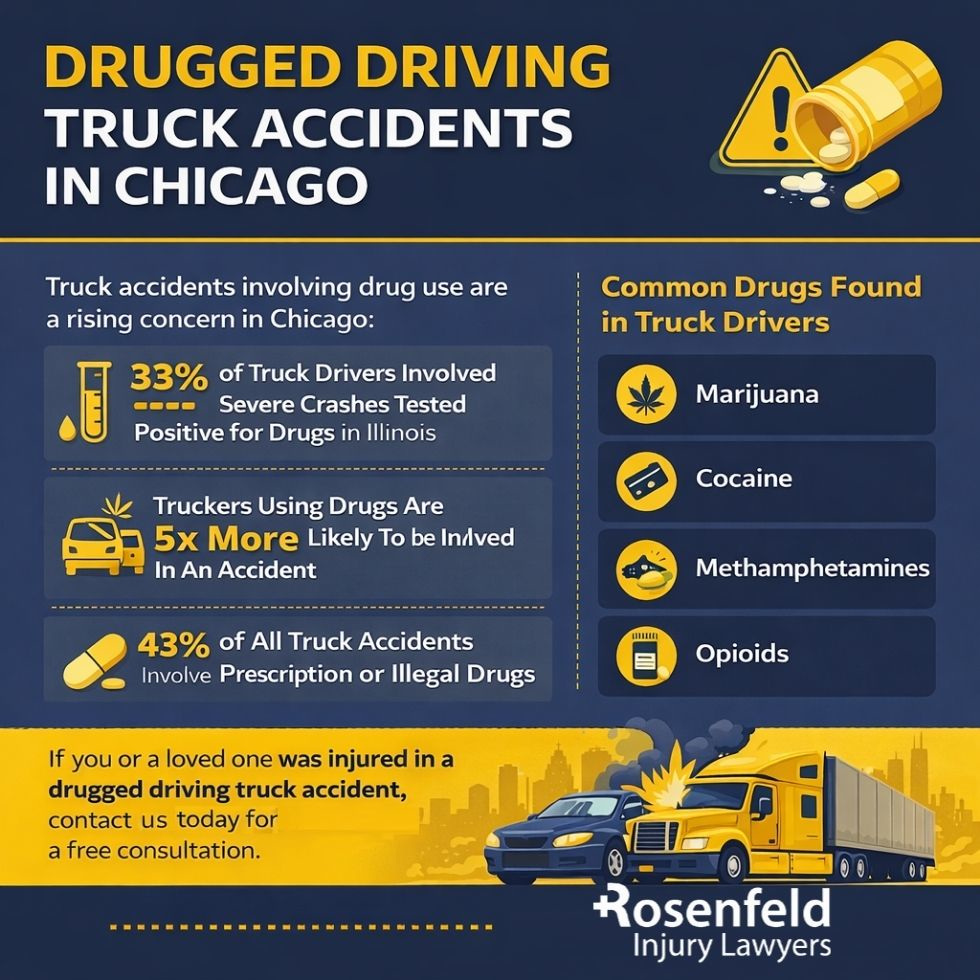
If you suspect impairment played a role, early steps should protect the case:
If you want a skilled lawyer to review the facts, we offer a free consultation. A Chicago personal injury attorney can explain how the testing rules apply, what evidence matters, and how we can seek compensation.
All content undergoes thorough legal review by experienced attorneys, including Jonathan Rosenfeld. With 25 years of experience in personal injury law and over 100 years of combined legal expertise within our team, we ensure that every article is legally accurate, compliant, and reflects current legal standards.