

Chicago Personal Injury Lawyer
Award-Winning Chicago Personal Injury Lawyer - Securing Justice
for Illinois Injury Victims - Over $450 Million Recovered



A dump truck is built to haul heavy material, not to maneuver like a normal vehicle. In Chicago, that matters because dump operations are tied to construction sites, temporary traffic patterns, and fast-changing job site access points. Those conditions create a specific kind of risk that shows up again and again in dump truck accidents: short-haul trips, frequent lane entries and exits, and loaded braking in tight urban traffic.
This is why accidents involving dump trucks often look simple at first and then expand into complex truck accidents with multiple impacts, shifting debris, and conflicting accounts at the accident scene.
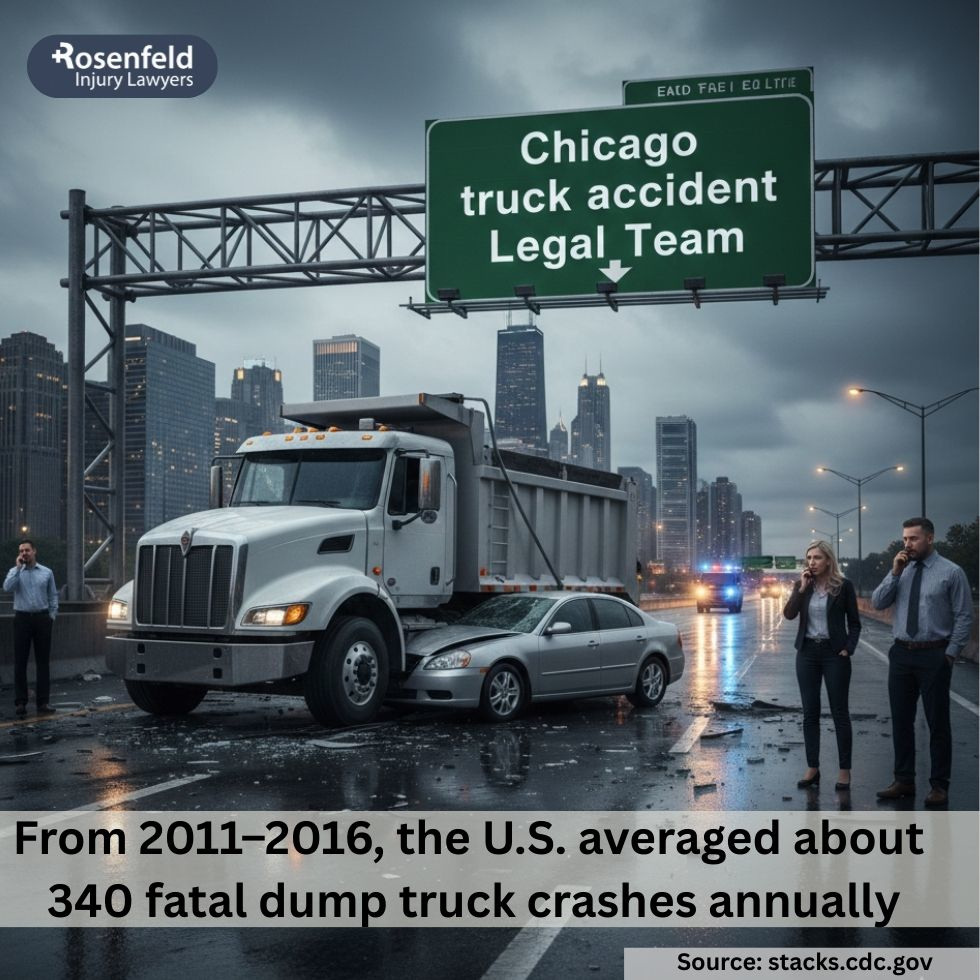
Most dump truck accidents cluster around active construction activity, where roadway geometry is temporarily rewritten.
In these zones, drivers in other vehicles have less space to react, and dump trucks have less room to brake safely.
A dump truck driver sits high with deep blind spots. The high-sided bed blocks angles that a normal car driver assumes are visible. In city traffic, that creates a predictable crash type: the squeeze.
We see it when:
These collisions often involve several vehicles because the first impact triggers secondary braking and chain reactions.
Dump trucks transport shifting material by design. When loading and tarping are sloppy, the cargo becomes part of the roadway.
Common triggers in dump truck accidents include:
When debris is involved, we investigate the loading process, the tarp procedure, and whether the driver checked the bed before leaving the site.
Some dump crashes do not happen at speed. They happen during unloading. Raising a bed changes stability, and on uneven surfaces, a dump truck can tip, slide, or strike nearby equipment.
We examine:
These incidents can cause severe injuries and, in the worst cases, death when people are in the wrong place during a bed-up event.
Dump runs are repetitive and time-driven. That can lead to unsafe choices, especially when drivers feel pressured to complete more trips.
In dump truck accidents, we frequently investigate:
A brief lapse can lead to a crash because a loaded dump truck needs more time and distance to stop.
A police report helps establish the basic narrative, but it often misses job-site details that explain why the crash occurred.
For a strong dump truck accident case, we secure:
This is how we move beyond “driver error” and prove the operational cause.
Liability often extends beyond the person behind the wheel. Depending on the facts, the responsible party may include:
Our goal is to identify every party that contributed to the danger and hold them accountable.
Because a dump truck is a large truck with rigid mass, the injuries can be serious.
Common outcomes include:
When a crash is fatal, families often face sudden financial and emotional impact that requires immediate legal support.
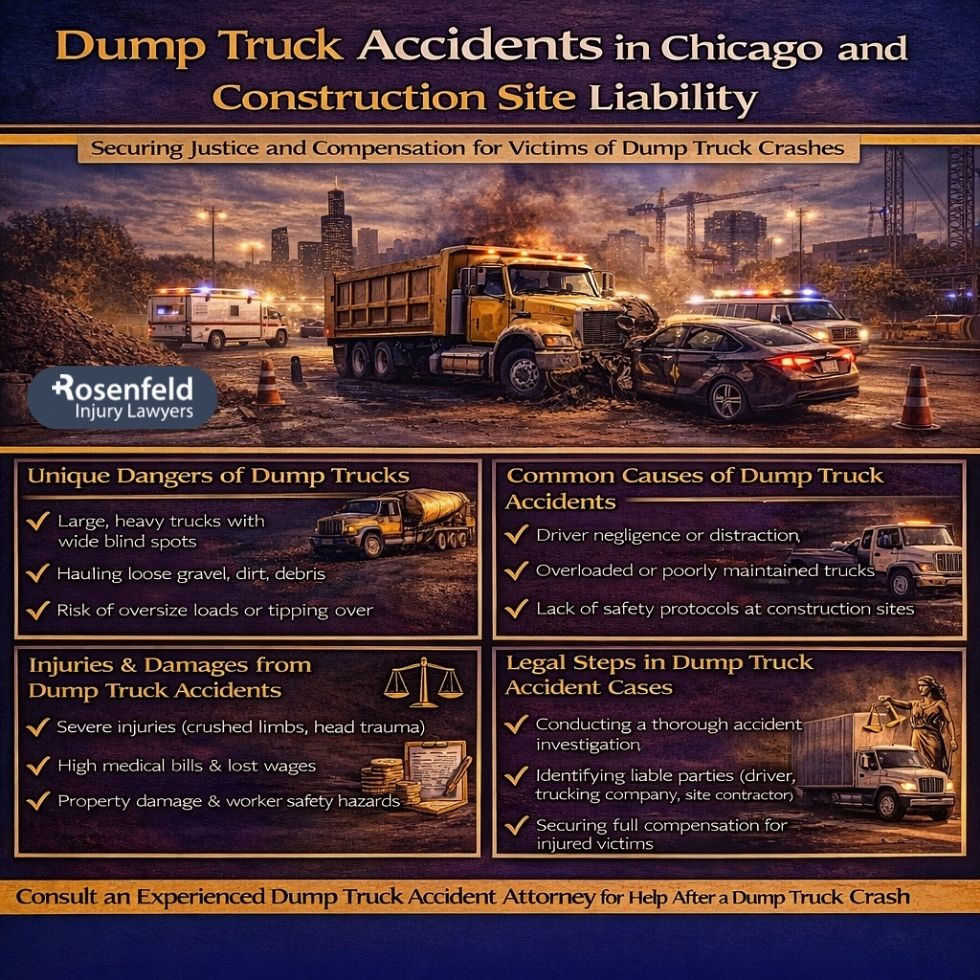
Dump truck cases have wide value ranges because the harm ranges from moderate crashes to catastrophic loss. The median is $3,117,500, and the average is $11,295,832, with outcomes ranging from $32,500 to $63,400,000.
That spread exists because the value is driven by facts that change case by case, including:
We use these factors to pursue compensation that matches what the crash actually cost.
If you were hurt in a crash involving a dump truck in Chicago, you need counsel that understands construction-zone operations, cargo movement, and unloading hazards. Our truck accident lawyers investigate the job site workflow, secure the evidence quickly, and build a case that targets the parties who created the risk.
Speak with a Chicago personal injury lawyer from our team to discuss your legal rights, understand your options, and start the process of recovering compensation.
All content undergoes thorough legal review by experienced attorneys, including Jonathan Rosenfeld. With 25 years of experience in personal injury law and over 100 years of combined legal expertise within our team, we ensure that every article is legally accurate, compliant, and reflects current legal standards.