
Chicago Personal Injury Lawyer
Award-Winning Chicago Personal Injury Lawyer - Securing Justice
for Illinois Injury Victims - Over $450 Million Recovered



As of November 2025, there were 89,467 trucks registered in Chicago, and thousands of other commercial motor vehicles pass through the city each day. Though the motor carrier industry is essential to the local, state, and national economy, complying with FMCSA trucking regulations is critical for preventing fatalities involving large trucks.
Rosenfeld Injury Law is a Chicago-based personal injury firm that is highly familiar with both state and federal motor carrier safety regulations. By reviewing investigation results and negotiating with all stakeholders, we force trucking companies to take accountability for negligent drivers.
The Federal Motor Carrier Safety Administration is an agency within the US Department of Transportation that oversees truck and bus safety, also known as commercial motor vehicles (CMVs). It was established in 2000 by the Motor Carrier Safety Improvement Act of 1999
Its role is to reduce crashes by setting regulations, enforcing compliance measures, collecting safety data, and developing safety information systems, such as the Safety Measurement System. Through its safety groups, the FMCSA cooperates with organized labor, such as truck drivers’ unions, to ensure safe working conditions and raise awareness about road safety.
FMCSA regulations set minimum standards for truck drivers. These federal regulations are applicable nationwide, with state agencies often setting stricter guidelines.
Compliance with these regulations is mandatory. Failure to do so can lead to the revocation of a commercial driver’s license (CDL), fines, penalties, or even jail time.
When commercial motor vehicles fail to comply with federal motor carrier safety regulations, our attorneys can force them to take legal and financial responsibility for these failures.
Commercial motor vehicles, like buses, trucks, and other interstate vehicles, are subject to federal trucking regulations.
These are defined as vehicles with a gross vehicle weight rating of 10,001 pounds or more, or a gross combination weight rating of 10,001 pounds or more, as well as any vehicle that can carry between 9 and 15 passengers. Any size vehicle that carries hazardous materials is also considered a commercial motor vehicle (49 CFR 390.5).
Federal codes balance safety and efficiency in operations and maintenance. Failure to follow them can lead to liability. Some of the key regulations include the following.
Hazardous materials can cause death or environmental damage in the case of an accident. As such, federal trucking regulations require placards that clearly identify what type of material is on board. All loads should be carefully secured, and only authorized drivers with the correct endorsement on their CDL can transport these materials (49 CFR 100-185).
Large vehicles can cause much more damage, including fatal accidents, in the case of even a minor collision. As such, transportation businesses must sign Form MCS-90, which affirms that they carry the appropriate insurance to pay for any liability. Minimum liability insurance is $750,000, but may be as high as $5,000,000 depending on the type of cargo (49 CFR 387).
The Department of Transportation is the parent agency of the FMCSA. While the FMCSA covers only commercial motor vehicles, the DOT oversees all modes of transportation, including airplanes, trains, boats, and private cars. Every motor carrier receives a DOT number used to track its safety rating, and the DOT conducts regular audits to ensure compliance with FMCSA regulations.
The key role of truck accident lawyers like Rosenfeld Injury Law is to quickly preserve evidence before it can be destroyed or altered.
We can issue subpoenas for information like driver records, maintenance logs, and black box information, then compare this evidence with federal trucking regulations to identify potential violations. Additionally, we will take depositionsfrom expert witnesses who can attest to whether the driver was following standard operating procedures.
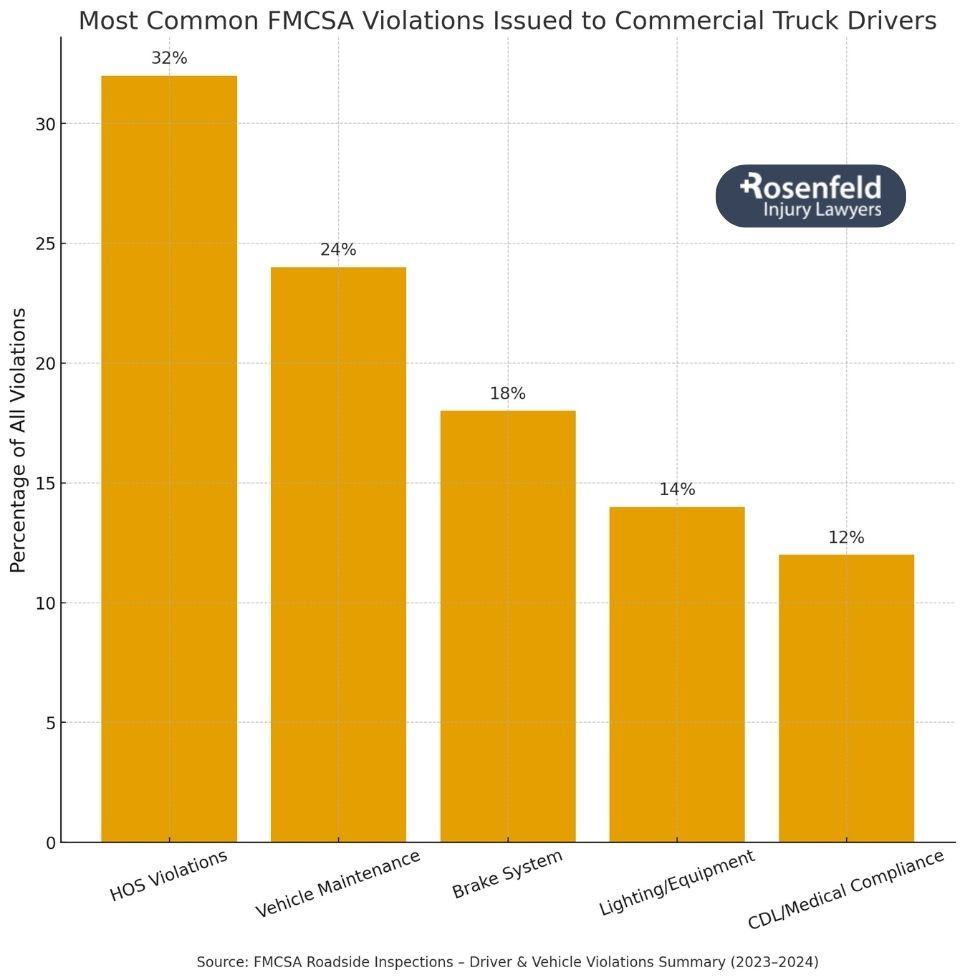
Common FMCSA violations that our truck accident attorneys see in Chicago include:
Per the Illinois Supreme Court case McQueen v. Lavonta M. Green, an employer may be held directly and vicariously liable for the actions of its employees.
Trucking laws are far more complex than the general Illinois vehicle laws (625 ILCS 5/), which are themselves complicated. Interpreting the evidence and comparing it to the law takes significant expertise, especially as multiple parties may be liable in an accident.
With over 100 years of combined legal experience in commercial trucking accidents, our firm has the knowledge and skills necessary to take on these massive logistics companies. We’ll aggressively negotiate on your behalf while applying all relevant regulations to demonstrate negligence.
Holding logistics agencies responsible for negligence takes tenacity and expertise. Our Super Lawyers®-rated firm has a 98% success rate and works on a contingency fee basis: no fees unless we win. We’ve secured over $450 million in successful settlements and verdicts over the past 25 years, ranking us as one of the top 10 litigators in Illinois.
You don’t need to fight these big companies alone. Call us at (888) 424-5757 or use our online contact form to schedule your free consultation with a highly experienced truck crash lawyer.