

Chicago Personal Injury Lawyer
Award-Winning Chicago Personal Injury Lawyer - Securing Justice
for Illinois Injury Victims - Over $450 Million Recovered



Head-on truck accidents are the most unforgiving truck crashes we handle because there is no “glancing blow.” A head-on collision combines speed from opposite directions into one impact.
When a truck crosses into oncoming traffic, passenger cars take the force in the front end and the passenger compartment. That is why these collisions so often lead to death, fatalities, and life-threatening injuries.
In Chicago, head-on truck accidents are rarely random. They usually start with a crossover: the truck drifts across the center line, cuts into adjacent lanes, or enters the wrong lane on a divided roadway. One lane mistake becomes a head-on crash involving two vehicles, and the outcome for truck accident victims can be catastrophic injuries, severe pain, and long-term treatment.
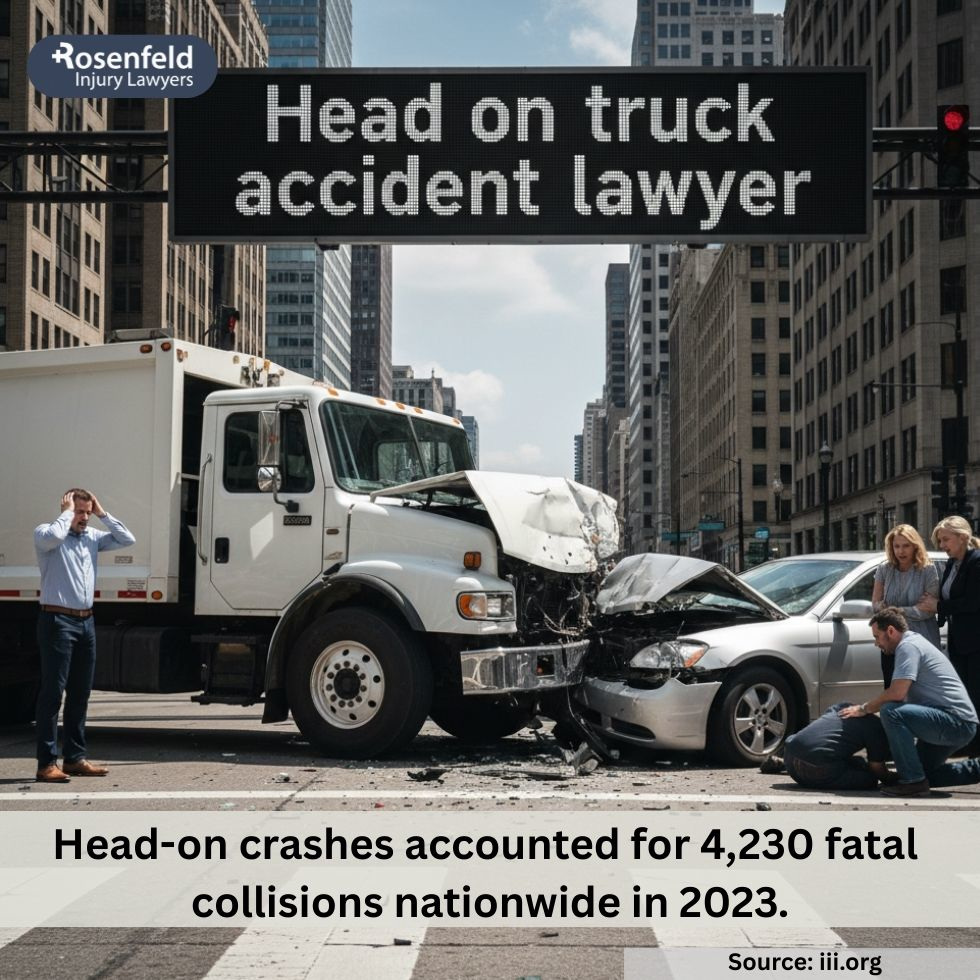
A head-on collision often begins with a small deviation that goes uncorrected. Chicago conditions make that more likely in specific situations: dark industrial corridors, tight lane geometry, and streets where large commercial traffic mixes with passenger vehicles.
Common causes we investigate in head-on truck accidents include:
When a truck driver crosses into oncoming traffic, the collision mechanics tell the story.
A head-on truck accident is usually a sequence, not a single instant.
When a head-on collision involves a large truck or tractor-trailer, the energy transfer can crush body parts, create burns from post-crash fires, and cause severe injuries that can change a person’s life permanently.
Head-on truck accidents produce a distinct injury profile because the impact is direct and concentrated.
Injuries we commonly see include:
For injured motorists, the medical expenses and lost income can begin within days and continue for months. These victims are not just dealing with pain. They are dealing with a crash that reshapes work, family, and independence.
When a truck enters opposite-direction traffic, it is often tied to preventable choices.
Our truck accident lawyers focus on whether the driver:
A head-on truck accident is often the end of a decision chain. Our job is to document that chain.
A trucking company is rarely absent from the story. The company’s scheduling, training, and monitoring systems can create predictable risk.
We look for:
When the facts support it, we pursue claims against all liable parties, not just the driver behind the wheel.
Fault in head-on truck accidents depends on rebuilding the lane story. Unlike many accidents, these cases leave strong physical evidence.
We typically use:
This is how we connect the head-on collision to a specific lane breach, not a vague “loss of control.”
Truck accident victims may pursue compensation that reflects the full harm of the accident. That includes medical treatment costs, future medical expenses, lost wages, and non-economic harm tied to pain and life disruption. The goal is to recover compensation that matches what this crash has taken.
In severe cases involving death, we also pursue claims built around the full consequences to surviving family members.
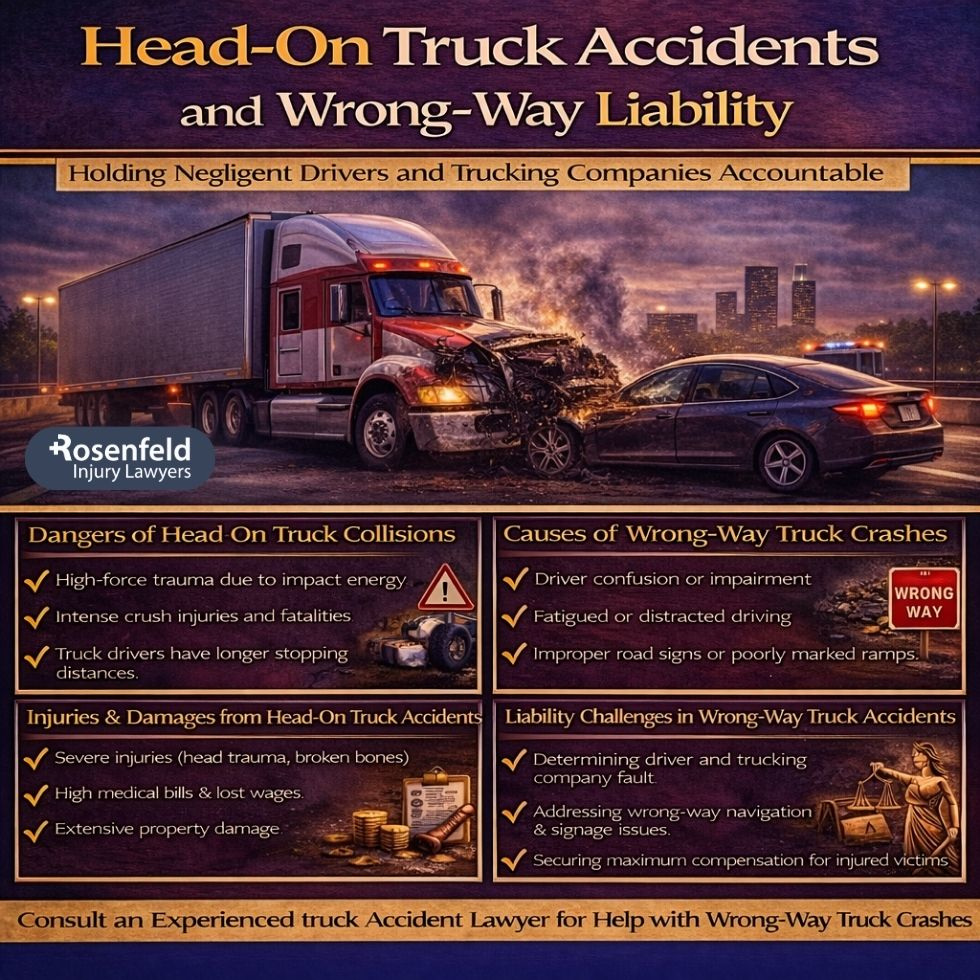
Illinois shows an average of $7,497,902 and a median of $1,922,452, with outcomes ranging from $4,699 to $35,450,000.
Here are the factors that most often move a settlement up or down in head-on truck crashes:
Head-on truck collisions move fast. Companies respond fast. Evidence changes fast. If you were injured in a head-on collision with a truck, do not let the narrative form without you.
Contact a Chicago truck accident lawyer from our team for a free consultation. Our personal injury lawyers explain your legal options, investigate how the truck entered oncoming traffic, and pursue fair compensation based on the proof that matters in a head-on crash.
All content undergoes thorough legal review by experienced attorneys, including Jonathan Rosenfeld. With 25 years of experience in personal injury law and over 100 years of combined legal expertise within our team, we ensure that every article is legally accurate, compliant, and reflects current legal standards.