
Chicago Personal Injury Lawyer
Award-Winning Chicago Personal Injury Lawyer - Securing Justice
for Illinois Injury Victims - Over $450 Million Recovered



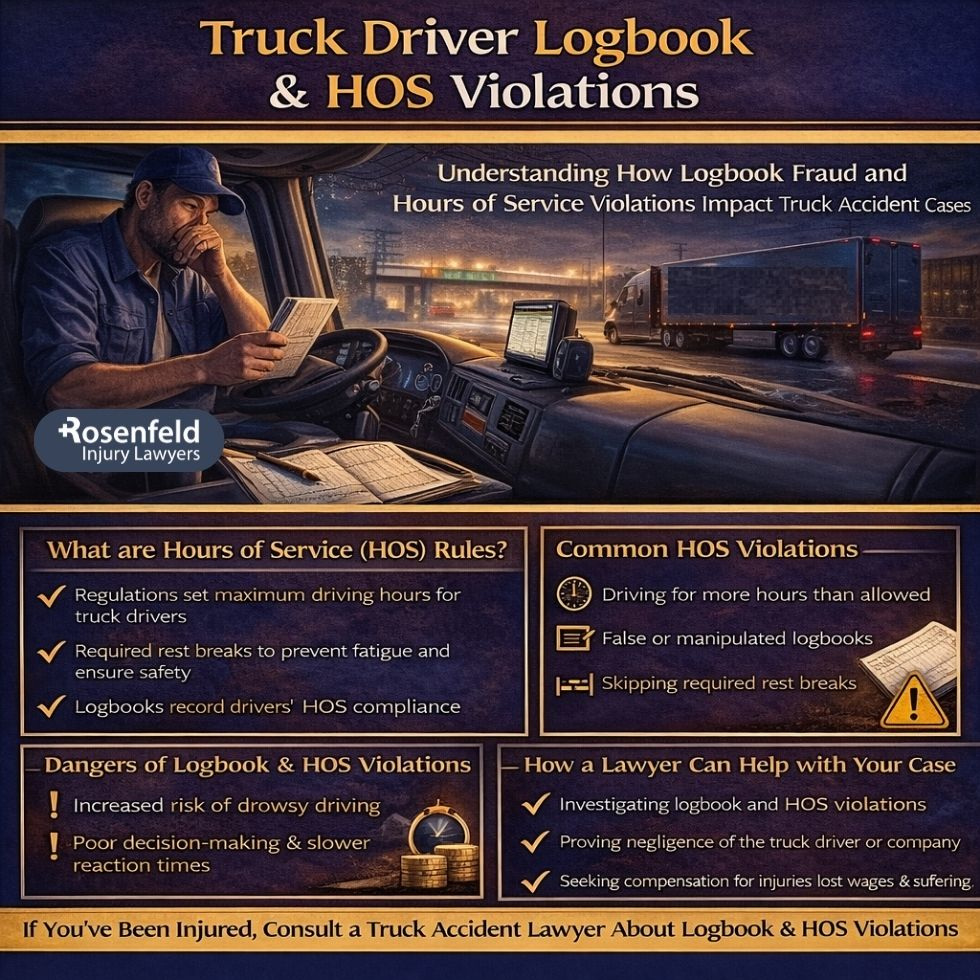
Hours of service regulations exist for a simple reason: fatigue in a commercial motor vehicle is as dangerous as impaired driving. The Federal Motor Carrier Safety Administration (FMCSA) sets strict rules that limit how long drivers can stay behind the wheel and how long they can remain on duty.
For most truck drivers in interstate commerce, the core hours of service limits and rest/break requirements include:
There is also the sleeper berth provision, which allows commercial truck drivers to split their mandatory 10-hour off-duty rest into two segments to meet Hours of Service (HOS) rules, offering flexibility by pausing the 14-hour driving window. However, per the sleeper berth rule, such drivers must be there for at least 7 hours back-to-back.
With slight differences for drivers transporting hazardous materials, these safety standards are meant to prevent driver fatigue and promote road safety. When hours of service violations occur, truck accidents become more likely, and the consequences are often catastrophic because of the size and weight of commercial trucks.
Fatigue crashes do not happen in a vacuum. They happen in a trucking industry system that rewards speed and punishes rest.
Many truck drivers are paid by the mile, not by the hour period they spend on duty. When the wheels are not turning, they are not earning. That financial pressure is one of the main causes of frequent violations of this federal law.
Trucking carriers also face commercial pressure. Tight delivery windows, penalties from shippers, and performance expectations can lead to dispatch coercion, where drivers push past strict rules and falsify logs to meet deadlines. This is where violating HOS rules becomes a business decision, not a mistake.
In Chicago, our truck accident attorneys see this pattern most clearly on highways like I-90, I-94, I-55, I-80, and I-294, where long-haul freight moves through heavy traffic conditions and delays. When the schedule slips, the temptation is to cut rest periods and pretend that the driver complies with federal HOS regulations.
Proving hours of service violations means comparing the logbook to reality.
Today, most commercial vehicles use an electronic logging device that can automatically record driving time and create a digital record of hours of service. But ELD data does not end the investigation. When truck accident cases involve suspected fatigue, we cross-check everything.
We compare the driver’s hours of service log to outside sources that reveal what actually happened:
This is how we prove falsified duty status entries. If the log claims sleeper berth time but the truck moved across state lines, that is not an innocent error. It is a violation of hours of service regulations.
Most common HOS violations involve the same core breakdowns:
These are the smoking gun service violations because they connect directly to truck driver fatigue and to why accidents happen in the first place.
Truck driver fatigue is not just feeling tired. It changes the way a person drives.
Fatigue affects reaction time, decision-making ability, coordination, and attention. When driving time stretches past safe limits, a truck driver is more likely to drift lanes, miss brake lights, misjudge closing speed, or fall asleep at the wheel.
FMCSA materials tied to the Large Truck Crash Causation Study report that fatigue was a factor in about 13% of large truck crashes. When that fatigue involves a commercial truck traveling at highway speed, the risk of severe consequences rises quickly, including catastrophic injuries and fatalities.
When a crash involving a fatigued commercial driver occurs, liability often extends beyond the individual behind the wheel. Both the driver and the trucking companies that created the pressure can be responsible.
When a driver violates hours of service rules and causes a truck accident, the violation can support an argument that the driver broke a safety law designed to protect the public. That matters because it reframes the case around rule-breaking, not excuses.
If we can prove a willful pattern of violating HOS regulations, the case can move beyond ordinary damages. Punitive damages are designed to punish and deter, and they become more realistic when the evidence shows intentional falsification or repeated service violations tied to profits.
Hours of service violations also carry enforcement consequences. Roadside inspections can trigger out-of-service orders that force drivers off the road until required rest is taken. Severe or repeated violations can also lead to serious consequences for drivers and motor carriers, including steep civil penalties and career damage through driver safety scoring systems.
For truck drivers, these violations can threaten a driving career through fines, license suspensions, and long-term employment impacts. For companies, repeat violations can raise insurance costs, damage reputation, and create exposure to larger verdicts.
Fatigue is not an accident. It is a choice, and the evidence proves it.
If you were injured in a truck accident where the driver drifted lanes, failed to stop, or appeared to fall asleep, we can investigate HOS compliance records, ELD data, and the full record of duty status to uncover the truth.
Contact us to start the process. Our personal injury lawyers preserve the data, compare logs to reality, and build the claim against the responsible parties, including trucking companies that pushed unsafe schedules.
All content undergoes thorough legal review by experienced attorneys, including Jonathan Rosenfeld. With 25 years of experience in personal injury law and over 100 years of combined legal expertise within our team, we ensure that every article is legally accurate, compliant, and reflects current legal standards.