
Chicago Personal Injury Lawyer
Award-Winning Chicago Personal Injury Lawyer - Securing Justice
for Illinois Injury Victims - Over $450 Million Recovered



Truck crashes on the Eisenhower Expressway tend to be violent and chaotic. I-290 runs through a narrow, fast-changing corridor where traffic surges, collapses, and shifts lanes with little warning.
When a semi, box truck, or delivery vehicle collides with a passenger car here, injuries often follow, along with a difficult claims process driven by commercial insurers and corporate defense teams.
Rosenfeld Injury Lawyers represents people injured in truck accidents on I-290 in Chicago and Cook County. We build cases around hard evidence, fast preservation, and a clear explanation of how this roadway’s design contributes to collision patterns. Consultations with a Chicago trucking accident lawyer are free, and we handle cases on a contingency fee basis.
The Eisenhower forces high traffic volume into tight geometry. Ramps arrive quickly, merges happen under pressure, and lane changes stack near exits where drivers commit late. That environment is risky for any vehicle. It becomes dangerous when commercial trucks must brake in waves, navigate blind spots, and operate with limited escape routes.
Congestion on I-290 also forms in recognizable places.
The Downtown approach tightens as drivers position for the Circle Interchange and the routes that feed into I-90 and I-94. The I-290 and I-294 interchange generates heavy weaving as vehicles move between expressways, and trucks need more distance to stabilize after a lane change. Even routine slowdowns can turn into sudden stops when traffic compresses near major ramps.
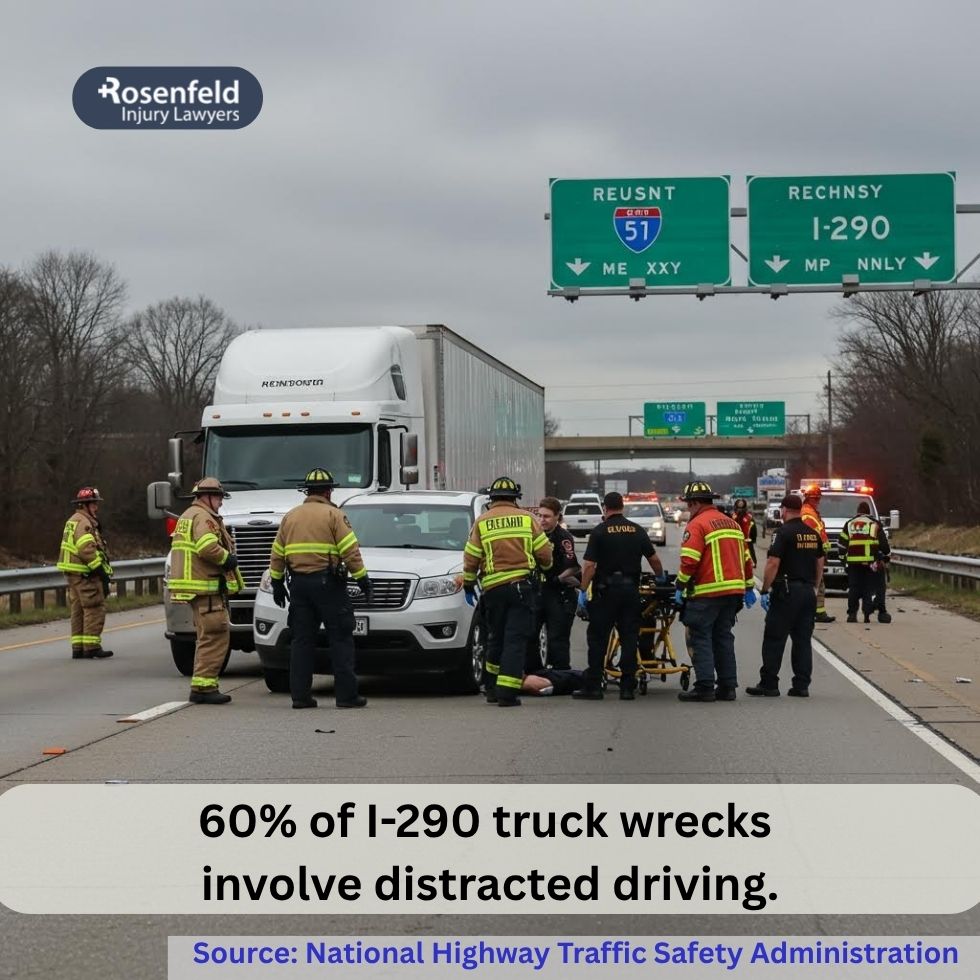
A defining feature of the Eisenhower is the CTA Blue Line running in the median. When a truck crash pushes debris into the rail corridor or blocks lanes beside the tracks, the scene becomes harder to manage. Space for disabled vehicles shrinks, emergency access narrows, and secondary collisions become more likely as drivers react late and run out of shoulder.
This median rail setup also affects recovery and cleanup. Tow access can be limited, lane closures last longer, and backups can extend quickly across interchanges. In serious truck cases, these roadway constraints often influence the injury severity and the sequence of impacts.
The Eisenhower cuts through Chicago’s West Side and feeds major destinations with closely spaced exits. Crash patterns often track exit clusters where drivers merge aggressively, and trucks have limited room to adjust.
Locations near the Medical District bring heavy commuter flow, rideshare traffic, and abrupt braking. The stretch near the United Center sees event-driven surges where congestion and lane changes spike.
Farther west, the transitions toward Oak Park and Forest Park create speed waves that lead to rear-end collisions and sideswipes, especially when drivers attempt to reposition late for ramps.
Many I-290 truck crashes are not random. They follow repeatable scenarios tied to how the Eisenhower moves.
Unsafe lane changes are common near exit clusters and interchange approaches. Passenger vehicles cut across a truck’s stopping path, and trucks drift while trying to create room in tight lanes.
Truck crashes on the Eisenhower often cause serious trauma because of the size difference between commercial vehicles and passenger cars. Victims frequently suffer traumatic brain injuries, spinal injuries, fractures, and internal damage.
High-energy collisions can lead to burns, crush injuries, and amputations. Fatal crashes leave families facing wrongful death claims while trying to process a sudden loss.
We document injuries with medical records, specialist input, and a clear treatment timeline. That work supports damages claims tied to long-term care, time away from work, and permanent limitations.
Liability on the Eisenhower often involves multiple parties, and each one may control critical evidence.
Illinois comparative negligence rules (735 ILCS 5/2-1116) allow recovery when a victim is 50% or less at fault, with damages reduced based on the assigned share of responsibility. Insurance carriers often push blame in lane-change disputes, sudden slowdown cases, and multi-vehicle collisions, so the fact pattern has to be locked down early.
Truck cases rise on documentation and electronic proof. That evidence can disappear quickly if it is not preserved.
We also gather scene evidence early, including video, witness statements, police documentation, and reconstruction analysis tied to roadway geometry.
Compensation may cover emergency care, hospitalization, rehabilitation, and future medical needs. Many victims face missed work and reduced earning capacity, especially after orthopedic trauma or brain injury. Claims often include pain and suffering and loss of normal life when injuries disrupt daily functioning.
Wrongful death cases may include funeral expenses, loss of financial support, and loss of companionship.

Truck accidents on I-290 often involve severe injuries and contested liability. Illinois generally gives victims two years to file a personal injury lawsuit under 735 ILCS 5/13-202, and early action helps preserve black box data, logs, and video evidence that can disappear.
If you were injured in a truck crash on the Eisenhower Expressway, contact a Chicago personal injury lawyer for a free consultation. Rosenfeld Injury Lawyers will evaluate your claim, protect the evidence, and pursue compensation tied to the full impact of your injuries.
All content undergoes thorough legal review by experienced attorneys, including Jonathan Rosenfeld. With 25 years of experience in personal injury law and over 100 years of combined legal expertise within our team, we ensure that every article is legally accurate, compliant, and reflects current legal standards.