
Chicago Personal Injury Lawyer
Award-Winning Chicago Personal Injury Lawyer - Securing Justice
for Illinois Injury Victims - Over $450 Million Recovered



Rosenfeld Injury Lawyers represents people injured in truck accidents on I-55 throughout Chicago and Cook County. We know how these cases are built, how trucking companies defend them, and what it takes to preserve the evidence that decides liability.
Our Chicago truck accident law firm offers a free consultation and handles cases on a contingency fee basis, so you do not pay unless we recover compensation.
The Stevenson carries constant pressure between Downtown access points and the Southwest Side. Drivers deal with short ramp spacing, heavy merging, and sudden slowdowns that ripple backward through traffic. A tractor-trailer that fails to brake in time or drifts during a lane change can trigger a chain reaction crash in seconds.
Certain stretches of I-55 produce predictable hazards.
The approach toward the I-90 and I-94 interchange tightens quickly as traffic funnels toward the Dan Ryan. The I-55 and I-294 interchange draws freight traffic that needs room to merge and weave. Areas near major exits like Damen, Ashland, Pulaski, Cicero, Harlem, and Kedzie see frequent lane changes as drivers scramble for the correct ramp.
Construction and lane shifts are another recurring risk on the Stevenson. When markings change, shoulders narrow, or lanes pinch down, trucks have less margin to correct mistakes. That lack of space turns routine driving errors into high-impact collisions.
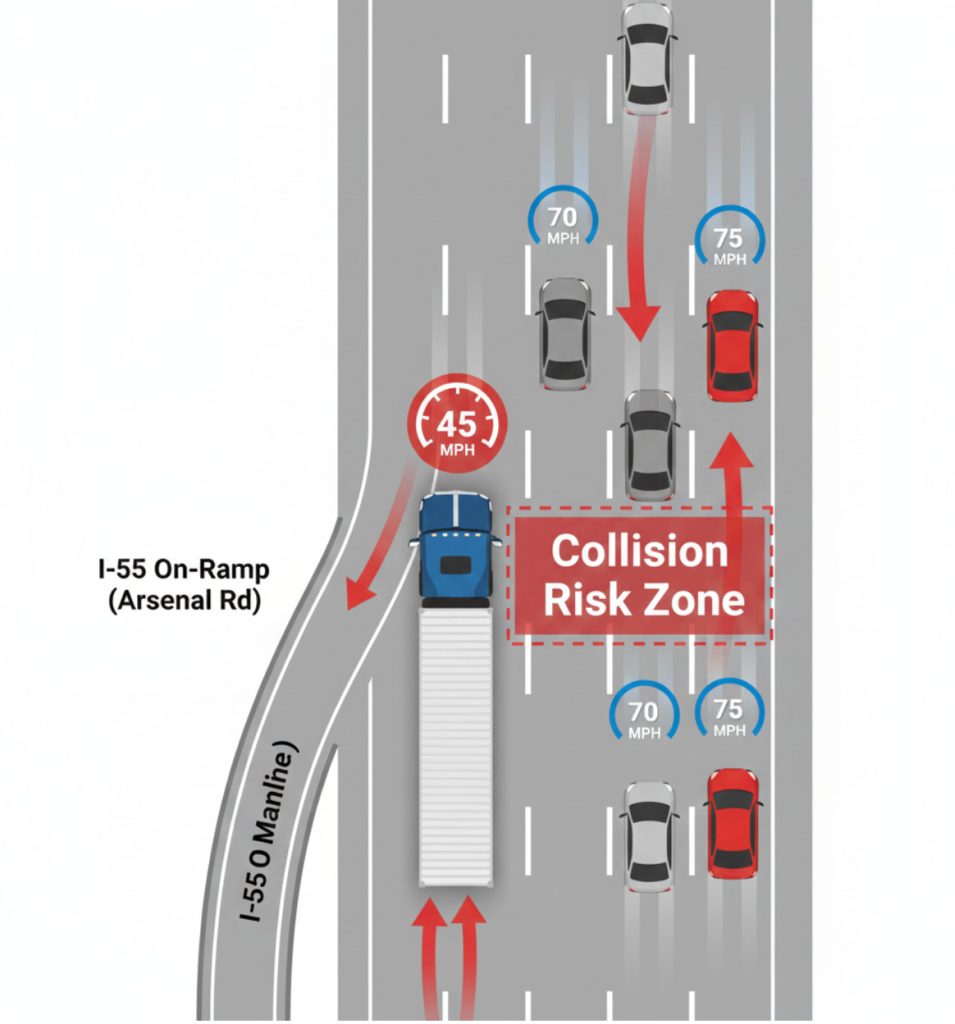
Fig 1.0. – A fully loaded semi requires more than 60 seconds to reach highway speed. The resulting 30-mph speed differential creates a high-risk zone for rear-end collisions for vehicles in the right lane.
I-55 threads through Chicago’s Southwest Side and connects neighborhoods that rely on the corridor every day. Crashes near Bridgeport, McKinley Park, Brighton Park, and Garfield Ridge often involve abrupt speed changes around entrance and exit clusters.
The Stevenson also runs alongside freight and industrial routes that bring delivery vehicles, local carriers, and regional semis into the same bottlenecks commuters use. When you combine that commercial flow with tight ramp geometry, the crash risk rises sharply.
Many Stevenson truck crashes come from a few consistent patterns tied to how the road functions.
Unsafe merging and lane changes happen often near interchange approaches and high-volume exits. Drivers cut across lanes to avoid missing an exit, and trucks need more time and space to respond.
Truck collisions on I-55 tend to produce severe injuries because of the size and weight of commercial vehicles. We frequently see traumatic brain injuries, spinal trauma, fractures, and internal injuries. High-speed impacts can lead to burns, crush injuries, and amputations. Some families face wrongful death after a fatal crash.
These injuries often require extended treatment and create long-term limitations. Building a strong claim requires medical documentation, treatment planning, and economic support to show how the crash affects work, daily life, and future care.
Truck accident liability rarely ends with one person. A careful investigation may show fault across several parties.
Under 735 ILCS 5/2-1116, Illinois follows a comparative negligence rule. You can still recover compensation if you are 50% or less at fault, though your recovery can be reduced based on your share of responsibility. That matters because insurers often try to shift blame in lane-change disputes, sudden slowdown claims, and multi-vehicle collisions.
Evidence decides these cases, and much of it sits in the trucking company’s hands. We act quickly to preserve it.
Scene evidence still matters too. Photos, video, witness statements, and police reports help establish how the crash unfolded. Reconstruction experts can tie impact patterns and roadway geometry to a clear timeline.
Compensation depends on the injuries and the facts, but it often includes medical expenses, future treatment, rehabilitation costs, and prescription needs. Lost income and reduced earning capacity matter when injuries change your ability to work. Pain and suffering and loss of normal life reflect the personal impact of serious injury.
When a crash results in death, families may pursue wrongful death damages that include funeral expenses, loss of companionship, and loss of financial support.
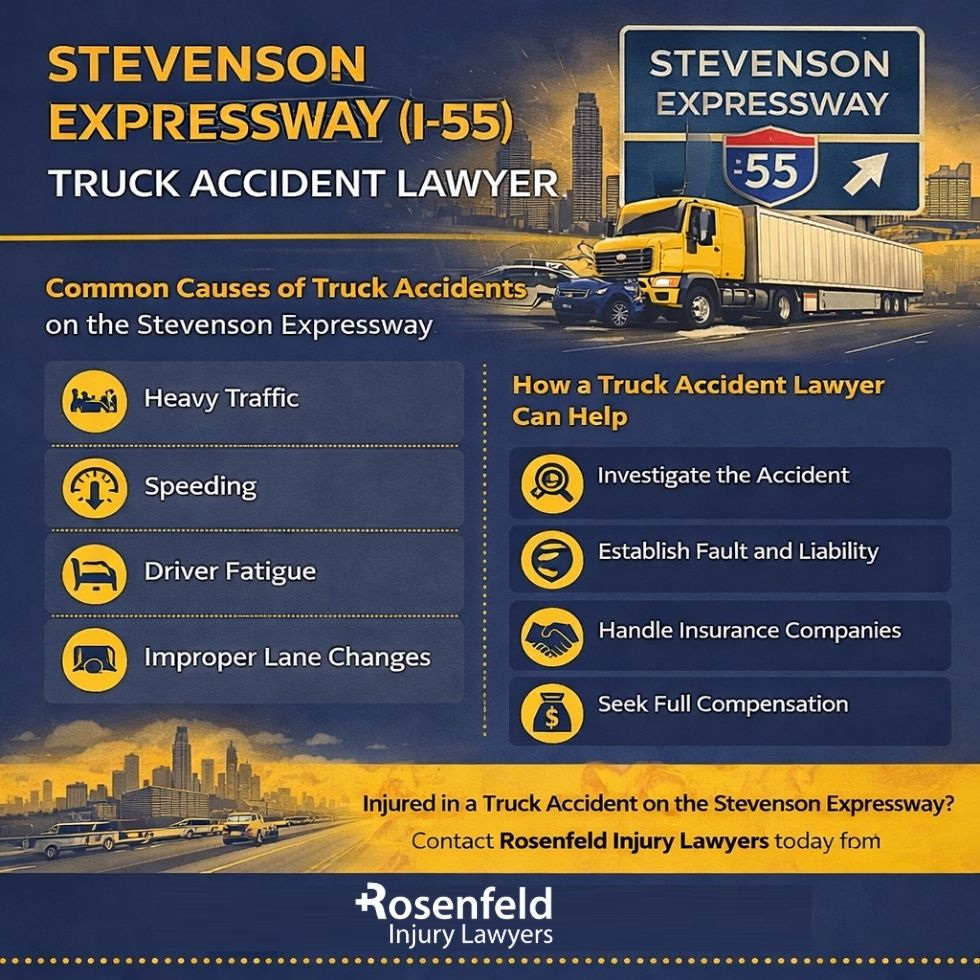
Truck crashes on I-55 often involve serious injuries and contested liability. Illinois generally provides two years to file a personal injury lawsuit under 735 ILCS 5/13-202, and early action helps preserve evidence that can disappear quickly.
If you were injured in a truck accident on the Stevenson Expressway, contact Rosenfeld Injury Lawyers for a free consultation. Our Chicago personal injury lawyers will evaluate your case, protect key evidence, and pursue the compensation your injuries require.
All content undergoes thorough legal review by experienced attorneys, including Jonathan Rosenfeld. With 25 years of experience in personal injury law and over 100 years of combined legal expertise within our team, we ensure that every article is legally accurate, compliant, and reflects current legal standards.