
Chicago Personal Injury Lawyer
Award-Winning Chicago Personal Injury Lawyer - Securing Justice
for Illinois Injury Victims - Over $450 Million Recovered



Truck crashes on I-88 often happen at highway speeds and leave little room for correction once a truck loses time or space. The Reagan Memorial Tollway carries heavy commuter volume through DuPage and Kane County, plus steady commercial freight moving between suburban distribution corridors and Chicago-bound expressway connections.
When a semi, box truck, or fleet vehicle collides with a passenger car here, the injuries can be severe, and the legal fight often centers on evidence controlled by trucking companies and their insurers.
Rosenfeld Injury Lawyers represents people injured in truck accidents on I-88 across the western suburbs and the greater Chicago region. Our Chicago trucking accident attorney team moves quickly to secure time-sensitive records and build a liability case grounded in how this tollway functions day to day.
Consultations are free, and we handle cases on a contingency fee basis.
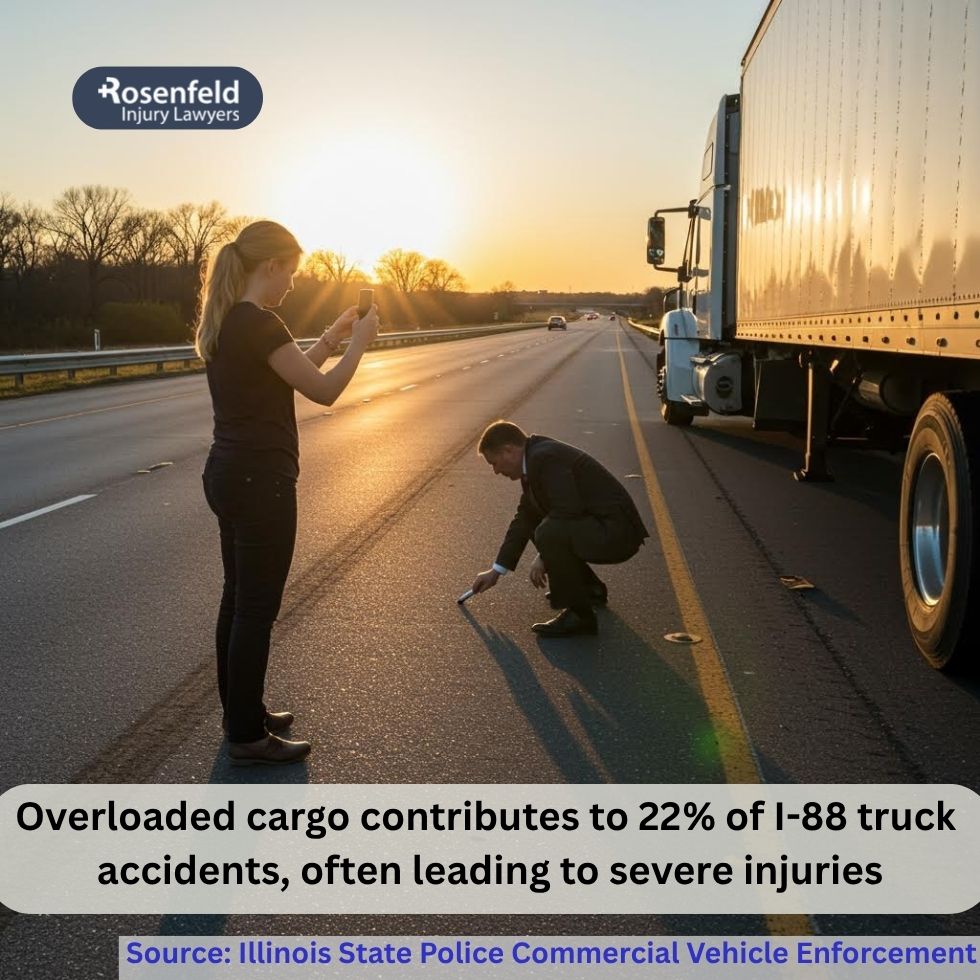
I-88 encourages speed. Long sightlines and open stretches can lead drivers to follow too closely and change lanes without adequate spacing. Then traffic compresses near interchange approaches and ramp clusters, and braking happens in waves. A loaded truck caught in that pattern can trigger rear-end collisions and multi-vehicle crashes with serious consequences.
Interchanges are a major driver of risk on this corridor.
The I-88 and I-290 connection near Hillside pulls traffic into rapid positioning and late lane changes. The I-88 and I-355 interchange near Downers Grove creates dense merging as vehicles transition between north-south and westbound travel.
Farther west, exit clusters around Naperville and Aurora create repeated lane-change pressure, especially when drivers realize too late they need a specific ramp.
Work zones and maintenance cycles add another layer of danger. When lanes narrow and shoulders shrink, trucks have fewer safe options to avoid a sudden slowdown or a drifting vehicle.
I-88 runs through a corridor shaped by office parks, industrial routes, and high-volume commuter patterns. Collisions commonly occur where traffic enters and exits in clusters and where drivers reposition quickly near ramps.
Oak Brook and the Downers Grove area see elevated interchange pressure. Naperville and Aurora see frequent merging and late lane changes tied to exit spacing and commuter peaks.
This tollway also draws a mix of long-haul trucks, regional carriers, delivery fleets, and service vehicles serving suburban commercial districts. That combination increases lane changes, passing behavior, and sudden braking near entrances and exits.
Many Reagan Tollway truck cases follow a small number of scenarios tied to speed and lane position.
High-speed rear-end crashes occur when traffic slows near interchanges, and a truck cannot stop in time. These impacts often involve smaller vehicles being pushed into secondary collisions.
Lane-change and blind-spot collisions happen when trucks position for interchanges and passenger vehicles attempt to pass on the right or cut into narrow gaps. The first contact may look minor, but it often triggers loss of control and secondary impacts.
Truck instability events happen during emergency braking. A hard stop can lead to trailer swing, jackknife behavior, or rollover risk, especially when a load shifts inside the trailer.
Breakdowns and mechanical failures can turn dangerous fast. A tire failure at tollway speed can pull a truck across lanes. Brake issues can eliminate stopping distance. Coupling failures can create separation hazards with catastrophic consequences.
High-speed truck crashes on I-88 frequently cause traumatic brain injuries, spinal trauma, fractures, and internal injuries. Severe impacts can lead to burns, crush injuries, and amputations. Fatal collisions leave families facing wrongful death claims while trying to process a sudden loss.
We document the medical impact with records, specialist input, and a treatment timeline that supports claims tied to long-term care, time away from work, and permanent limitations.
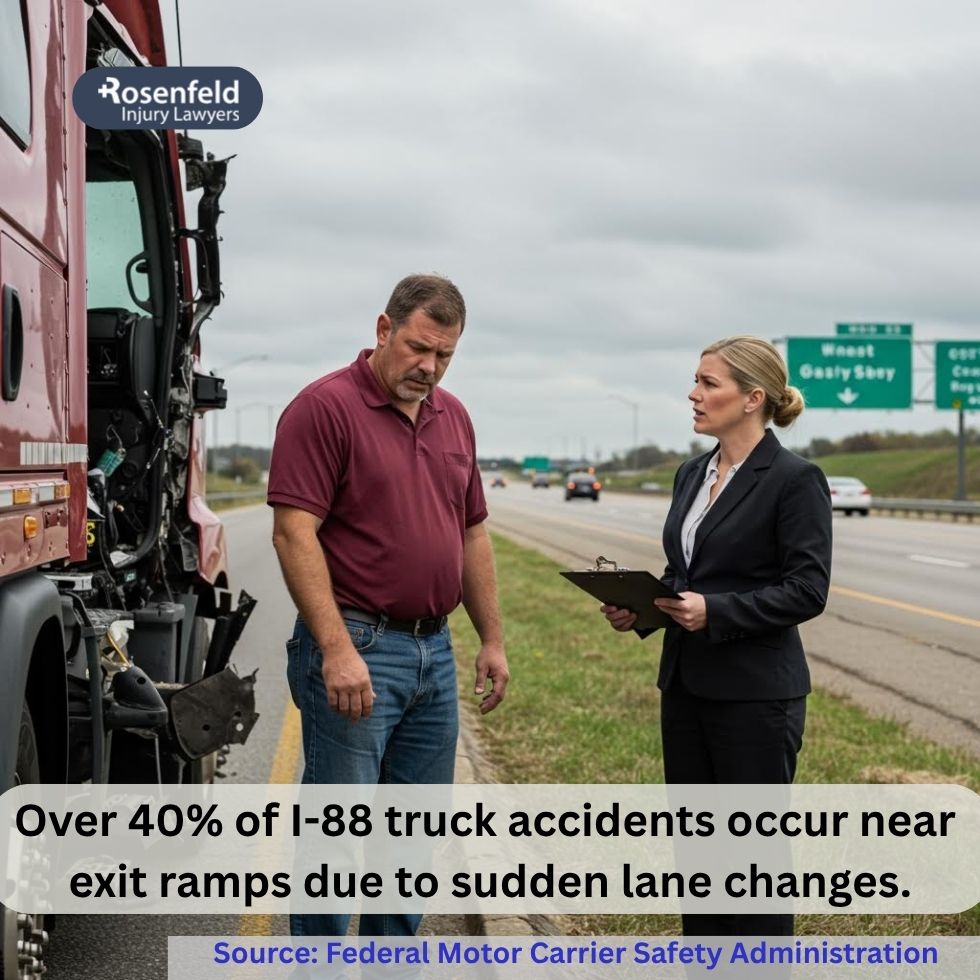
Liability on the Reagan Memorial Tollway often involves more than the truck driver, and each responsible party may control key evidence.
Under 735 ILCS 5/2-1116, Illinois comparative negligence rules allow recovery when a victim is 50% or less at fault, with damages reduced based on the assigned share of responsibility. On I-88, insurers often argue fault around lane-change disputes, sudden slowdowns near interchange approaches, and high-speed impacts, so the evidence has to be secured early.
I-88 investigations often depend on proof that is specific to tollway collisions.
We also secure scene evidence quickly, including witness statements, police documentation, and reconstruction analysis tied to ramp spacing and impact geometry.
Compensation may cover emergency care, hospitalization, rehabilitation, and future medical needs. Many victims face missed work and reduced earning capacity after serious injuries. Claims often include pain and suffering and loss of normal life when injuries disrupt daily functioning.
Wrongful death cases may include funeral expenses, loss of financial support, and loss of companionship.

Truck crashes on the Reagan Tollway often involve serious injuries and disputed liability. Illinois generally gives victims two years to file a personal injury lawsuit under 735 ILCS 5/13-202, and early action helps preserve tollway footage and electronic data before it disappears.
If you were injured in a truck crash on I-88, contact Rosenfeld Injury Lawyers for a free consultation with a personal injury attorney in Chicago. We will evaluate your claim, secure the evidence, and pursue compensation tied to the full impact of your injuries.
All content undergoes thorough legal review by experienced attorneys, including Jonathan Rosenfeld. With 25 years of experience in personal injury law and over 100 years of combined legal expertise within our team, we ensure that every article is legally accurate, compliant, and reflects current legal standards.