Chicago Personal Injury Lawyer
Award-Winning Chicago Personal Injury Lawyer - Securing Justice
for Illinois Injury Victims - Over $450 Million Recovered



BNSF Corwith Yard is different from most intermodal terminals because it is not tucked away on the edge of a rural industrial park. It sits inside a dense Chicago neighborhood near Kedzie Avenue and 47th Street, where freight traffic meets daily life.
Residents in Brighton Park and McKinley Park do not just pass by the terminal. They live next to it, walk around it, bike near it, and drive its surrounding grid every day.
That location creates a predictable safety problem. Corwith handles massive freight volume, and those containers leave the yard on trucks that have to navigate narrow city streets, tight corners, and crowded intersections.
The result is constant conflict between heavy commercial vehicles and passenger cars, cyclists, pedestrians, and local residents trying to move through their own neighborhood.
When a crash happens near Corwith Yard, it is often not a freak occurrence. It is a known risk created by high freight volume operating in a street system built for city traffic, not constant intermodal trucking.
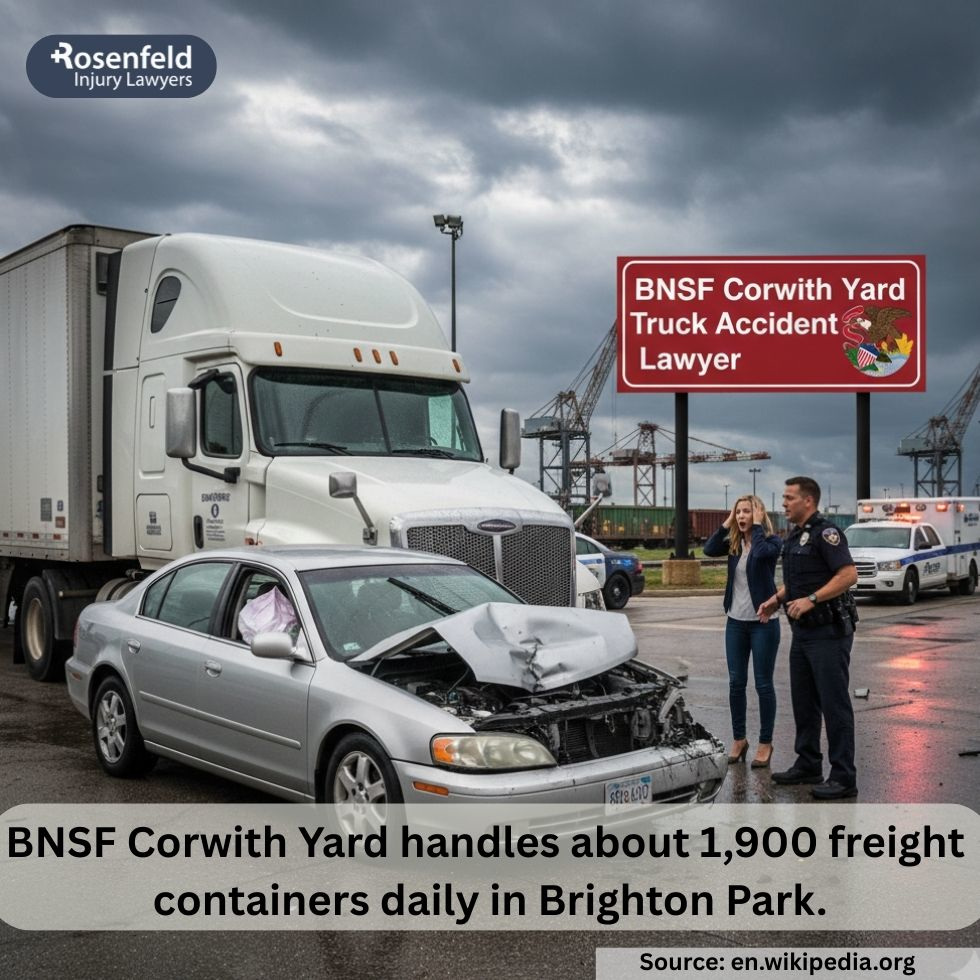
Drayage trucks do not turn like passenger cars. When a tractor-trailer makes a right turn on a tight urban corner, the trailer can off-track, which means the truck swings wide and cuts into adjacent lanes. On a city grid, that can happen at 90-degree turns where there is not enough space to clear the corner safely.
These crashes often look like sideswipes or crush events. A driver thinks they are safely alongside a truck, then the trailer arcs into their lane. The result can be serious injuries, especially when a smaller vehicle is pinned or forced into a curb, parked cars, or other traffic.
The highest-risk people in this area are not protected by a vehicle frame. Pedestrians and cyclists are exposed to blind spots, wide turns, and sudden lane shifts by trucks that are built for freight, not neighborhood streets.
Crosswalk conflicts near major intersections, close passing on narrow lanes, and turning trucks that fail to yield are common mechanisms of injury. These incidents can cause life-changing harm, including head injuries, fractures, and long-term disability, even at relatively low speeds.
For local residents, the danger is not hypothetical. It is daily exposure to heavy vehicles moving through places that are also used by kids walking home, cyclists commuting, and families crossing the street.
Corwith’s rail activity also creates blocked crossings and stalled traffic patterns that spill into residential routes. When intersections are blocked by trains or truck queues, drivers and pedestrians are forced into unsafe decisions, including sudden U-turns, risky crossings, and walking around stopped vehicles with limited visibility.
These conditions can create secondary crashes, especially when a driver tries to beat a backup, passes around stopped traffic, or fails to anticipate how abruptly congestion can change near the yard.
A significant share of Corwith truck traffic moves along the I-55 corridor and then exits into the city grid. The Pulaski Road and Kedzie Avenue exits become predictable danger zones because they funnel large trucks into mixed urban traffic within seconds.
This is where highway-speed decisions meet city-speed realities. Trucks exiting the expressway must quickly merge, change lanes, and prepare for turns while navigating dense local traffic. Passenger vehicles often do not expect a truck to drift wide, slow abruptly, or take extra space to set up a turn, which can lead to rear-end collisions, sideswipes, and intersection crashes.
When congestion builds, drayage drivers sometimes use local streets to bypass backups. That can push heavy truck volume into residential routes and smaller streets that were never designed for constant commercial traffic.
For Brighton Park and McKinley Park residents, that means increased collision risk near schools, parks, small intersections, and street parking. It also means tighter clearance, more frequent wide turns, and more situations where pedestrians and cyclists are forced into closer proximity with large trucks.
Commercial drivers are trained professionals. In an urban environment, that matters. A truck driver cannot treat neighborhood streets like an open highway. The standard of care requires heightened caution around crosswalks, cyclists, parked cars, and tight turning conditions.
When a truck causes a crash through unsafe turning, failure to yield, following too closely, distracted driving, or improper lane positioning, the driver and the company can be held accountable. In many cases, the legal focus is whether the driver operated the vehicle in a way that was reasonable for a dense Chicago neighborhood.
Sometimes the negligence begins before the truck ever enters the neighborhood. Companies that route oversized trucks through restricted residential areas, ignore known conflict points, or fail to account for urban hazards can create foreseeable risk.
Route planning and dispatch decisions can become part of the liability case, especially when the route forces trucks onto streets that are too narrow, too crowded, or clearly unsuited for repeated heavy freight traffic. When a company chooses speed and convenience over safe routing, the resulting crash is not simply a driver error. It is an operational failure.
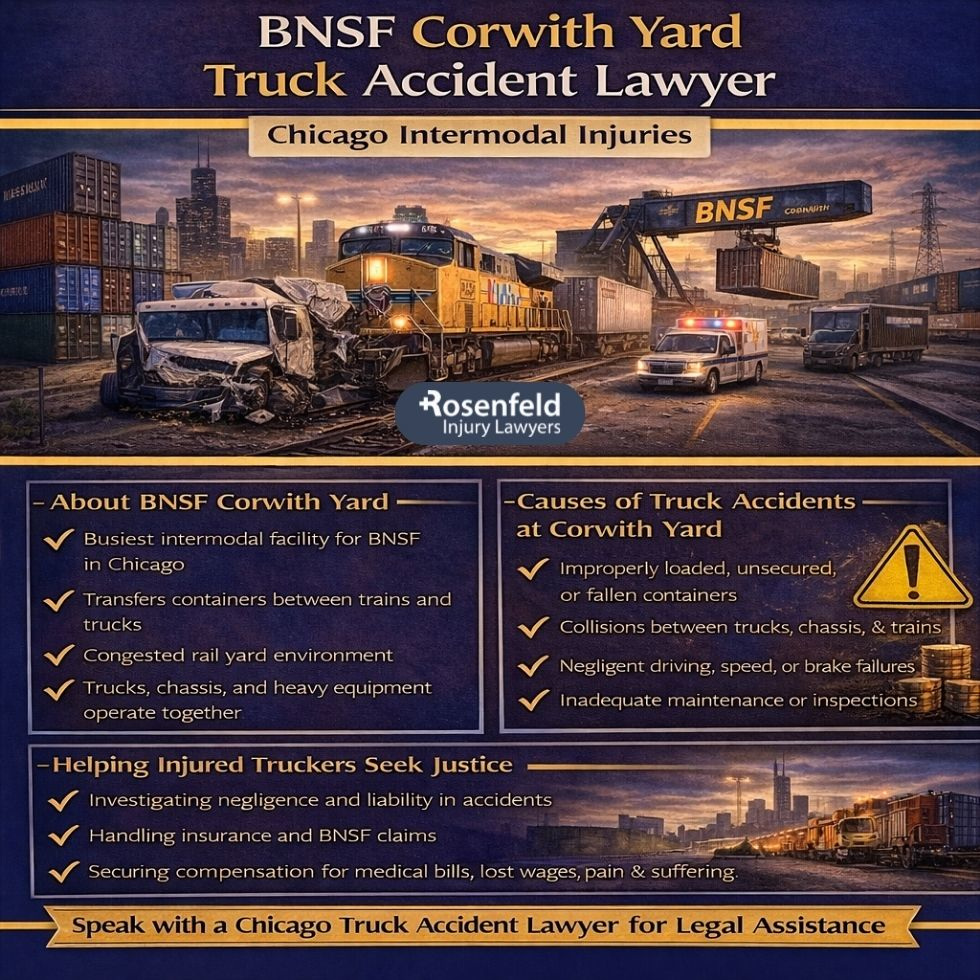
If you were involved in a crash near Corwith Yard, you need a truck accident lawyer who knows Chicago traffic laws. At Rosenfeld Injury Lawyers, we understand the Brighton Park and McKinley Park street grid, the I-55 access points, and the predictable hazards created by intermodal trucking in dense city neighborhoods.
We can move quickly to preserve evidence, identify the responsible parties, and build a case that focuses on accountability, not excuses. Contact us to speak with a Chicago-based personal injury lawyer.
All content undergoes thorough legal review by experienced attorneys, including Jonathan Rosenfeld. With 25 years of experience in personal injury law and over 100 years of combined legal expertise within our team, we ensure that every article is legally accurate, compliant, and reflects current legal standards.