Chicago Personal Injury Lawyer
Award-Winning Chicago Personal Injury Lawyer - Securing Justice
for Illinois Injury Victims - Over $450 Million Recovered



CenterPoint Intermodal Center is not just a rail yard. It operates like an inland port, a logistics hub where containers arrive by rail, transfer to drayage trucks, and fan out across the region into warehouses, distribution centers, and last-mile delivery routes.
That scale creates a unique danger in Joliet and Elwood. With roughly 20 million square feet of warehousing concentrated in one zone, traffic patterns are not normal commuter patterns. They are industrial surges.
Short-haul drayage trucks cycle between rail gates and warehouse docks all day, stacking up at intersections, filling access roads, and forcing sudden stops that local infrastructure was never designed to absorb.
When crashes happen here, they are typically caused by saturation and speed, congestion that turns ordinary merges into high-risk decisions, and a system that rewards quick turnarounds even when the roads are already overwhelmed.
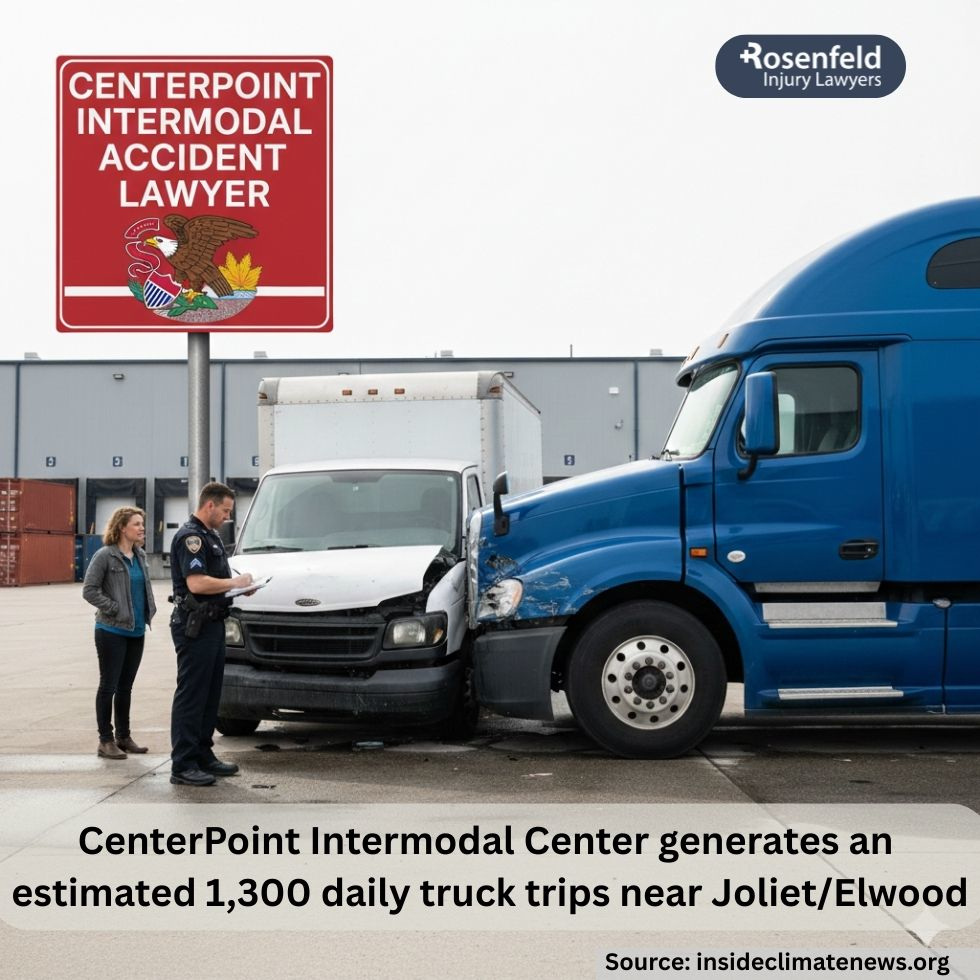
Arsenal Road and Houbolt Road function like arteries feeding an industrial ecosystem. They also become choke points. Truck queues, stop-and-go movement, and sudden lane changes create conditions where rear-end collisions are common, especially when passenger vehicles are trapped behind long lines of trucks and braking patterns become unpredictable.
These crashes often involve a simple pattern with high consequences. A line compresses quickly, a driver looks away for seconds, and an 18-wheeler cannot stop in time. The result is a violent rear impact that leaves local motorists with spinal injuries, head trauma, or fractures, even at relatively low speeds.
The I-55 interchange is a second major danger zone, especially when slow-moving trucks attempt to merge into high-speed highway traffic. A drayage truck accelerating from an on-ramp has less room to build speed, and surrounding vehicles may not anticipate how slowly the truck will enter the flow.
That mismatch creates crash scenarios that repeat in this corridor: sideswipes during merges, sudden braking chain reactions, and lane-change collisions when passenger vehicles try to avoid a truck entering too slowly.
Warehouse entrances and exits near major tenants create another predictable crash environment. Trucks often make wide turns that cut into adjacent lanes, or they stop abruptly to check gate instructions, verify appointments, or reposition for a dock approach.
Accidents are common near high-volume facilities such as Amazon, Walmart, and Home Depot operations in the surrounding area, where constant inbound and outbound traffic increases the number of turning conflicts and reduces the margin for error. Many collisions happen at the exact moment a truck swings wide, blocks multiple lanes, or pulls out when a gap is not truly safe.
Drayage work is built around short trips and fast cycles. Many drivers are paid per load, not per hour. That pay structure can create a predictable incentive to rush between rail gates and warehouse docks, even when congestion is heavy, and access roads are packed.
When speed and volume collide, safety suffers. Drivers take tighter gaps, brake harder, follow too closely, and push through yellow lights because every minute lost in a queue threatens the next run.
Another recurring hazard is queueing. When gates back up, trucks can spill onto public roadways, forcing passenger vehicles to navigate around stopped or slow-moving tractor-trailers in places that were never designed for long lines of commercial traffic.
This can trigger rear-end collisions, unsafe passing attempts, and sudden lane shifts. It also creates visibility problems. A stopped trailer can block sight lines at intersections, driveways, and turns, leaving local drivers with little warning before they meet a hard obstacle.
Congestion does not just cause delay. It creates time compression. Drivers who wait for long periods in line may try to make up time immediately after the delay clears. That rush often happens when they are mentally drained, physically fatigued, and more likely to make poor decisions.
Fatigue is not always a long-haul issue in this zone. It can be the result of hours spent idling, watching the clock, and trying to recover lost productivity in a short window on crowded roads.
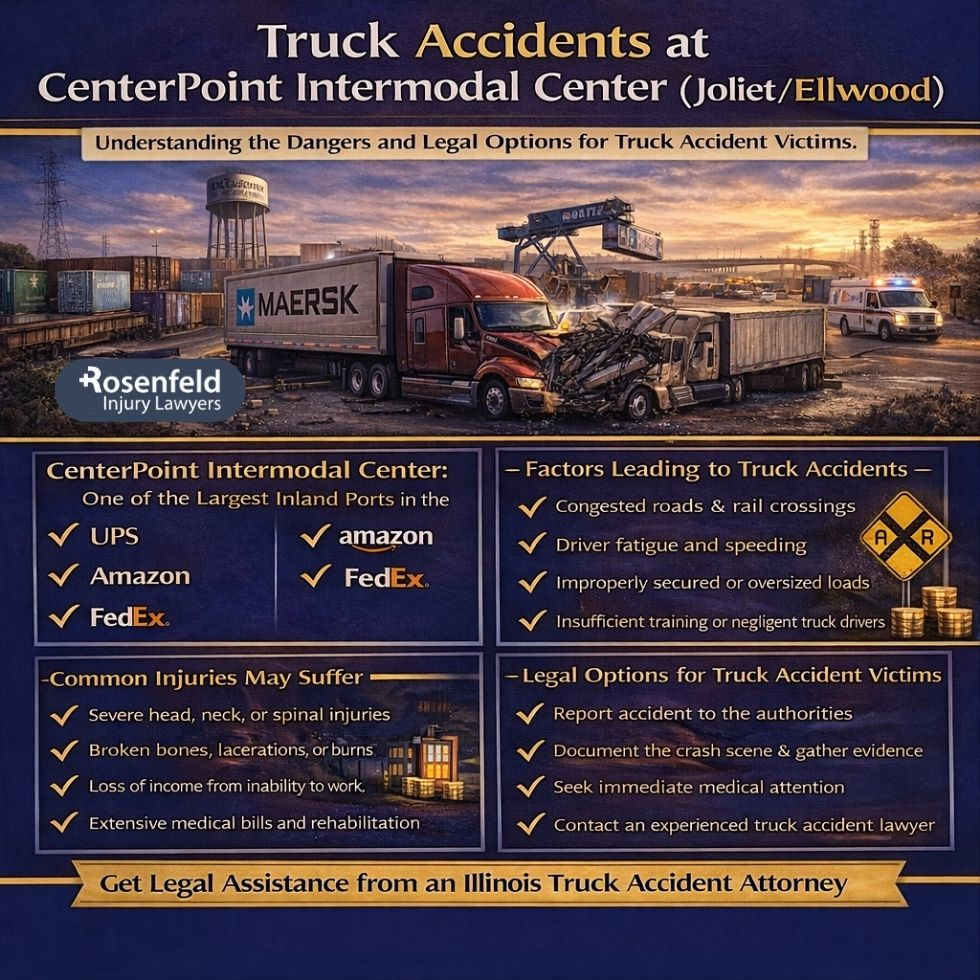
Crashes in the Joliet and Elwood intermodal zone often involve more than a single driver mistake. The responsibility chain can include the carrier, the site operations, and the warehouse systems that create bottlenecks and unsafe traffic patterns.
A logistics park that controls access, routing, signage, gate procedures, and traffic flow may contribute to dangerous conditions. If congestion is predictable and recurring, and design choices create unreasonable risks, CenterPoint’s traffic planning and operations can become part of the investigation.
That can include how queues are managed, whether truck staging is sufficient, whether signage is adequate, and whether access roads are configured in a way that forces unsafe merges, turns, or backups.
The drayage company may be responsible when unsafe behavior is encouraged or tolerated. If dispatch practices reward speed over safety, ignore fatigue, or pressure drivers to run loads despite known congestion hazards, liability may extend beyond the person behind the wheel.
Our truck accident attorneys often examine training, supervision, safety policies, and whether the company enforced reasonable standards for following distance, speed, and roadway conduct in this specific corridor.
Warehouses can contribute to crash risk when their intake systems cause severe backups and force trucks to wait on public roads. Unsafe dock practices, poor traffic direction at entrances, and delays that lead to rushed departures can all influence how and why a collision occurred.
Warehouses may also play a role when loading issues cause cargo shift, unstable trailers, or uneven weight distribution that affects braking, handling, and rollover risk.
We understand the chaos of the Joliet and Elwood intermodal zone. If you were hit by a drayage truck near the CenterPoint Intermodal Center, contact us. Our personal injury attorneys can move quickly to identify the responsible company, preserve critical evidence, and hold the right parties accountable for putting speed and volume ahead of public safety.
All content undergoes thorough legal review by experienced attorneys, including Jonathan Rosenfeld. With 25 years of experience in personal injury law and over 100 years of combined legal expertise within our team, we ensure that every article is legally accurate, compliant, and reflects current legal standards.