

Chicago Personal Injury Lawyer
Award-Winning Chicago Personal Injury Lawyer - Securing Justice
for Illinois Injury Victims - Over $450 Million Recovered



A rear-end crash between two passenger cars is often survivable. Rear-end truck accidents are different because the vehicle’s weight and braking limits change the physics.
When a semi truck or other commercial truck is traveling behind a smaller vehicle in Chicago traffic, the margin for error disappears fast. If the truck driver looks down for a moment, misjudges distance, or delays braking, rear-end collisions can become multi-impact truck accidents that leave people severely injured.
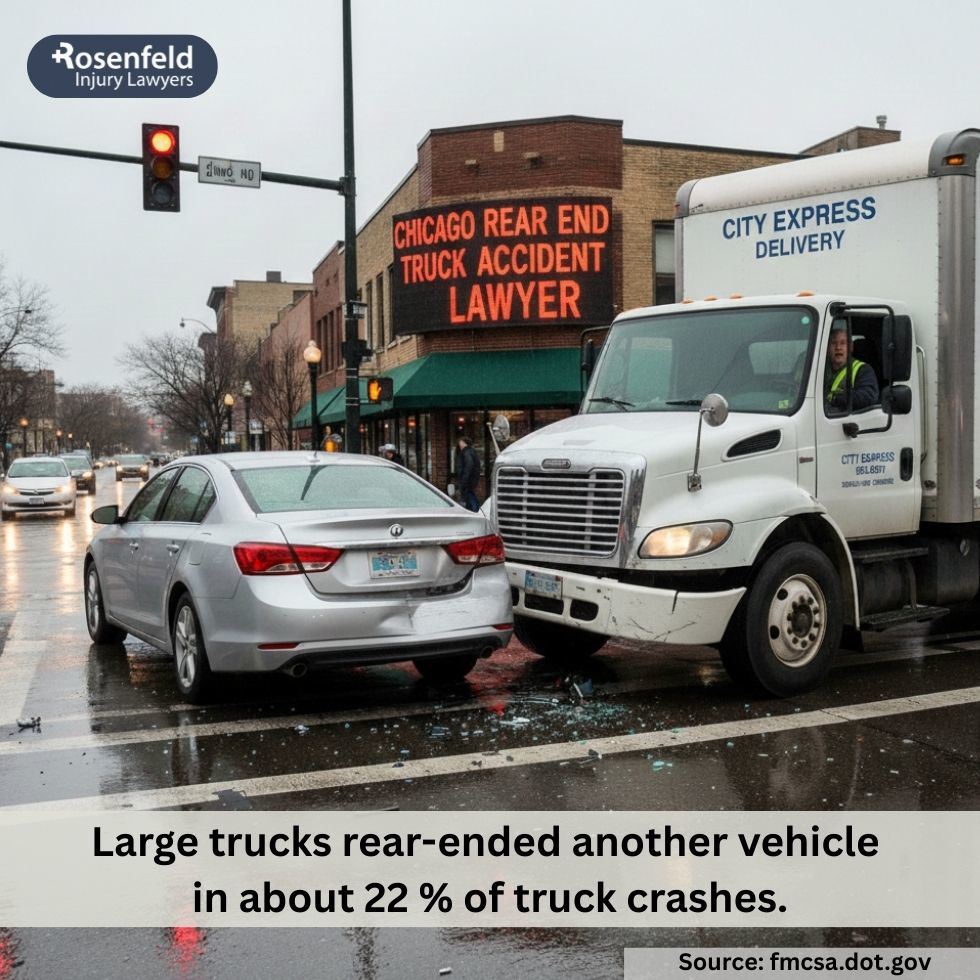
Rear-end truck accidents often happen in the exact places Chicago drivers expect congestion, which is why they are so preventable. The truck rear-end dynamic is not “bad luck.” It is usually a pattern of unsafe choices and failures that show up in records.
Chicago has unique congestion rhythms that are brutal for large commercial trucks:
In these zones, rear-end truck accidents become predictable because the truck is operating with a longer stopping distance in traffic that repeatedly forces quick deceleration.
A truck rear-end accident rarely stays limited to one vehicle. When the rear driver is a truck, the first impact can push a passenger vehicle into other vehicles, creating multiple points of injury and extensive property damage.
The common pattern looks like this:
That is why the accident scene evidence matters, including skid marks, debris fields, and vehicle resting positions.
Rear-end crashes in truck cases are often about delay, not intention. That delay can come from:
A fully loaded truck needs a disciplined following distance. When the truck driver compresses that distance in traffic, the result is rear-end truck crashes that could have been avoided with basic safety.
Rear-end collisions are fought with data, not opinions. In such cases, a Chicago truck accident lawyer from our team will secure:
When a trucking company delays, evidence can disappear. That is why early action matters in rear end truck accidents.
Rear-end truck accidents are rarely only about the person behind the wheel. A trucking company often creates the conditions that lead to these end truck accidents by pushing schedules, tolerating unsafe behavior, or failing to maintain the equipment.
We investigate whether the company:
If the rear-end collision was predictable based on records, liability expands quickly.
Rear-end truck collisions sometimes involve mechanical contribution, especially in older fleets or poorly maintained units. In the right fact pattern, truck manufacturers can be part of a truck accident lawsuit when a design defect or known failure mode contributed to the crash.
More commonly, we see maintenance failures such as:
When the truck’s weight meets delayed braking, the outcome can be severe injuries in passenger vehicles, even at moderate speeds.
Poor weather conditions do not excuse rear-end collisions. When rain hits Chicago roads, a commercial vehicle traveling at the posted speed limit can still be unsafe because it needs more distance to stop, especially near bridges, lane drops, and sudden traffic compressions.
In these cases, commercial truck drivers are expected to adjust for visibility and traction, and traffic laws still require a safe following distance.
We investigate whether the driver failed to slow, followed too close, or ignored weight limits that increase stopping distance. Because such accidents often involve large trucks, they can rapidly become multiple-vehicle crashes where multiple parties suffer serious injuries, creating high-stakes legal proceedings.
Rear-end truck accidents commonly cause injuries that are more severe than a standard car accident because the impact forces crush vehicle structures and amplify occupant movement.
Common injuries include:
Medical expenses and lost wages often become an immediate crisis, especially when the injured person cannot return to work.
Rear-end truck accidents span a very wide range because some cases involve soft-tissue recovery and others involve permanent disability or wrongful death. The median is $155,447, and the average is $2,938,042, with outcomes ranging from $2,500 to $35,129,371.
That gap exists because a small group of catastrophic rear-end collisions drives the average upward. Factors that tend to increase value include:
We use those factors to pursue fair compensation that reflects the real impact of the crash, not a generic number.
Rear-end collisions with commercial trucks demand speed and structure. We secure the evidence, identify every party and insurer involved, and build the claim around objective proof.
Key steps typically include:
When insurance companies try to minimize the claim, the case strength comes from what the records show.
If you were hit from behind by a commercial truck in Chicago, you should not have to guess what happened or fight the trucking company alone. Our team will investigate the rear-end truck accident, secure the critical evidence, and explain your legal options in plain terms.
Call a Chicago personal injury lawyer from our team for a free consultation to discuss your case and the next steps toward a fair settlement.
All content undergoes thorough legal review by experienced attorneys, including Jonathan Rosenfeld. With 25 years of experience in personal injury law and over 100 years of combined legal expertise within our team, we ensure that every article is legally accurate, compliant, and reflects current legal standards.