

Chicago Personal Injury Lawyer
Award-Winning Chicago Personal Injury Lawyer - Securing Justice
for Illinois Injury Victims - Over $450 Million Recovered



Rollover truck accidents feel sudden, but the physics builds up earlier. A truck rollover starts when a tractor-trailer enters a curve, an off-ramp, or a tight turn with the wrong balance of speed, steering, and load placement. The real tipping point is the center of gravity.
When a fully loaded tractor-trailer carries freight stacked high, the high center and raised center of gravity reduce vehicle stability. A small steering correction can become a roll moment, and the trailer can begin vehicle quarter turns before the truck rollover.
That is why truck rollover accidents in Chicago are not “bad luck.” They are usually preventable events involving the driver’s choices, the trucking company’s loading practices, or equipment conditions that made a rollover situation inevitable.
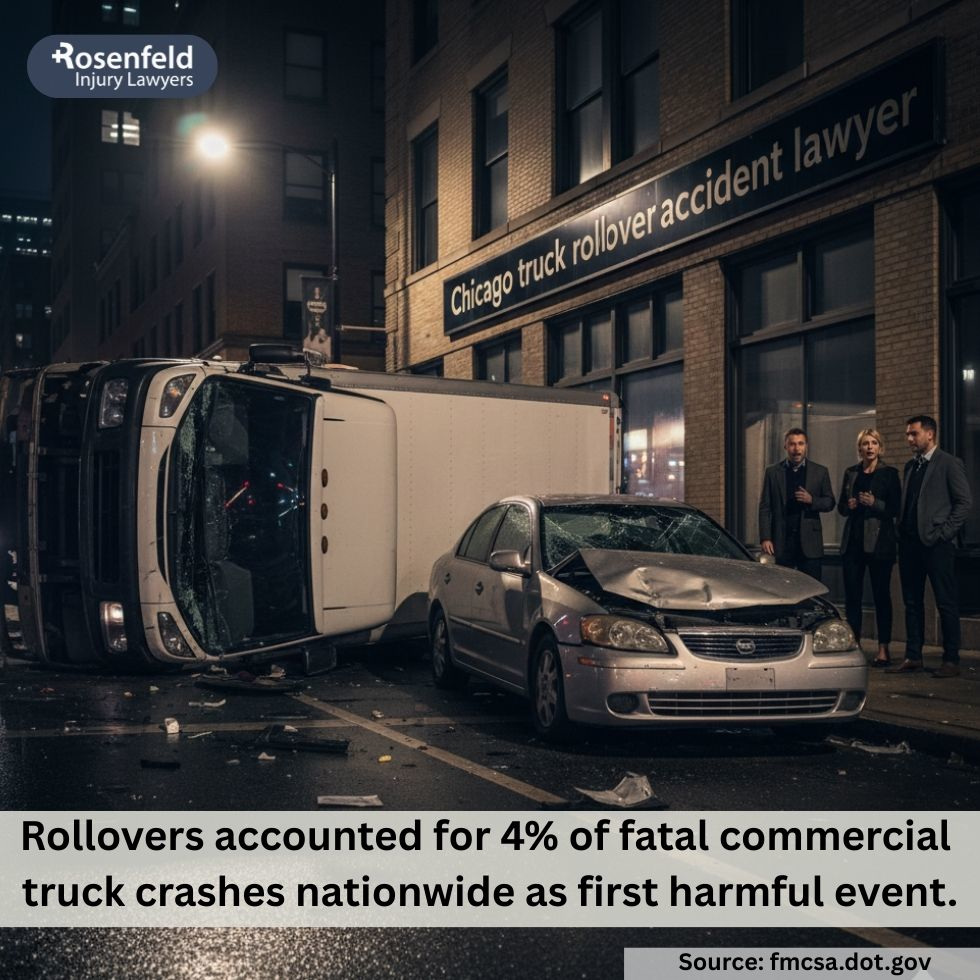
Chicago is a freight city with heavy tractor-trailer traffic mixing with tight geometry. Rollover accidents show up where curves and lane shifts punish speed and abrupt steering.
A rollover truck accident occurs when the trailer’s weight shifts and the driver cannot recover before the truck rollover.
A truck rollover is a stability failure. Large trucks sit higher, carry heavier loads, and respond differently than motor vehicles built for passenger use. That is why rollovers occur far more easily when freight is stacked high or secured poorly.
Key factors that drive rollover crashes:
This is why commercial truck rollover accidents happen in scenarios that look ordinary until the roll moment is already in motion.
Truck rollover accidents occur due to specific, provable reasons. Our Chicago truck accident attorney team focuses on the mechanisms that separate “driver error” from actionable negligence.
Many semi-truck rollover accidents happen because drivers fail to adjust speed for the curve and the load. Even when a semi truck is not “speeding” in the ordinary sense, safe speed for a tractor-trailer may be far below posted speed limits. When drivers fail to adjust speed, the trailer’s center of gravity creates a rollover situation.
Driver fatigue can cause late braking, poor lane positioning, and delayed reactions. A truck driver who is falling asleep or who has compromised driver’s attention can drift, then jerk the wheel back. That correction is exactly how truck rollover accidents happen. Distracted driving can create the same pattern when the driver looks away and then overcorrects.
Some rollover accidents begin as mechanical failure. Tires can drop stability instantly. Under-inflated tires and worn tires can also increase heat and flex, raising rollover risk. Brake failure can trigger panic steering when the driver cannot slow as expected, which can cause the tractor-trailer to lose control.
A truck rollover accident is often the result of freight that was loaded high or secured improperly. When the load shifts mid-curve, the center of gravity changes instantly. Truck rollovers happen not because the driver intended it, but because the load created the roll moment that the driver could not overcome.
Rollover accidents are not mysteries. They leave a signature that a company cannot talk away.
We look for:
This is where accident reconstruction experts can matter, especially when the insurance company tries to frame the rollover as unavoidable driver error.
Determining fault in rollover truck accidents requires a thorough investigation because the defense often repeats the same narrative: the truck driver “lost control” and that is the end of the story. It is not.
We examine whether:
Truck accident victims deserve an answer that matches the physics, not a generic explanation designed to reduce the claim.
Rollover accidents frequently cause severe injuries because the cab and trailer can crush passenger vehicles or create secondary impacts with others. These events can cause traumatic brain injuries, spinal cord injuries, and other life-altering harm.
Beyond the physical injuries, the costs add up fast: medical expenses, medical bills, and lost wages can follow truck accidents for months or years. We build each injury claim around the real impact and the real losses so victims can recover compensation and receive fair compensation that reflects what happened.
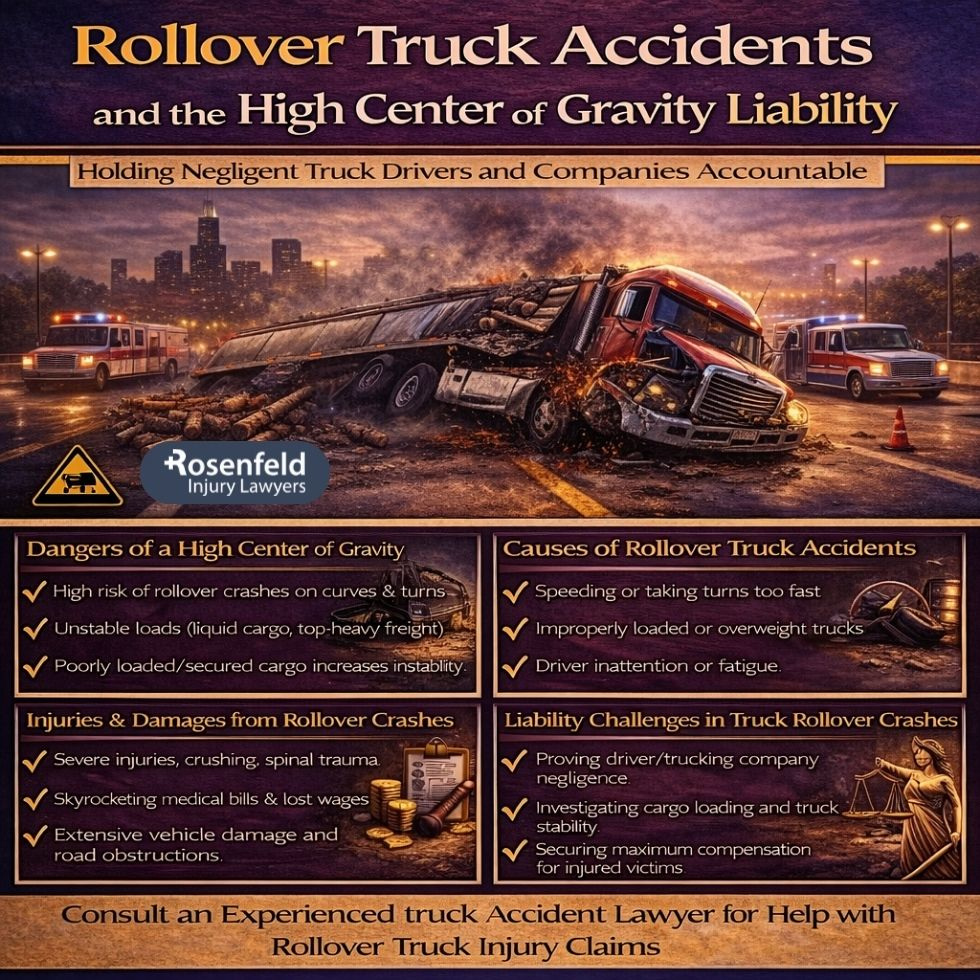
Trucking companies and the trucking industry know rollover prevention is part of safe operations. Federal motor carrier safety guidance expects safe practices, and the Motor Carrier Safety Administration enforces safety rules that make fatigue, inspection, and equipment condition relevant when a rollover truck accident occurs.
When a trucking company fails to manage center of gravity risks, sends a tractor-trailer out with tire issues, or pressures a truck driver into unsafe timing, that is not an accident. That is negligence. In the worst cases, it becomes truck driver negligence backed by company policy.
A skilled truck accident attorney can force the evidence into the open before it disappears and stop the insurer from minimizing what caused the truck rollover.
If you were injured in an event involving a truck rollover, do not wait for the insurance company to define the cause. Rollover truck accidents happen for specific reasons, and proving them is the difference between a reduced payout and a full recovery.
Contact our office for a free consultation with a Chicago personal injury attorney. We investigate why the truck rollover accident happened, identify the contributing factors, and pursue the claim with the proof needed to hold the responsible parties accountable.
All content undergoes thorough legal review by experienced attorneys, including Jonathan Rosenfeld. With 25 years of experience in personal injury law and over 100 years of combined legal expertise within our team, we ensure that every article is legally accurate, compliant, and reflects current legal standards.