

Chicago Personal Injury Lawyer
Award-Winning Chicago Personal Injury Lawyer - Securing Justice
for Illinois Injury Victims - Over $450 Million Recovered



Semi truck accidents are not “bigger” truck accidents. A semi truck is a tractor pulling a trailer and a load that behaves like a moving force. When that force changes suddenly, the crash does not stay contained. The trailer can sweep lanes, the braking window collapses, and multiple vehicles get pulled into the impact zone.
That is why big rig accidents show up in the data behind large truck crashes and fatal large truck crashes. In crashes involving large trucks, a single error can produce fatal crashes, lifelong injuries, and permanent loss for families. A semi truck driver may walk away from the cab, but people in smaller cars and other vehicles often do not.
This page focuses on the details that make semi crashes provable in Chicago: trailer dynamics, blind-zone geometry, braking limits, and the company systems that keep risky behavior on the road.
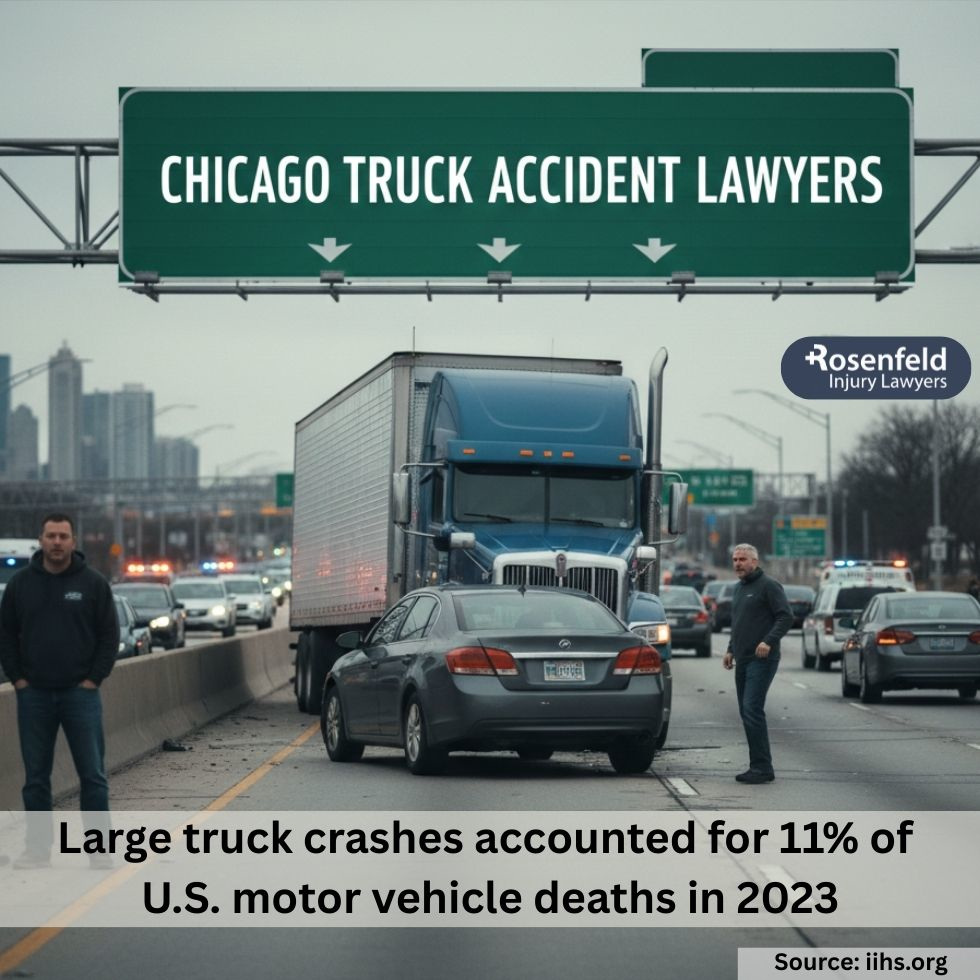
Here is the unique truth about a semi: the trailer does not respond at the same time as the tractor. In sudden braking or an abrupt lane move, the tractor reacts first, and the trailer “catches up” a moment later. That delay is what turns a near miss into a lane-sweeping event.
When the truck driver brakes hard to avoid a stopped car, the trailer’s momentum can shove the tractor forward, lighten steering traction, and reduce control. If the driver then corrects, the trailer can swing, creating the start of a jackknife. This is why jackknife accidents often begin with a normal traffic slowdown and end with the trailer blocking lanes and crushing other vehicles involved.
Chicago makes this worse because traffic slows fast. You do not get a long warning. You get a brake-light wave, a half-second decision, and a trailer that reacts after the driver has already committed.
Most people think blind spots are just “next to the cab.” In an 18-wheeler, there are two practical danger zones.
One is the area beside the cab where the side mirrors still cannot show a small vehicle riding tight. The other is along the trailer, where a car can sit in the driver’s peripheral dead space, especially if the driver is scanning forward for merges and brake lights.
That is why sideswipe accidents are a recurring pattern in semi-truck accidents. A lane move that would be harmless in a car becomes catastrophic in a semi, because the trailer tracks laterally into the space the driver never truly cleared. When the semi is moving at speed, the impact is not a tap. It can be a barrier pin or a roll event for the passenger car.
Rear-end crashes in Chicago often involve the same mechanical story.
A big rig rolls in traffic, brakes lightly for miles, and builds heat in the brake system. Then traffic stops abruptly. The driver hits the brakes hard and late. That combination can create reduced braking effectiveness, longer stopping distance, and a hard impact that leaves the people in the struck car with severe injuries.
When we handle rear-end crashes caused by a semi truck, we do not treat “couldn’t stop” as an excuse. Our big rig accident lawyers treat it as a measurable failure that can be traced to driver timing, speed management, and the trucking company’s maintenance and training culture.
18-wheeler accidents repeat because the tractor-trailer system repeats the same failure modes.
Distracted driving is not a buzzword in these cases. It is the half-second gap between seeing a stop and reacting. That gap is enough to turn a slowing traffic wave into a serious crash.
Jackknife accidents often begin with hard braking, uneven traction, or abrupt steering corrections. Once the trailer swings, the semi becomes a moving barricade.
Head-on collisions involving a semi are frequently fatal accidents because of the closing forces. They are often tied to fatigue, drift, or an overcorrection event.
Sideswipe accidents happen when a semi changes lanes without truly clearing the trailer path. Side mirrors help, but they do not eliminate dead space.
Wide turn accidents happen because the trailer gets off-tracked. A car that tries to pass on the inside can get caught in the squeeze zone.
Our Chicago truck accident lawyers build semi-truck cases around provable behaviors, not assumptions. The patterns our 18-wheeler accident lawyers see repeatedly include distracted driving, fatigue, and speeding because all three erase the limited margin a big rig has.
These are not isolated mistakes. They are the predictable outcomes of how drivers are pushed to perform and how safety is enforced.
A trucking company is not a bystander. The trucking company sets schedules, trains drivers, inspects equipment, and decides what behavior is tolerated. In many cases, the driver is the final link in a chain of corporate choices.
Our semi truck accident lawyers investigate whether the trucking company:
This is how we identify who is responsible and force the carrier to account for the system that put a dangerous semi on the road.
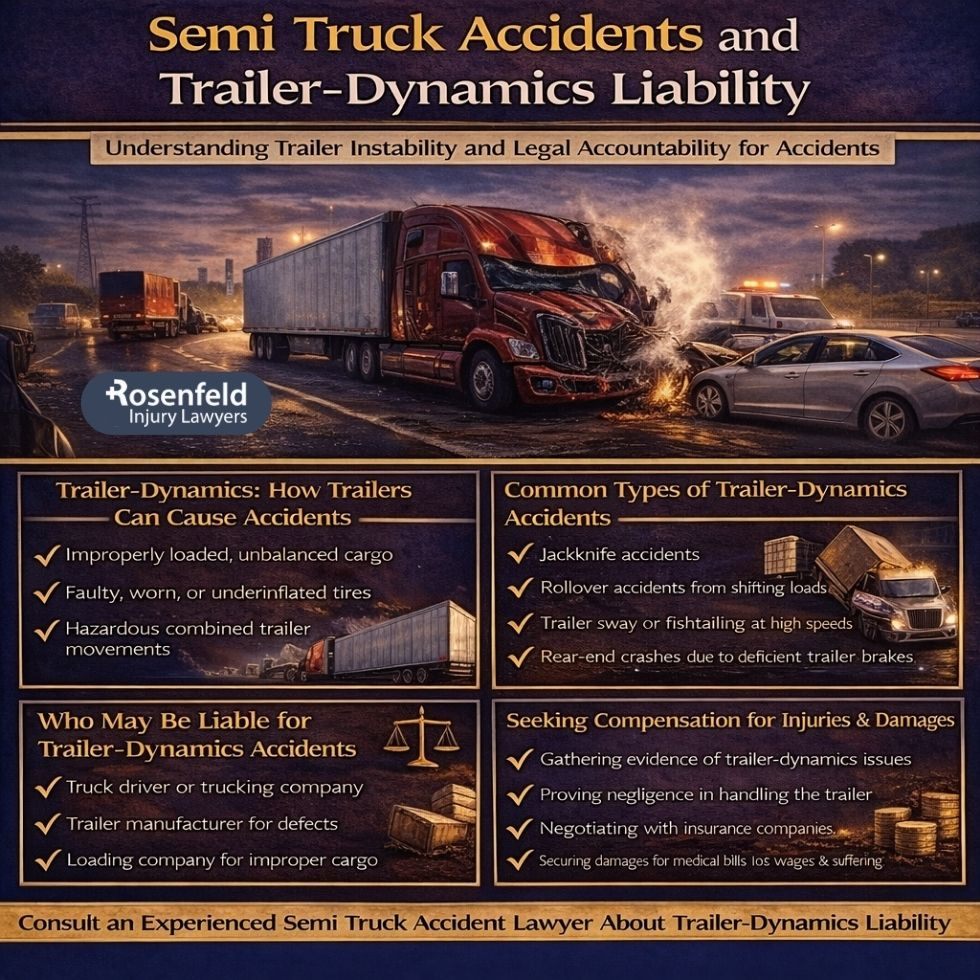
An 18-wheeler crash is an engineering event. We prove it by tying the crash pattern to data and physical evidence.
We focus on:
When the proof matches the mechanics, fault becomes hard to deny.
Semi truck accidents often cause long recoveries, permanent limitations, and high financial costs. Compensation should reflect the total impact, including medical care, ongoing treatment needs, wage loss, and full life disruption. Our Chicago personal injury lawyers also pursue recovery for property damage when the vehicle is totaled or heavily repaired.
Your claim is not just a file. It is the path to accountability and a safer outcome for others.
Semi truck accidents are not unavoidable. They happen when safety margins are ignored, and predictable failure modes repeat. If you were injured in a crash involving a semi truck, contact us. We identify every responsible party, build proof that holds the trucking company accountable, and pursue the compensation you need to move forward.
All content undergoes thorough legal review by experienced attorneys, including Jonathan Rosenfeld. With 25 years of experience in personal injury law and over 100 years of combined legal expertise within our team, we ensure that every article is legally accurate, compliant, and reflects current legal standards.