
Chicago Personal Injury Lawyer
Award-Winning Chicago Personal Injury Lawyer - Securing Justice
for Illinois Injury Victims - Over $450 Million Recovered



A T-bone truck accident is one of the most violent forms of vehicle crashes because the impact hits the weakest part of a car. In Chicago, T-bone accidents are especially common at dense, signal-heavy intersections where a commercial vehicle can roll through a red light, cut a turn too tight, or misjudge cross-traffic while trying to keep momentum.
Our Chicago team builds these cases around one idea: intersection side impact accidents are not “he said, she said.” They are measurable. A T-bone truck collision leaves a timeline, a point of impact, and a pattern of damage that accident reconstruction experts can test against traffic controls and camera evidence.
If you are looking for a Chicago truck accident lawyer who understands how these side impacts happen in the city, we are here to help you understand signal timing, turn geometry, curb lanes, delivery pressure, and the proof that sits in municipal systems.
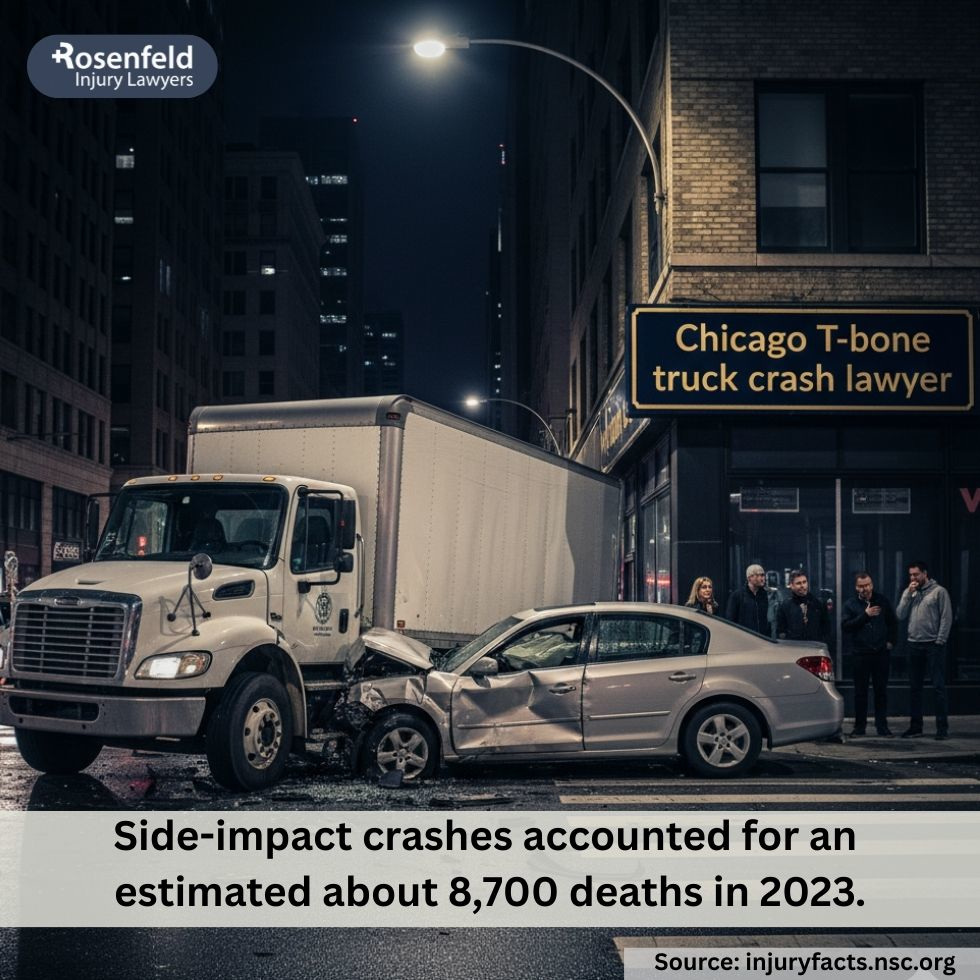
Chicago intersection crashes have their own rhythm. Streets are narrow, lanes are tight, and trucks often need wide turns even when they are not supposed to. A large truck or tractor trailer trying to clear an intersection may roll forward to set up a turn, then enter on a stale yellow or after a red light. That is when one vehicle suddenly becomes the target of a side impact.
T-bone truck crashes also happen when a truck driver treats a stop sign like a yield, or when the driver fails to scan the cross street before entering. With a large truck, the mass and height of the impact frequently causes severe injuries even at speeds that do not sound high on paper.
The core Chicago-specific issue is this: these accidents occur in the box, the intersection space governed by traffic laws, markings, and signal control. That gives us more ways to prove fault than in many highway collisions.
Many T-bone accidents in the city come down to late entry.
A truck driver approaches an intersection and either accelerates to beat a red light or continues through after the light changes. When the truck hits the side of one car, the impact can cause severe injuries.
We see the same issue at sign controlled intersections. The truck rolls, the trailer follows, and the truck takes the right of way that it did not have. In a T-bone truck collision, the question is simple: who had the control and who entered illegally.
Because these are intersection events, determining fault is often built from physical proof and electronic evidence, not memory.
Chicago gives us evidence sources that are unusually powerful for a T-bone accident, and we move quickly to collect evidence before it disappears.
Police reports matter more in T-bone accidents than in many other truck accident scenarios because officers often document lane positions, signal statements, and the intersection layout. In a side impact accidents case, that diagram can identify the conflict path and the likely violation.
Traffic camera footage can be decisive in determining fault in Chicago T-bone truck crashes. When a traffic light violation is the trigger, video can show the moment the truck entered and whether the light was already red.
When distracted driving is suspected, phone records and cell phone activity can help prove the driver was not watching the intersection. We often pursue phone records to test whether a truck driver was interacting with a device in the minutes surrounding the accident involving the truck.
This matters because distraction in an intersection is different than distraction on an open road. A half second can be the difference between stopping at the line and entering the box.
Accident reconstruction specialists are especially valuable in T-bone truck crashes because the geometry is fixed. They analyze impact angles, crush profiles, vehicle rest positions, and timing to determine whether the driver rolled a stop sign. In a T-bone accident, reconstruction can also validate speeds and reaction windows.
A T-bone truck collision usually has one primary cause: a driver fails to yield the right of way at a controlled intersection. But Chicago intersections add layers that help us prove responsibility.
Determining fault typically involves several factors:
We use these points to build the injury claim against the responsible parties, including trucking companies when the crash involves a commercial vehicle operating under delivery pressure or company routing practices.
T-bone truck crashes are not fender-benders. Side impact truck accidents frequently cause injuries because the side of a passenger vehicle has less structure than the front or rear.
From lateral head movement.
Especially ribs, pelvis, and shoulder injuries.
Internal bleeding and organ damage that requires urgent treatment.
Leading to prolonged physical therapy.
If you were in a T-bone accident, seek medical attention immediately. Many injuries do not announce themselves at the accident scene, and you need records that matter later.
These cases move quickly because evidence disappears quickly.
This is how we protect your injury claim and position the case for full value.
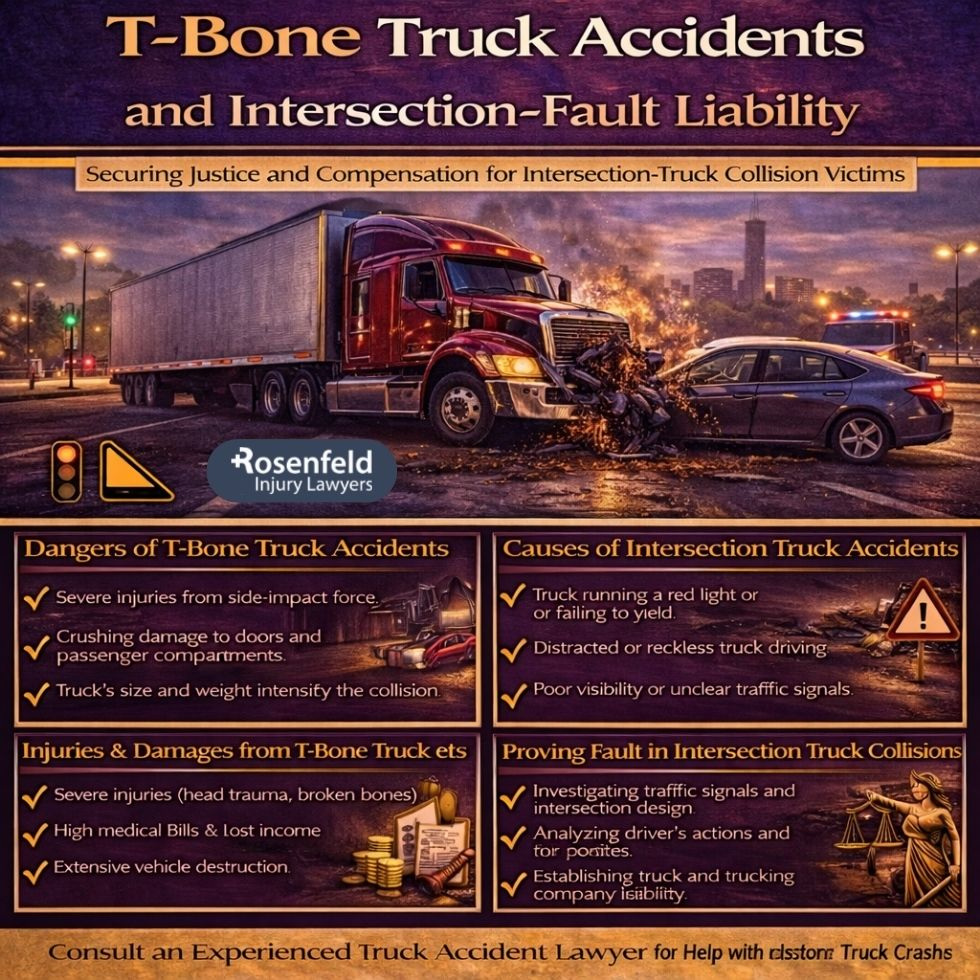
A T-bone crash can create medical bills that continue for months. The financial impact often includes lost wages, medical bills for physical therapy, and long-term treatment needs. We build claims that reflect the true harm, including the cost of medical care and the life disruption these accidents cause.
Property damage is also common in side impact truck crashes because the door intrusion and frame damage can total one vehicle even when the other vehicle looks less damaged.
A T-bone truck accident is not just a traffic event. It is a collision that often leaves permanent consequences, and trucking companies and their insurance company partners move fast to control the narrative.
If you were injured in a T-bone collision with a large truck, contact a Chicago personal injury lawyer at our office for a free consultation and a free case review. We run a thorough investigation, secure medical records, and use reconstruction to determine fault and hold the responsible parties accountable.
All content undergoes thorough legal review by experienced attorneys, including Jonathan Rosenfeld. With 25 years of experience in personal injury law and over 100 years of combined legal expertise within our team, we ensure that every article is legally accurate, compliant, and reflects current legal standards.