
Chicago Personal Injury Lawyer
Award-Winning Chicago Personal Injury Lawyer - Securing Justice
for Illinois Injury Victims - Over $450 Million Recovered



An underride truck accident happens when a passenger car slides underneath the side or rear of a trailer during a collision.
In a normal crash, the vehicle’s front structure absorbs force and safety systems activate as designed. In underride accidents, that protective zone disappears. The trailer intrudes into the passenger compartment, leading to roof crush, traumatic head impacts, and catastrophic outcomes.
This is why underride accidents are different from most truck accidents. Even when speeds are not extreme, the geometry of the impact can bypass airbags and other safety features, leaving occupants exposed to direct force at the head and neck level.
For victims and families, these cases often involve severe or fatal injuries, including traumatic brain injury, spinal cord injuries, and wrongful death claims. A truck crash of this kind is not only violent. It is preventable when safety equipment works the way it should.
If you are searching for an underride truck accident lawyer in Chicago, the central question is rarely just what the truck driver did. It is whether a safety guard failed at the exact moment it was supposed to save a life.
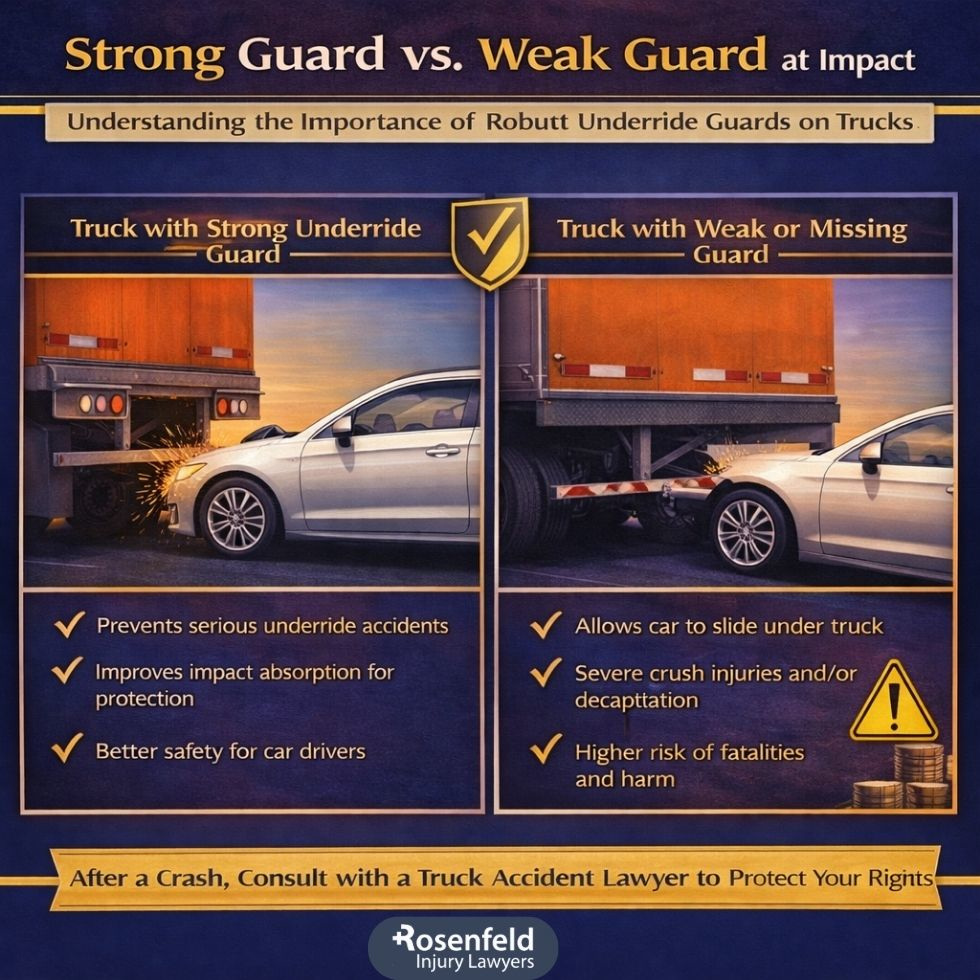
Rear underride protection is commonly called the “Mansfield bar,” a name tied to a widely known crash in the 1960s involving actress Jayne Mansfield. The public awareness that followed helped push the industry toward rear impact guards, but the hard truth is that many rear guards remain mechanically weak in real-world conditions.
Federal regulations require rear impact guards, but “legal compliance” does not always mean “effective.”
In many underride accidents, the guard buckles, shears, or collapses. Some fail during higher-speed impacts. Others fail during offset crashes where only the corner of the guard is struck, which can cause the trailer to rotate or the guard to twist away from the point of impact. When the guard fails, the trailer’s structure becomes the striking surface, and passenger vehicles do not stand a chance.
These cases often hinge on mechanical failure, the strength of the guard design, and whether the trailer was maintained and inspected in a way that kept that guard capable of doing its job.
Side underride accidents can be just as devastating, and in some ways, more preventable. The major legal gap is simple. Rear guards are required, but side guards are not federally mandated in the same way across the board.
That leaves long stretches of open trailer space where a car can slide beneath the trailer during a side-impact collision, especially at intersections or during lane-change conflicts.
The negligence argument is direct. The risk is well known, and there are proven side guard options, sometimes called “angel wing” side guards, that can reduce the likelihood of a vehicle traveling under a trailer.
Yet many fleets choose not to install them. When a trucking company prioritizes cost savings over known safety measures, the result can be serious injuries that never should have happened.
In a truck accident in Chicago involving side underride, the investigation often focuses on how visible the trailer was, what traffic laws applied to the maneuver, and whether the large commercial truck created a foreseeable side-impact hazard without adequate protective equipment.
Underride accident cases often involve more than one responsible party. The evidence is physical, technical, and often time-sensitive. The key is identifying whether the failure was built into the equipment, created by neglect, or both.
When a rear guard design is structurally weak, poorly engineered, or prone to buckling in foreseeable impact conditions, a product liability claim may be warranted.
These cases focus on whether the manufacturer designed a guard that could meet minimum requirements on paper but failed during the very crashes it was intended to mitigate. In those situations, the “compliance” defense can collapse under engineering reality.
We also investigate whether the trucking carrier failed to keep the guard in a safe working condition. Guards can be bent, rusted, cracked, or improperly repaired after minor impacts. If a trucking company failed to replace a damaged guard during inspections or signed off on a trailer that should not have been on the road, that paper trail can become the center of liability.
In some cases, the issue overlaps with truck driver negligence, including when a truck driver fails to perform basic pre-trip awareness of obvious damage or ignores warning signs that the trailer is unsafe.
This is where our Chicago truck accident lawyers focus on documentation, inspection histories, repair records, and the condition of the tractor-trailer at the time it was placed into service.
Underride cases require more than a general personal injury approach. We treat them as a safety equipment failure investigation from day one. Our Chicago truck accident attorney team moves fast to preserve the trailer, secure measurements, and document the guard condition before repairs, scrapping, or evidence loss changes the facts.
In underride accident cases, we often rely on:
These details are not minor. They determine whether the guard should have prevented the vehicle from intruding under the trailer, and whether a safer design or proper maintenance could have avoided the outcome.
The consequences of underride accidents are often life-altering. Many victims face extensive rehabilitation, long-term limitations, and major financial stress from medical bills and lost income. When the harm is permanent, compensation can also include pain and suffering and the cost of future care needs. In the most devastating cases, families pursue wrongful death claims under Illinois law.
A skilled truck accident lawyer will not treat these cases as routine. They require a full accounting of the severe injuries, the long-term impact, and the evidence proving why the safety system failed.
If a safety guard failed to protect your family, it was not an “accident.” It was an engineering failure.
Our Chicago personal injury law firm represents people harmed in serious truck accidents, including underride accidents involving rear impact guards and side underride hazards.
If you believe a Mansfield bar failed, or a trailer lacked reasonable protective equipment, contact our Chicago truck accident lawyers for a free consultation. We will move quickly to preserve the evidence, identify who is responsible, and pursue accountability for the harm caused.
If you need an accident lawyer who understands the technical evidence in an underride truck accident, we are ready to help.
Resources: NHTSA
All content undergoes thorough legal review by experienced attorneys, including Jonathan Rosenfeld. With 25 years of experience in personal injury law and over 100 years of combined legal expertise within our team, we ensure that every article is legally accurate, compliant, and reflects current legal standards.