
Chicago Personal Injury Lawyer
Award-Winning Chicago Personal Injury Lawyer - Securing Justice
for Illinois Injury Victims - Over $450 Million Recovered



When a truck accident happens, the trucking company often tries to frame it as one driver’s mistake and nothing more. Vicarious liability exists to prevent that escape hatch. Based on vicarious liability in truck accident cases, an employer can be held accountable for a truck driver’s negligence when that driver was performing job-related duties and acting within the scope of employment.
That matters because it can move the case from a claim against individual drivers to a claim that reaches the company’s insurance coverage, compliance systems, and safety decisions.
In Chicago truck accident cases, we use vicarious liability as a practical tool. The goal is to identify potentially liable parties and secure the proof needed for truck accident claim decisions that reflect real harm.
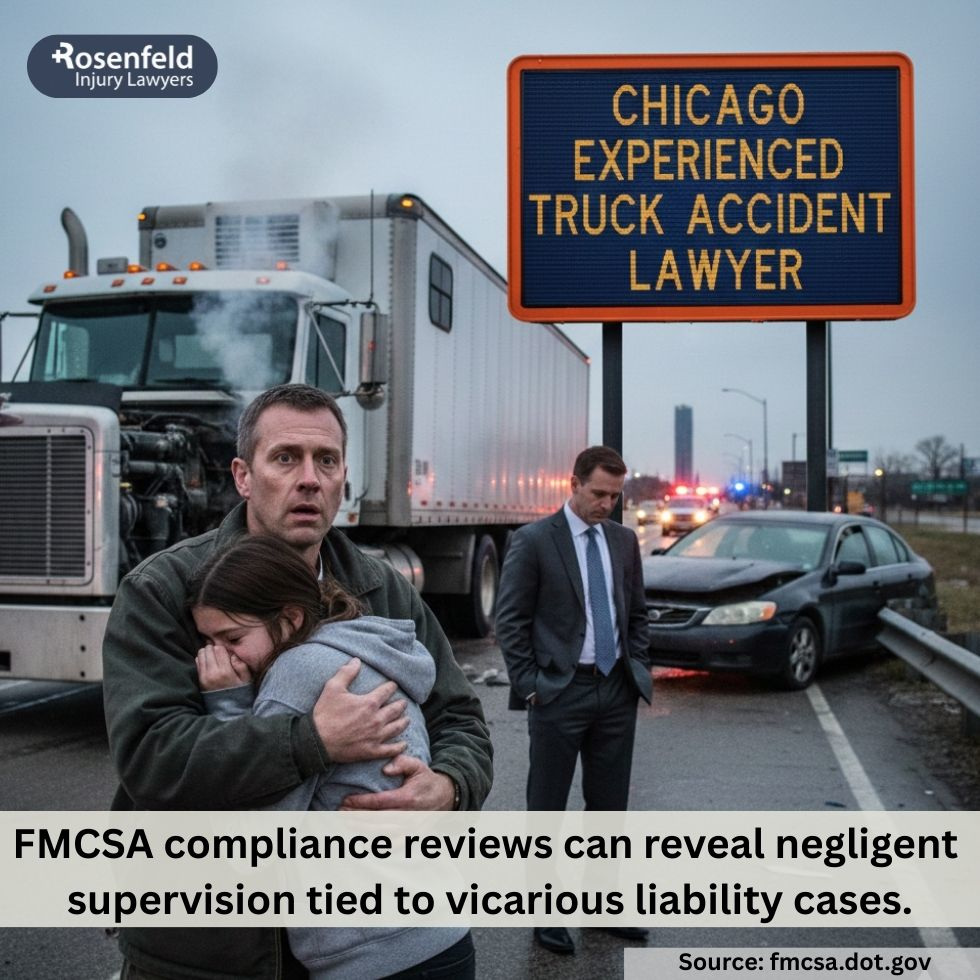
Vicarious liability is a doctrine of personal injury law that can make a trucking company liable for a negligent truck driver.
If the truck driver was acting within the scope of employment, the company can be held liable even if it was not physically present when the accident occurred. That is the core of understanding vicarious liability: responsibility follows the business when the work is being done for the business.
This is why vicarious liability can be a direct path for truck accident victims to recover compensation. The trucking industry is structured around layers of carriers, contractors, and service vendors. Vicarious liability is one of the cleanest ways to tie the crash to the entity that controlled the work.
To establish vicarious liability, we focus on two pillars: the employer-employee relationship and the scope of employment. These are the gatekeepers to whether vicarious liability applies in truck accident lawsuits.
The defense may claim the driver was an independent contractor, not an employee. We evaluate control: who assigns routes, sets schedules, requires reporting, dictates load procedures, and enforces traffic laws. Those facts are often more important than a label in a contract.
We prove the negligent driver was acting within the scope of employment at the moment the truck accident occurred. If the driver was hauling freight, heading to a pickup, returning equipment, fueling on a dispatch route, or otherwise performing job related duties, the carrier is more likely to be held accountable through vicarious liability.
Trucking companies frequently rely on independent contractors to create distance between themselves and the people operating commercial trucks. That structure is common in the trucking industry, but it does not automatically erase liability in truck accident cases. The legal landscape turns on control, not branding.
This becomes especially important when the same corporate systems that push performance also create risk. If the crash is tied to hours of service pressure or ignored safety rules, we use those facts to show the company’s operations contributed to the accident and should be considered among the liable parties.
Vicarious liability matters because it can affect what compensation is realistically available in a personal injury claim.
A trucking company often has more comprehensive insurance policies than individual drivers, and the insurance coverage may respond differently when the carrier is directly involved in the case. That can influence medical bills, medical expenses, wage loss, and other damages, particularly after catastrophic injuries.
It is also why we do not stop with one defendant. Many truck accident cases involve more than one party that may be responsible.
Beyond the trucking company and truck driver, other potentially liable parties can include a motor carrier that controlled dispatch, a maintenance provider linked to brake failure, or entities that failed to properly maintain equipment. In some cases, freight brokers can also come into focus depending on their role and control.
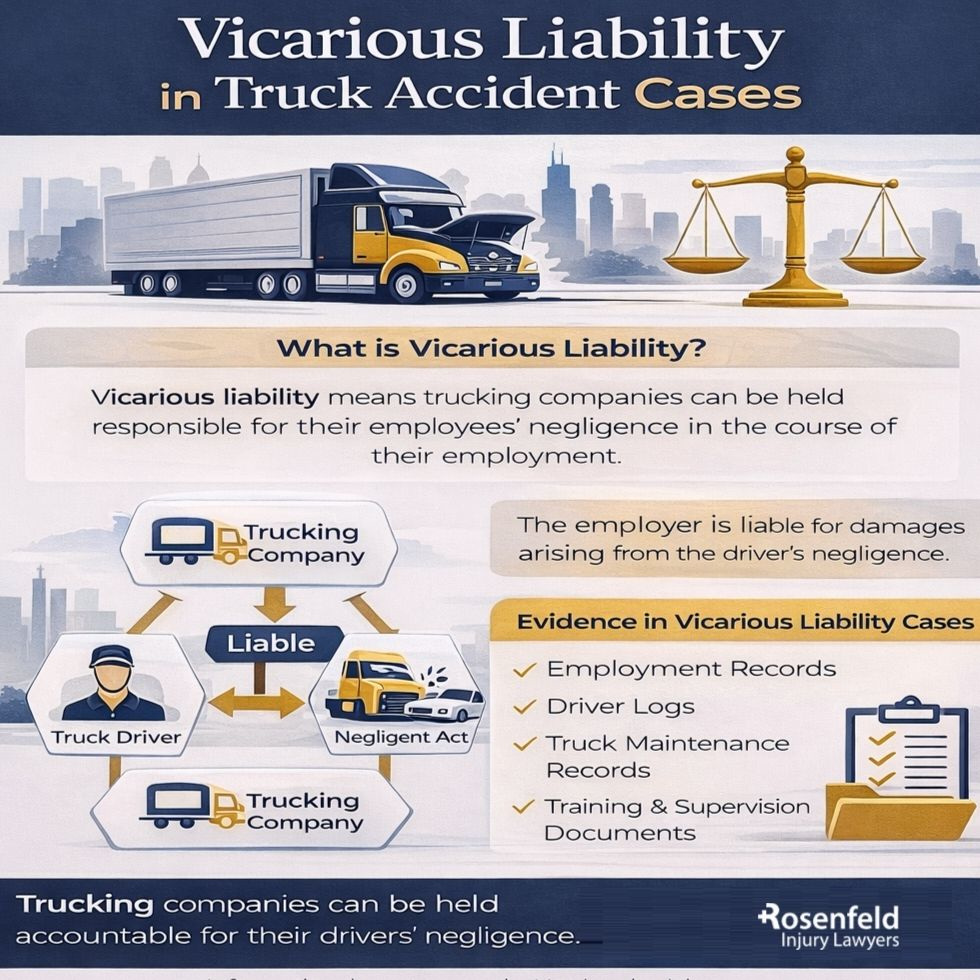
In vicarious liability cases, we secure records that show the business relationship and what work was being done. We look at dispatch and trip records, delivery windows, policy and training materials, and communications confirming the driver’s actions were tied to job duties.
We also evaluate whether company practices increased risk, including hours of service expectations, service violations, and lapses showing the company did not properly maintain key safety systems.
This evidence supports proving negligence and establishing negligence in a way that is difficult to explain away. It also helps identify responsible parties so the right entities are held accountable.
If you were injured in a truck accident, the early phase of a truck accident case often determines whether it will have leverage. An insurance company may try to narrow the story to the driver alone. Vicarious liability is one of the main ways to prevent that and pursue maximum compensation based on legal responsibility rather than convenience.
An experienced truck accident lawyer from our team can determine whether you can establish vicarious liability in your case. If you want help with your legal claim, our personal injury lawyers offer a free consultation and can explain the legal process and your options for seeking compensation.
All content undergoes thorough legal review by experienced attorneys, including Jonathan Rosenfeld. With 25 years of experience in personal injury law and over 100 years of combined legal expertise within our team, we ensure that every article is legally accurate, compliant, and reflects current legal standards.