

Chicago Personal Injury Lawyer
Award-Winning Chicago Personal Injury Lawyer - Securing Justice
for Illinois Injury Victims - Over $450 Million Recovered



Weather-related truck accidents happen in Chicago for many factors, but the pattern is consistent. The mix of winter weather, stop-and-go traffic, and fast transitions between ramps and merges creates a risk for crashes involving large trucks.
When weather conditions shift quickly, truck drivers often face reduced visibility at the same moment tire traction drops. That combination can cause a semi truck to drift, brake late, or lose control near interchanges, bridges, and industrial corridors.
Chicago winter driving adds a second problem. Shorter daylight hours make visibility worse during peak commute times, so bad weather can turn a routine trip into an accident that leaves families dealing with serious injuries. In truck accident cases tied to inclement weather, we focus on what the driver and the trucking companies did before the crash occurred, not what they say after.
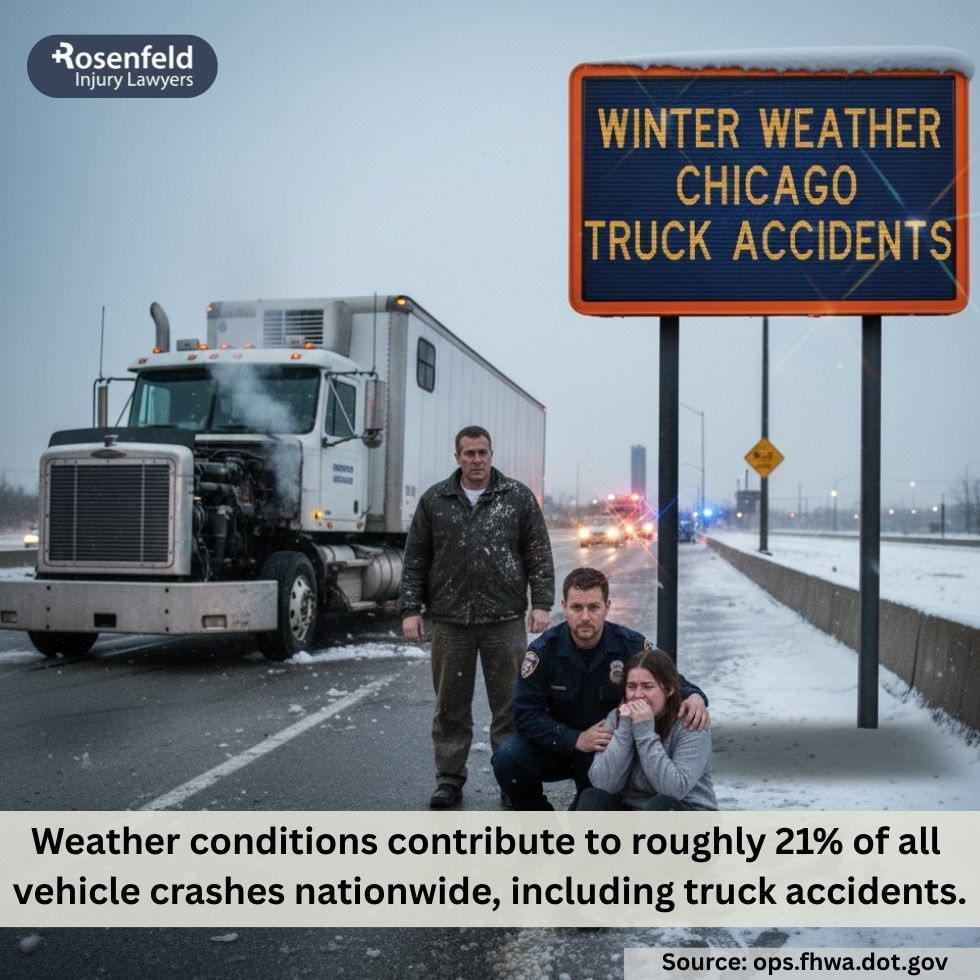
Reduced visibility changes how quickly a truck driver can identify other vehicles, react to brake lights, and stay centered in a lane. In Chicago, low visibility conditions often show up in:
Semi trucks need longer decision time than passenger vehicles because the combination of size, weight, and longer stopping distances demands earlier choices. When poor visibility meets traffic at merges and lane splits, sudden lane changes by other drivers also become more common, which increases risk for vehicles involved behind the first braking event.
Poor weather is not a single condition. A Chicago storm can shift from rain to freezing rain, then into snow and ice in one commute window. Cold temperatures also matter because they change road surface behavior. A roadway that looks damp can reduce traction in minutes if the temperature drops.
In these cases, the critical decision is whether drivers reduce speed early enough to keep the truck stable without sudden movements. That includes earlier braking, wider spacing, and avoiding aggressive lane changes. A semi truck that can maintain control at one moment may lose control seconds later if the next section of roadway has black ice or a different texture.
Snow and ice in Chicago produce repeat crash mechanics that show up in photos, event timelines, and scene reports.
The larger the trailer, the more the “push” effect shows up during braking and turning. That is why semi trucks must be driven differently in winter conditions, even when surrounding vehicles appear to be moving at normal speed.
Driver fatigue is dangerous in any setting, but it becomes a contributing factor that matters more in bad weather. Fatigue slows reaction time, worsens judgment, and increases the chance a driver will miss early cues of low traction or poor visibility.
Long hours also lead to more mistakes when the road demands constant micro-adjustments. This is why we examine schedules, routes, and the timeline of the run when truck accident cases involve winter months. If commercial truck drivers are already strained, inclement weather becomes the moment when small errors become catastrophic.
Large trucks respond to wind in a way passenger vehicles do not. The trailer’s large surface area acts like a sail. High winds can push a semi truck sideways during a lane change or while exiting a ramp. Strong winds can amplify a minor steering correction into drift, especially when the road has reduced traction.
In Chicago, wind risk is often concentrated along exposed stretches by the lakefront, bridge approaches, and open industrial corridors where buildings funnel gusts. Wind speeds do not have to be extreme to create instability. When the trailer begins to move laterally, the driver may over-correct and trigger a trailer swing, which increases risk for other vehicles on both sides.
Federal regulations (49 CFR § 392.14) require drivers to exercise extreme caution when hazardous conditions adversely affect visibility or traction, and require that speed be reduced when such conditions exist.
That legal standard matters in determining liability. If the evidence shows the driver did not use extreme caution, the weather does not excuse the crash. It becomes part of the negligence proof in weather-related truck crashes.
Bad weather conditions expose problems that a fleet can sometimes hide in dry conditions. Mechanical issues that matter most in winter weather include:
When a trucking company sends equipment that is not prepared for winter conditions, that decision can be a key liability point. This is especially true when the crash involves loss of stability or a delayed stop that would have been avoidable with safer equipment.
Determining liability in these accidents focuses on decisions and documentation. We look for proof that the drivers and the company adjusted to the weather, or failed to do so. Evidence often includes:
Considering the conduct of other drivers can further clarify how the crash occurred and whether the truck was driven safely in the conditions.
Recovering damages in truck accident cases requires building a liability theory that fits the weather and the operational choices. A claim can include medical care, wage loss, and ongoing treatment costs tied to injuries. It can also include vehicle damage and other losses tied to accidents that leave families rebuilding their lives.
Some crashes result in fatal crashes, especially when a semi truck crosses lanes or strikes a smaller vehicle at speed. In those cases, the damages can involve long-term household loss, funeral costs, and the impact on surviving family members.
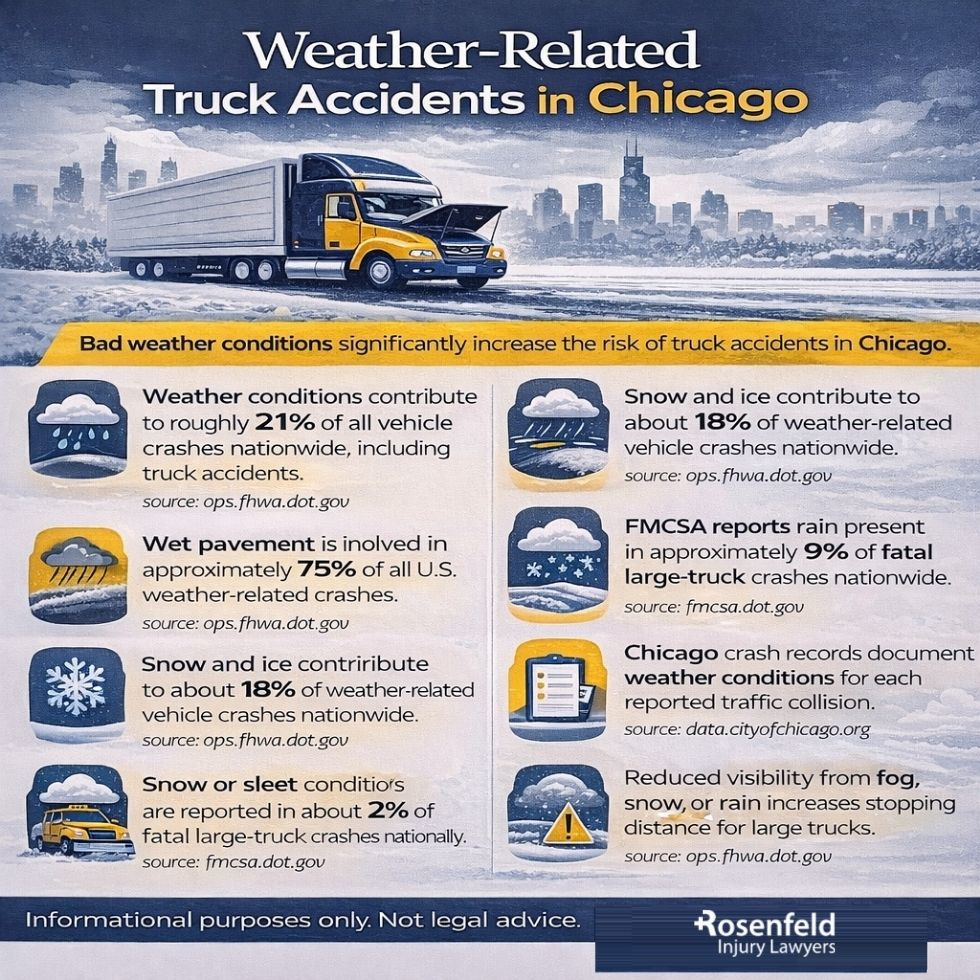
If you were hit in bad weather, focus on steps that preserve proof:
Weather-related truck crashes are not “unavoidable” by default. The core issue is whether the truck drivers and the trucking companies chose actions that were safe for the conditions. If you want us to review what happened and explain your options, our personal injury lawyers offer a free consultation.
All content undergoes thorough legal review by experienced attorneys, including Jonathan Rosenfeld. With 25 years of experience in personal injury law and over 100 years of combined legal expertise within our team, we ensure that every article is legally accurate, compliant, and reflects current legal standards.