
Chicago Personal Injury Lawyer
Award-Winning Chicago Personal Injury Lawyer - Securing Justice
for Illinois Injury Victims - Over $450 Million Recovered



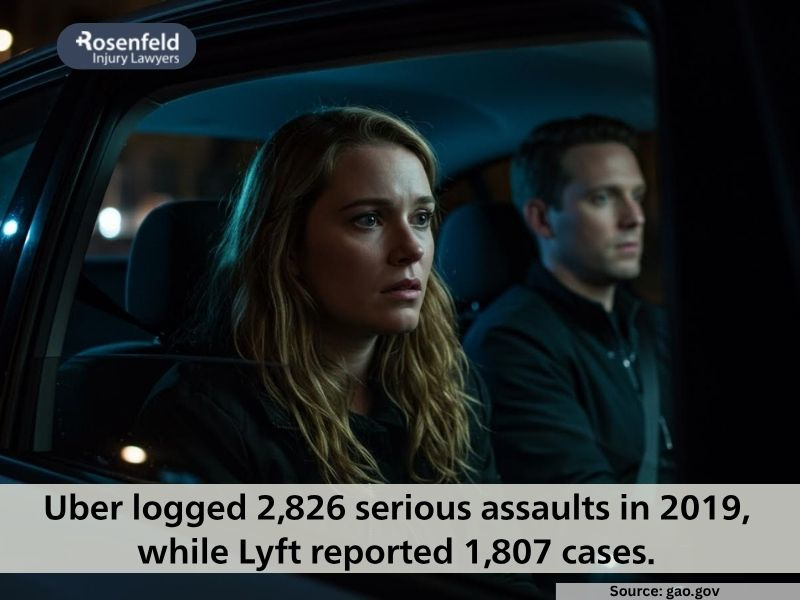
Rideshare sexual assault lawsuits are giving Lyft and Uber sexual assault survivors a powerful way to hold negligent companies accountable, and Rosenfeld Injury Lawyers is here to help every step of the way. Our law firm represents individuals who have been sexually assaulted while using services like Uber or Lyft, fighting to secure justice and compensation for the harm they’ve suffered.
Too often, rideshare companies failed to implement basic safety measures to protect passengers, leaving riders vulnerable to devastating assaults. If you or a loved one has suffered sexual assault or sexual abuse, our experienced sexual assault attorneys can guide you through the legal action needed to pursue accountability and recovery.
Across the country, survivors have taken legal action against Uber Technologies Inc. and other rideshare companies for failing to protect passengers. These Lyft and Uber sexual assault lawsuits have revealed repeated patterns of negligence, including weak background checks and ignored sexual assault reports.
For example, a New York Times investigation of confidential internal documents revealed that Uber received over 400,000 reports of sexual assault or sexual misconduct in the U.S. from 2017 to 2022, a figure much higher than what the company has publicly reported.
One of the most widely recognized cases is the Uber sexual assault lawsuit consolidated into a multidistrict litigation (MDL) in California federal court. Hundreds of women who were sexually assaulted by Uber drivers joined the Uber sexual assault litigation, alleging that the company failed to implement adequate safety measures and ignored serious warnings about predator drivers.
Another high-profile Uber sexual assault case involved multiple sexual assault incidents reported by Uber passengers in Chicago, New York, and Los Angeles. These Uber sexual assault lawsuits claimed Uber was responsible for sexual assault by highlighting how passenger sexual complaints were disregarded, allowing dangerous Lyft/Uber drivers to remain on the road.
Uber has added safety features like RideCheck and an emergency button in the Uber app due to legal and public pressure, but these basic safety measures alone may not be enough to fully address passenger safety concerns.
Recent safety reports from Uber and Lyft reveal alarming sexual assault statistics involving the Lyft and Uber platforms.
Uber’s most recent safety report disclosed 3,824 reports of sexual assault in 2019–2020, including 141 rapes in 2020 alone. The vast majority of survivors were women riders, though some sexual assault cases involved riders assaulting Lyft/Uber drivers.
Lyft’s first-ever safety transparency report showed 4,158 reports of rideshare sexual assault from 2017–2019, including 360 rapes and 10 deaths from physical assaults.
January 17 – California Bellwether Trial Begins
The first bellwether trial in the coordinated California Uber sexual assault litigation officially got underway in San Francisco. This case is seen as a critical test for hundreds of similar sexual assault claims. Plaintiffs argue Uber knowingly placed growth and revenue ahead of rider safety, despite mounting reports of sexual misconduct over several years.
At trial, plaintiffs are focusing heavily on internal company data they say shows sexual violence reports were far higher than Uber publicly acknowledged. They contend Uber declined stronger safety measures, such as fingerprinting drivers or requiring in-car cameras, because those steps might have slowed expansion.
The verdict is expected to influence how more than 500 remaining California cases move forward, as well as parallel federal litigation. Plaintiffs are optimistic following several pretrial rulings and believe the evidence of Uber’s conduct is substantial.
January 6 – Judge Denies Uber’s Attempt to Delay Trial
Judge denies Uber’s request to delay the trial because of the advertising campaign.
January 5 – Uber MDL Tops 3,000 Uber Sexual Assault Lawsuits
As of early January 2026, the Uber driver sexual abuse/assault MDL has 3,191 total cases that have been filed, with 3,078 active cases.
The MDL is one of the largest pending in the country at the moment, with continued growth in the number of sexual assault cases added. Uber is preparing to face the first bellwether trial after a judge denied the company’s attempt to delay proceedings or block plaintiff-side advertising.
That case, brought by an Arizona woman alleging rape by her Uber driver, is scheduled to begin January 13, 2026. The judge declined to explain the denial, but the ruling clears the way for the trial to proceed as planned.
Although Uber previously avoided liability in a state bellwether, this federal trial is widely viewed as a turning point that could significantly affect Uber’s sexual assault settlement posture across the MDL.
December 19 – Lyft Cases May Soon Be Consolidated Into MDL
Lyft cases may soon be consolidated into a federal MDL. A hearing was set for January 29 to evaluate whether federal coordination is appropriate. Lyft cases are already coordinated in the California state court.
December 5 – JCCP Appeal Notice and MDL Trial Delay Request
The first bellwether plaintiff in California’s Judicial Council Coordination Proceedings (JCCP) for Uber sexual assault cases has informed the court of plans to appeal the October verdict, in which Uber was found not liable. The plaintiff initially sought a new trial in the same court, but did not pursue that motion and will instead appeal to a higher California court.
At the federal level, Uber moved to delay the first MDL bellwether trial, scheduled for January 13, 2026, arguing that a plaintiff-side advertising campaign should be halted before the case proceeds.
Uber argues that the campaign (referencing reporting that Uber sexual misconduct incidents were reported every eight minutes between 2017 and 2022) is misleading and seeks to restrict its distribution in states where bellwether trials will be held. Uber also requested authority to subpoena the law firm behind the campaign.
December 2 – More Uber MDL Cases Added, and California Lyft Cases Remained Around 100
Almost 200 new Uber sexual assault lawsuits were added to the Uber sexual assault MDL in November, and as of December 2025, the federal MDL has 2,949 active cases. Lyft’s California state court coordination still has 100+ active cases.
November 18 – Uber Bellwether Schedule Change
The first bellwether trial in the Uber sexual assault MDL is now set for January 13, 2026, about a week later than previously planned.
November 3 – Uber MDL Continues to Grow
The federal Uber MDL continued growing, reaching 2,783 active Uber sexual assault lawsuits, an increase of more than 60 cases over the prior month.
October 29 – Another Uber Bellwether Trial Scheduled
Another Uber bellwether trial in California state court was slated for May 2026, while the first federal bellwether trial continued moving toward a jury trial in the near future. Both were described as likely global settlement drivers.
At a case management conference, the parties filed a joint case management statement ahead of a scheduled court conference. In that filing, they reported that Uber was defending 2,804 sexual assault cases in federal court, in addition to approximately 750 related cases pending in California state court.
October 22 – Deadline Disputes Over First Uber Bellwether
Uber’s legal team and the plaintiff’s legal teams disputed deadline extensions that could affect the first federal bellwether’s timing, particularly around rebuttal expert reports and whether extensions could fit without disrupting the broader trial calendar.
October 6 – Motion Filed to Establish Lyft MDL
A motion was filed to establish a Lyft MDL, proposing placement before the judge already overseeing Uber’s federal litigation.
October 1, 2025 – Negligence Found, But No Liability, Jury Questions Focus on Causation
The jury concluded that Uber acted negligently in connection with a 2016 sexual assault involving an 18-year-old rider. However, the jury in the San Francisco Superior Court also found that Uber’s negligence was not a substantial cause of the injury, which ultimately shielded the company from damages.
While the verdict was disappointing for the plaintiff, it established an important point for the broader passenger sexual assault litigation: jurors were willing to find Uber Technologies Inc. negligent, even if causation proved to be a hurdle in that specific case.
During deliberations in the California trial, jurors asked the court for clarification on what qualifies as a “substantial factor” in causing harm. The judge explained that the plaintiff had to show that the emotional distress and physical injuries would not have occurred without Uber Technologies Inc.’s conduct.
The question revealed jurors were less concerned with whether Uber was negligent and more uncertain about whether that negligence directly caused the plaintiff’s harm. Observers believe this issue may be less problematic in cases involving clearer connections between Uber’s conduct and severe trauma.
September 29 – MDL Discovery Disputes Continue
The federal MDL court held a discovery hearing addressing ongoing disagreements over document production, deposition logistics, access to sensitive mental health records, and the handling of protected materials from related cases.
Despite these procedural disputes, attention remained on the California jury, which had not yet reached a verdict at that time.
September 26 – California Jury Begins Deliberations
After the closing arguments, the jury received the case. Plaintiffs urged jurors to award $21.8 million in damages, arguing Uber knowingly rejected safety measures like dashcams and stronger driver oversight.
Deliberations were scheduled to begin the following Monday, with all eyes on what would become the first verdict in coordinated proceedings.
September 25 – Congressional Inquiry Launched
A House oversight subcommittee opened an investigation into Uber’s handling of sexual assault reports, prompted by reporting that incidents occur far more frequently than the company has disclosed.
Representative Nancy Mace sent a letter to Uber’s CEO demanding answers about how the company tracks, responds to, and reports sexual misconduct, emphasizing that the issue represents an ongoing safety threat to riders.
September 24 – Dispute Over Alleged Document Leak
Uber asked the California court to address what it claims was a leak of sealed discovery materials to The New York Times. The company sought certifications from plaintiffs’ counsel that they were not involved.
While acknowledging that violations of protective orders should carry consequences, critics argue that overly broad confidentiality rules in mass tort cases often prevent the public from learning about systemic safety failures with real public importance.
September 21 – Evidence Highlights Safety Tradeoffs
As the California trial unfolded, jurors heard testimony and reviewed internal documents showing Uber’s long-standing awareness of rideshare sexual assault risks. Evidence included data on misconduct reports, delayed safety features, and executive decisions that Uber prioritized rapid growth over the safety of passengers. This is alleged to have led to system failures in protecting passengers from being sexually assaulted.
Plaintiffs emphasized that Uber resisted feasible protections, such as dashcams and gender-based matching, due to concerns about cost, regulation, and public perception. Uber countered by arguing assaults were statistically rare and pointing to existing safety tools.
September 16 – Uber Sexual Assault Trial Begins
A California state Uber sexual assault trial began, treated as a major early test case for the litigation.
September 16 – Federal Bellwether Transfers Ordered
The Uber MDL judge ordered two bellwether cases transferred to the Western District of North Carolina while keeping them under his supervision. The move allows jury trials to proceed in that district while preserving centralized control.
The first federal bellwether remained scheduled for early January 2026. Although bellwether verdicts are not binding on other plaintiffs, they are expected to heavily influence global settlement negotiations in the Uber sexual assault MDL for the entire litigation.
September 2 – Uber MDL Court Signals Continued Momentum
In a late-summer Uber MDL hearing, the judge signaled skepticism toward Uber’s attempts to limit discovery and appeared open to ordering production of additional internal datasets. The court emphasized cooperation as the litigation moved closer to trial and potential resolution.
The first wave of bellwether trials in the Uber passenger sexual assault MDL is scheduled to begin on December 8, 2025, with both sides agreeing to start with Dean v. Uber. The case involves an Arizona plaintiff. The plaintiff alleges she was raped by an Uber driver even though the company had previously received multiple complaints about him, including allegations of sexual misconduct. She claims Uber failed to warn her or remove the driver before the assault.
The second Wave 1 bellwether will be a North Carolina case brought by a plaintiff identified as WHB 823, selected by the defense and trial-ready due to completed fact discovery. Additional Wave 1 trial sequencing is still under consideration, with Charles Breyer expected to issue further guidance.
The Uber MDL court ordered bellwether trials to proceed in five waves, intending to test a broad range of theories and safety-feature disputes.
The Uber MDL experienced a sharp increase in filings: 1,263 pending cases at the start of September, compared with 387 one month earlier.
In October 2023, Uber sexual assault cases were consolidated into an MDL in The Northern District of California before Judge Charles Breyer in the Northern District of California. The MDL is meant to streamline aspects of the legal process for similar individual cases that have been filed against Uber Technologies, Inc.
In San Francisco County Superior Court, 550 plaintiffs filed Uber sexual assault/harassment cases, with law firms reportedly reviewing additional potential matters.
Lyft riders and drivers filed 17 new lawsuits alleging failures to ensure safety and/or inadequate follow-up after reports.
Lyft reached a $25 million shareholder settlement tied to allegations about disclosure of safety concerns prior to going public.
Uber and the California Public Utilities Commission reached a $9 million settlement regarding alleged failures to provide information about safety violations.
Seven additional women joined an Uber assault lawsuit that had begun earlier.
Two women filed an Uber class action lawsuit alleging Uber’s driver screening and related practices created unsafe conditions that enabled sexual violence.
Uber settled with two anonymous women alleging sexual assault by drivers, avoiding trial.
Two women filed a federal complaint in San Francisco alleging Uber failed to provide safe rides and that both were sexually assaulted while using the service.
Common damages in a Lyft or Uber lawsuit include:
To get the most compensation possible, survivors are encouraged to get medical attention, report the incident to the police, and save any digital evidence, such as Lyft/Uber ride receipts and GPS data, as soon as possible after the event.
By pursuing a Lyft or Uber lawsuit, survivors can seek justice while also pushing rideshare companies to adopt stronger safety protocols to protect passengers from preventable harm. We are committed to guiding victims of sexual assault litigation and fighting for the maximum recovery possible.
Rideshare sexual misconduct can take many different forms, all of which can leave survivors with lasting physical and emotional trauma. According to company safety reports and court filings, survivors of rideshare sexual assault have reported a wide range of sexual misconduct by rideshare drivers, including:
It is important to recognize that survivors may be eligible to pursue legal action, whether they were physically assaulted, sexually harassed, or coerced during a ride. These incidents are not isolated, as many Lyft and Uber lawsuits have shown that rideshare companies ignored warning signs and failed to enforce safety practices that could have prevented sexual assault and abuse from occurring.

The Uber sexual assault MDL is a major mass tort, one of the largest in recent years, with thousands of sexual assault claims filed, making it one of the largest currently active MDLs. Uber’s sexual assault lawsuits claim the company should be held liable for sexual assaults committed by its drivers because it failed to properly screen them and did not put adequate safety measures in place.
Many sexual assault cases against Lyft and Uber are resolved through pre-litigation settlements or before a case moves to trial. That means a lot of settlement values are private, with limited details shared publicly.
Still, our experienced legal team uses its extensive work with rideshare claims to project a range of possible settlements based on patterns we see and the facts presented in similar cases.
Settlement values for Lyft/Uber sexual assault lawsuits often fall into tiers based on the nature of the assault and the severity of the harm:
It is important to recognize that every situation is unique – actual Lyft/Uber sexual assault settlement values may be higher or lower depending on the details of your case, the severity of the assault and harm you suffered, and the strength of the evidence you have that links Uber’s negligence to the assault. The figures listed here are not guaranteed outcomes for any individual claim.
When a Lyft or Uber driver sexually assaults someone, survivors may be eligible to pursue justice for such incidents, but strict legal deadlines apply. These deadlines, known as sexual abuse statutes of limitations, vary from state to state, and missing them can prevent survivors from seeking compensation through the courts.
In California, survivors generally have 10 years to bring a civil claim for rideshare sexual assault, and many are active participants in the current MDL against Uber. Many Illinois survivors have filed cases within the state’s extended deadlines, which allow several years depending on the circumstances.
Survivors in New York can take advantage of special “lookback windows,” which have temporarily reopened expired sexual assault claims, allowing more victims to file an Uber sexual assault lawsuit. States like Texas have shorter timelines, often ranging from 2–4 years, making it critical for survivors to act quickly and consult a law firm experienced in rideshare sexual assault litigation.
Because statutes of limitations differ and are influenced by factors like age, discovery of injuries, and ongoing investigations, speaking with a Lyft or Uber sexual assault lawyer right away is essential. Rosenfeld Injury Lawyers helps survivors understand their rights, navigate these complex deadlines, and take swift legal action to hold Uber accountable.
Pursuing Lyft/Uber sexual assault lawsuits against powerful rideshare companies like Uber or Lyft after a Lyft or Uber driver sexually assaults someone is never simple.
Survivors often face unique challenges, including proving liability when companies argue that drivers are “independent contractors,” uncovering ignored reports of assault, and showing how failed background checks contributed to the attack. These cases also involve deeply personal testimony, requiring both compassion and skill from the legal team representing survivors.
That’s where Rosenfeld Injury Lawyers comes in. We understand the sensitivity of working with assault survivors while building the strongest case possible.
We investigate company records, expose how passenger complaints were handled, and demonstrate when the company failed to adopt safety protocols to protect riders. In some cases, we file Lyft/Uber sexual assault lawsuits individually, and in others, we may join a class action Lyft or Uber lawsuit or join existing multidistrict litigation (MDL) to amplify survivors’ voices.
With decades of experience, our attorneys know how to maximize compensation for survivors who were sexually assaulted by rideshare drivers and hold companies accountable. When you choose our Lyft/Uber sexual assault law firm, you’re partnering with a team that will fight tirelessly for justice, recovery, and meaningful change in the rideshare industry.
At Rosenfeld Injury Lawyers, we have secured significant results for victims of sexual assault. Some of our cases include:
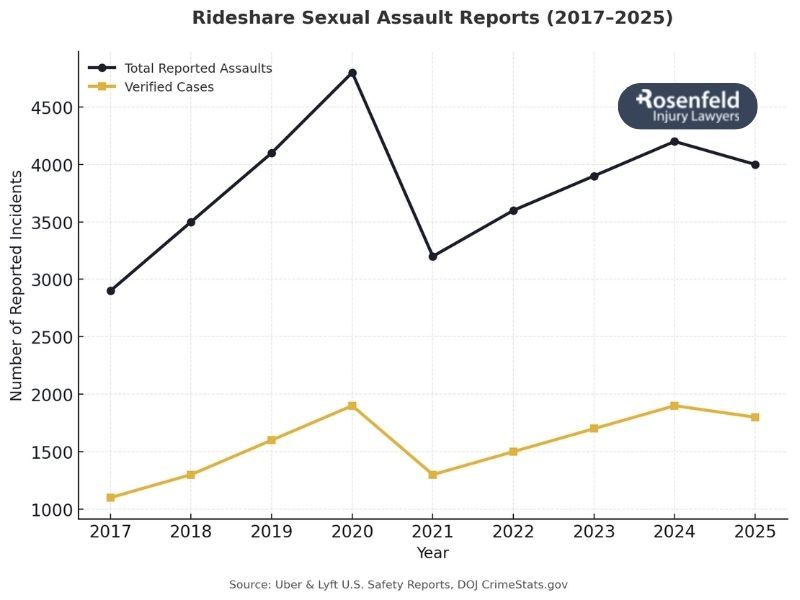
Over 2,500 sexual assault victims from more than 29 states have joined the MDL against Uber as of August, 2025.
Yes. Survivors may be eligible to file a civil Uber sexual assault lawsuit even if the driver was never arrested or prosecuted. Civil rideshare lawsuits are separate from criminal charges (which could potentially lead to incarceration and sex offender registration for the driver).
Instead, the civil Lyft and Uber assault lawsuits focus on whether the rideshare company failed to apply adequate background checks or ignored reports of assault, and could lead to compensation being recovered for the victim. Our law firm builds these cases on company negligence, not just criminal outcomes, to help survivors pursue justice.
In many cases, survivors can proceed under initials or pseudonyms to protect privacy. Courts recognize the sensitive nature of passenger sexual assault litigation, and our attorneys work to ensure your identity is safeguarded.
Victims who suffer sexual assault or abuse often face long-term psychological trauma, anxiety, PTSD, and loss of trust in everyday activities. Many also struggle with lost wages, career setbacks, and ongoing therapy needs. That’s why our law firm fights aggressively for damages covering emotional harm, lost income, medical treatment, and counseling
At Rosenfeld Injury Lawyers, we represent victims of sexual assault on a contingency fee basis. This means there are no upfront costs, and you only pay if we win your case by obtaining a Lyft/Uber sexual assault settlement or verdict. We also provide a completely free and confidential consultation.
If you or a loved one has experienced sexual assault in a rideshare vehicle, you may be eligible to file an Uber sexual assault lawsuit. Our experienced Lyft and Uber sexual assault lawyers have the knowledge, resources, and determination to challenge major rideshare companies and win.
Whether your case involves individual claims or participation in a Lyft/Uber class action lawsuit, we are committed to protecting your rights, exposing when companies failed to establish safety measures to protect passengers, and proving that sexual assault occurred as a result of their negligence. Our goal is to secure justice for sexual assault survivors.
Contact our personal injury lawyers for a free and confidential consultation today.
All content undergoes thorough legal review by experienced attorneys, including Jonathan Rosenfeld. With 25 years of experience in personal injury law and over 100 years of combined legal expertise within our team, we ensure that every article is legally accurate, compliant, and reflects current legal standards.