
Chicago Personal Injury Lawyer
Award-Winning Chicago Personal Injury Lawyer - Securing Justice
for Illinois Injury Victims - Over $450 Million Recovered



The popular herbicide paraquat is an extremely toxic chemical known to cause severe injuries. While it is an effective way to kill weeds, for years, some farmers allege a link between paraquat and Parkinson’s Disease. Some Parkinson’s research now confirms this. Paraquat exposure increases your risk of developing Parkinson’s Disease by 150% [1].
If you or a loved one received a Parkinson’s diagnosis after exposure to paraquat herbicide, you have the right to file a civil lawsuit in state or federal court. The team at Rosenfeld Injury Lawyers has experience filing injury lawsuits that involve a dangerous chemical, such as industrial herbicides.
Read on to learn more about the current paraquat lawsuits, the statute of limitations, and what you can expect in terms of a settlement if you develop Parkinson’s Disease as a result of paraquat exposure.
For years, paraquat has been a popular herbicide used in commercial lawns and different agricultural applications. Unfortunately, research shows that many people exposed to the highly toxic herbicide paraquat later developed Parkinson’s disease.
In particular, people who have repeated exposure, such as agricultural workers, have an increased risk of developing Parkinson’s disease from it.
In the current lawsuits, agricultural workers claim the manufacturers of paraquat products failed to warn users about the possibility of being diagnosed with Parkinson’s Disease as a result of paraquat exposure. If you have been injured by paraquat, you could be entitled to recover compensation through a new paraquat lawsuit.
As of May 2024, there are over 5,590 pending and 6,509 lawsuits filed in Illinois federal court [2]. The number of cases where people have been diagnosed with Parkinson’s Disease from exposure to the toxic chemical paraquat continues to grow. At the time of this writing, no settlements have been awarded by a judge or jury from paraquat exposure.
At the time of this writing, there is a federal multidistrict litigation (MDL) against the maker and distributor of Gramoxone from people who helped manufacture or who applied it and subsequently developed Parkinson’s Disease as a result of paraquat exposure [3]. As of December 2022, there were 2,352 plaintiffs in the MDL for those harmed by paraquat exposure [4].
An MDL is similar to a class action lawsuit except for a few distinct differences, such as:
A bellwether test trial is important to assess the validity of future cases. It is a small group of cases taken from a larger group of similar cases to be tried together. The first bellwether test trial was scheduled for 2022 [5].
However, this bellwether trial was pushed back to later in 2024 for the court to have time to consider the admissibility of evidence and list of expert witnesses. Some other notable updates for the MDL case include:
The amount of time that you have to file a lawsuit is called the statute of limitations. This varies by state.
Generally, the amount of time that you have to file a lawsuit is typically only a few years and starts on the date of the injury. However, developing Parkinson’s Disease doesn’t happen instantly and occurs over the course of many years or decades after direct exposure to paraquat.
If you have a history of working with paraquat through work and received a Parkinson’s Disease diagnosis, it is a good idea to reach out to a paraquat lawsuit attorney as soon as possible to see if you can get involved in the MDL or what other legal options might be available to you.
In many instances, these cases use the discovery rule when it comes to the statute of limitations. Parkinson’s Disease takes years to develop. You won’t know right after paraquat exposure that you’re going to develop it.
Instead, some cases are being tried under the legal principle of discovery so that the statute of limitations will begin when you were diagnosed with Parkinson’s Disease or would have reasonably known you have Parkinson’s Disease related to your paraquat exposure.
The current paraquat lawsuits are being tried in a few different states and jurisdictions. During your free consultation, your attorney can give you guidance on how the statute of limitations applies in your case. The sooner you contact a lawyer, the better, as there will be some sort of time limit in place that could affect your case.
The highly toxic paraquat was never approved for residential use. To file a paraquat lawsuit, you generally must be exposed to paraquat through its commercial applications. This means most of the plaintiffs eligible to file a paraquat lawsuit are:
If you developed Parkinson’s Disease or suffered from other injuries as a result of being exposed to paraquat, it is important to take legal action today while it is still possible to do so. To file a paraquat lawsuit:

The paraquat lawyers at Rosenfeld Injury Lawyers can help:
The attorneys at Rosenfeld Injury Lawyers work on a contingency fee basis. This means you won’t pay anything upfront or out of pocket for our help with your paraquat case. Instead, we receive a small percentage of the compensation we help you recover as a settlement or award.
If we are unable to recover compensation for you, you do not have to pay anything for our services.
The types of damages you can recover in a paraquat lawsuit include economic damages and non-economic damages.
Economic damages that can be potentially recovered in a paraquat lawsuit include:
Non-economic damages do not relate to tangible losses. However, this type of damage can be added to your case. Common non-economic damages include:
If your loved one died as a result of paraquat exposure, our Chicago wrongful death attorneys can help you recover compensation for:
The value of settlements is based on the specific factors in each case, including:
So far, none of the plaintiffs that are a part of the MDL have received paraquat lawsuit settlements. It is too early in the bellwether trials process to know what the settlements will look like. However, it is possible to look at similar cases to make an educated guess as to how much a settlement might be worth.
In the settlement based on harm from Roundup’s active ingredient glyphosate, Bayer paid an average of $160,000 in 2020 to plaintiffs, though some plaintiffs received more [8].
While the two cases are similar in that they involve injuries due to the use of herbicides, the Roundup cases involved cancer, not Parkinson’s Disease. Whether this has a significant impact on the case settlements is yet to be seen.
According to its 2022 annual report, Syngenta and another defendant have already paid $187.5 million in paraquat settlements [9]. However, this case was not a part of the MDL case.
When it comes to injury lawsuits, there are no standardized settlement amounts. Each settlement will vary based on the case itself. There are some factors impacting how much paraquat cases are worth.
The most important factor is the severity of your symptoms. A paraquat case only involving mild motor symptoms will likely not recover as much as a case that’s progressed to needing full-time care in a nursing facility.
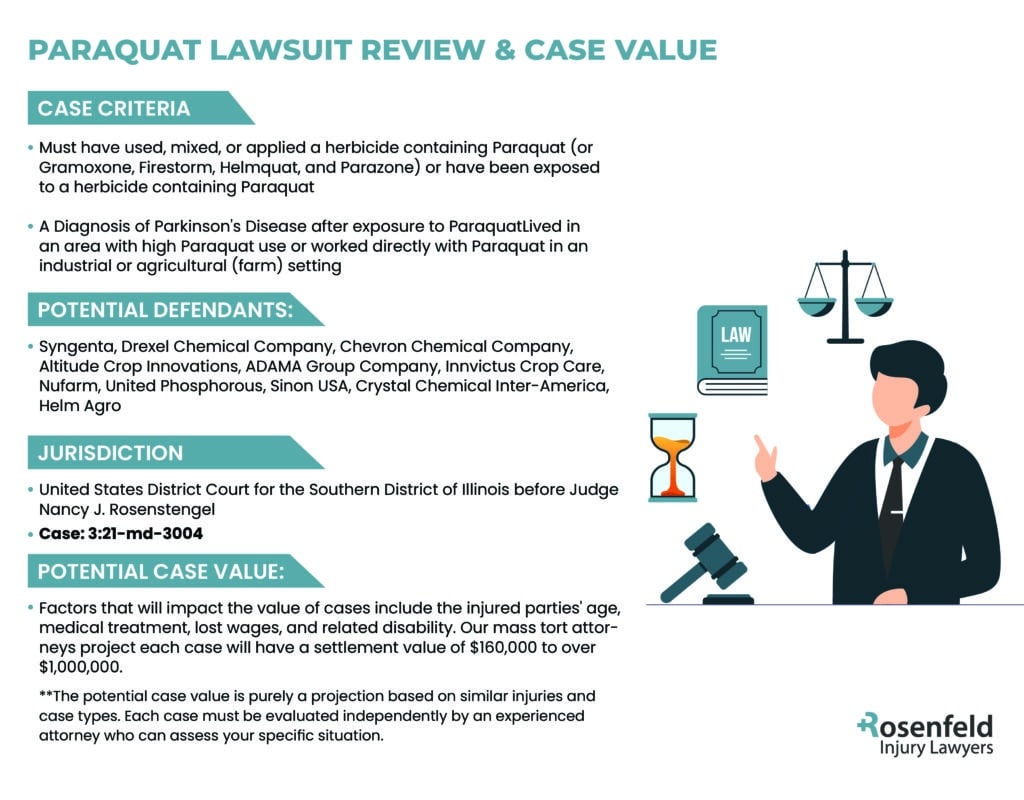
Our attorneys project individual Paraquat settlements to be $180,000 to $1,000,000 based on the severity of the injury, age, and occupation of the individual.
Your paraquat lawyer will work diligently to ensure your future medical expenses and lost wages are also factored into your settlement. Even if you only face mild to moderate motor symptoms now, Parkinson’s Disease is progressive. Your lawyer will advocate for your future needs, too.
The plaintiffs in multiple lawsuits against the manufacturer and distributor of Gramaxone and other brands of paraquat products claim paraquat dichloride caused them to develop Parkinson’s Disease, even when it was used as directed. These plaintiffs claim the company did not warn them about these risks.
Paraquat is the popular name for paraquat dichloride, one of the most popular herbicides used in the United States [10]. One of the most common end products using paraquat is Gramoxone. However, it is also listed as an ingredient in Blanco, Devour, Paraquat Concentrate, Firestorm, Para-Shot 3.0, Bonedry, and Ortho-Paraquat.
It is only approved for commercial use by trained, certified applicators, as one sip of paraquat can be fatal. One to two deaths occur each year as a result of paraquat poisoning by accidental ingestion. There is no known antidote for paraquat poisoning. Inhaling paraquat is known to cause lung damage from paraquat poisoning [11].
To reduce the rate of paraquat poisoning, the EPA requires manufacturers to add certain additives to paraquat products. These include blue dye, a strong fragrance, and an additive to induce vomiting. Like with other toxic chemicals, these measures are meant to dissuade people from accidentally ingesting paraquat.
However, the Centers for Disease Control and Prevention acknowledges that paraquat purchased from outside the U.S. may not have these safeguards in place [12].

Parkinson’s Disease has been positively associated with the use of paraquat [13]. Researchers believe Parkinson’s Disease is caused by the death of the neurons responsible for making the neurotransmitter dopamine. Paraquat exposure causes oxidative stress that kills these neurons [14].
Research continues to mount to support the link between being exposed to paraquat and Parkinson’s Disease. Some notable pieces of research to include:
Some of the defendants in the paraquat lawsuit are:
However, it is possible, outside of the MDL, to file a paraquat lawsuit against other parties. For instance, if your employer had you apply paraquat during the course of employment, it may be possible to file a claim against them.

Paraquat is banned in 58 countries [19]. At the time of this writing, the Environmental Protection Agency has not banned the sale of paraquat in the United States. As of July 2021, the Environmental Protection Agency is now requiring mitigation measures to reduce the dangers of paraquat as a part of its registration review and proposed interim mitigation decision [20].
However, in February 2024, the EPA reaffirmed its approval of paraquat and it is still available.
The specific products named in paraquat lawsuits include:

If you have been diagnosed with Parkinson’s Disease after exposure to paraquat herbicides, you could be entitled to compensation. At Rosenfeld Injury Lawyers, we have helped many victims in other mass tort cases. We have recovered millions in settlements for our clients. A member of our team is available 24/7 to help you get started with your free consultation. We work on a contingency fee basis, so you don’t need to pay anything upfront for our help.
Contact our Paraquat lawyers for a free case review by filling out our contact form or calling toll-free at (888) 424-5757.
Specific Cases We Handle
Resources: [1] New York Times, [2] Southern District of Illinois, [3] Southern District of Illinois, [4] Forbes, [5] Forbes, [6] ABC News, [7] U.S. Courts, [8] Forbes, [9] Syngenta, [10] EPA, [11] CDC, [12] CDC, [13] National Library of Medicine, [14] NCBI, [15] Michael J. Fox Foundation for Parkinson’s Research, [16] American Journal of Epidemiology, [17] National Institute of Health, [18] Cell Death & Differentiation, [19] Center for Biological Diversity, [20] EPA
All content undergoes thorough legal review by experienced attorneys, including Jonathan Rosenfeld. With 25 years of experience in personal injury law and over 100 years of combined legal expertise within our team, we ensure that every article is legally accurate, compliant, and reflects current legal standards.